
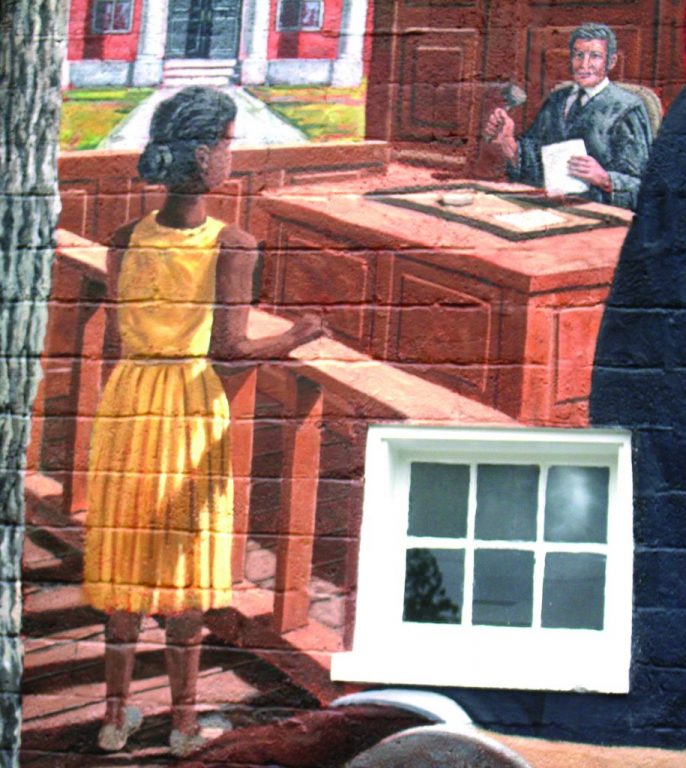
Who is the girl in the yellow dress facing a judge depicted on the T.C. Walker mural on Gloucester’s Main Street?
Retired Gloucester County school teacher Roberta Ray was determined to find out, after learning that mural artist Michael Rosato painted it from a real-life description given by Walker in the manuscript, “Lawyer Walker of Gloucester.”
She believes that girl was named Mary Manly.
Walker wrote that he was inspired to study law when, as a young man, he happened to walk into Gloucester courthouse while a trial was underway. What he saw, he said, filled him with “a bitter sense of injustice” after the trial and conviction of “A Negro girl, not more than fourteen years old [who] was being tried for housebreaking and larceny of a few dollars by a white family where she works as cook and housemaid. You know how that is.”
In the manuscript, Walker continued, “The story the white employer told was that one Sunday the family went to church leaving her locked out until their return. When they got back they found her inside the house and claimed she had not only eaten food but had taken money too.
“The little girl, with no one to defend her, told the Court it was because she got so cold outdoors that she climbed back into the house through a window and had eaten some food because she was hungry. She denied absolutely that she had taken any money and no evidence was offered to prove that she had,” Walker continued.
“Her case went to the Jury which pronounced her guilty and she was sentenced to two years in a penitentiary where criminals of all sorts and ages were to be her companions.”
Walker said his sense of injustice stemmed from his feeling that “the girl had done nothing really bad and that any kind of a lawyer with a heart in him could have cleared her and kept her from being branded as a criminal, and compelled to associate with criminals.”
While Walker stated, from a distance of many years, that she had no representation, the court record shows that Mary Manly was defended by Benjamin Bland, a white man. Walker’s sense of injustice was enhanced, he said, because “there was no member of her race in Gloucester qualified to defend her at this crisis in her life. Right then and there I determined to study law myself.”
Ray wanted to find the actual record on which this memory of Walker was based. She found Gloucester court records on microfilm at the Library of Virginia and spent a day there peering at the records, which were written in longhand in court books and subsequently preserved on film.
She found an account of a trial held Aug. 5, 1884 in Gloucester Court, in which a jury heard the case of Mary Manly indicted on a charge of burglary. Another charge, not specified, was dismissed in September. Ray believes the defendant to have been the girl now painted on the wall, basing her conclusions on the court record and on a further bit of evidence that “the county’s Register of Convicts confirms that there was only one 14-year-old black girl convicted of the crime of burglary and sent to the penitentiary in 1884.” This register shows the imprisonment of Mary Manly, a 14-year-old Black person described as a laborer, with a conviction of burglary.
Could this girl discovered by Ray been the case that inspired T.C. Walker to become a lawyer? The timing is right, she said.
Walker would have been 22 years old if this was the case that he observed. Ray said that “Judge Jones reported swearing Walker in as a lawyer at the bar on June 7, 1886, just shy of Walker’s 24th birthday” which would have been June 16. “T.C. Walker accomplished a lot in almost two years.”
The manuscript which inspired artist Rosato is a typewritten copy of interview questions and answers posed to Walker and is the basis for his autobiography, “The Honey-pod Tree.” It is held in the special collections of the library of the College of William and Mary under the heading “Thomas C. Walker Autobiography.”