
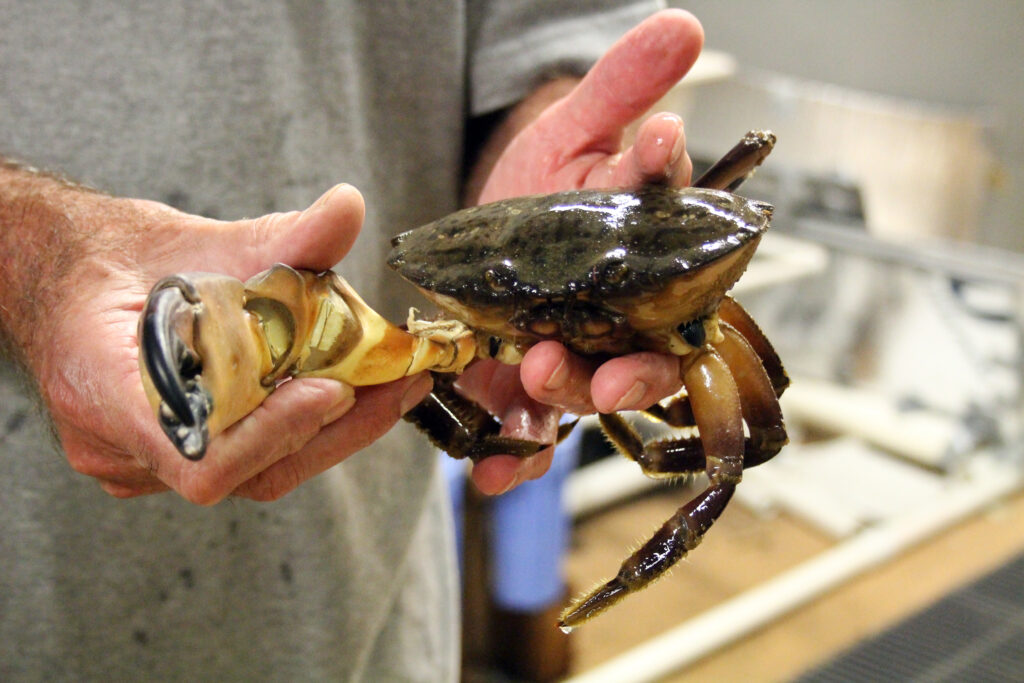
“Adults have never been observed north of North Carolina.”
Dr. Rom Lipcius, a professor at William & Mary’s Batten School & Virginia Institute of Marine Science, has documented the first case of adult stone crabs in the Chesapeake Bay. A tropical species, the stone crab has never before been observed in Virginia waters.
“It’s not unexpected,” said Lipcius.
Tropical species are periodically seen traveling and establishing themselves this far north, such as the white shrimp. Stone crabs are common in Florida and Caribbean waters and have slowly crept their way up the coast over time. According to Lipcius, these crabs began to establish themselves as far north as North Carolina about 15 years ago.
“I think the temperatures are a key driver,” said Lipcius about the stone crabs’ movement. “It’s originally a tropical marine species.”
Stone crab larvae had been found in Virginia waters decades ago, but the water temperature had been too cold for any to survive to adulthood.
In 2013, a single stone crab was caught close to the mouth of the Chesapeake Bay but no others were found.
“It could have happened by luck,” said Lipcius about the presence of the solo stone crab. “It wasn’t convincing.”
Lipcius said he suspects that stone crabs are riding the Gulf Stream into the Chesapeake Bay and finding nursery habitats. “They’re riding the currents in,” he said.
Stone crabs rely on oyster reefs in their juvenile stage. Thanks to oyster reef restoration efforts in the Chesapeake Bay, juveniles have plenty of space to exist here.
“Habitat is basically set up for them,” said Lipcius.
In June, Lipcius started to become interested in stone crab movement after crabber Ty Farrington mentioned he had seen the species during a Virginia Marine Resources Commission Crab Management Advisory Committee meeting.
He asked Farrington to keep an eye out for stone crabs while on the water. The very next week, Farrington caught a stone crab at Willoughby Spit in Norfolk.
Farrington had caught stone crabs periodically over the past few years, but did not know the significance of these catches.
“He just didn’t realize it was that important at the time,” said Lipcius.
There are now three male stone crabs in VIMS’s Seawater Research Laboratory on the Gloucester Point campus where researchers are studying the crustaceans. Researchers will perform genetic testing on the crabs to discover how long they have been living in the bay.
“This is a big crab,” said Lipcius, showcasing the biggest of the three. “It’s been alive for a few years.”
Now that stone crabs have been observed in Virginia waters, VIMS is interested in learning more about their movements. Lipcius is asking that local licensed crabbers and homeowners with crab pots on their properties keep an eye out for stone crabs and report any found to VIMS.
“We want to get the word out,” said Lipcius.
From a legal standpoint, Lipcius said that only licensed crabbers and homeowners with their two permitted pots should look for stone crabs. Lipcius emphasized that people who do catch stone crabs need to be careful.
“They’re big and they can hurt you,” he said, though they are not as aggressive as blue crabs.
VIMS is particularly interested in obtaining female stone crabs to study, especially those that are carrying eggs.
Stone crabs are low in abundance now, but are not expected to create any negative environmental impacts if they become fully established in Virginia.
“It’s not invasive,” said Lipcius about the stone crabs. “It’s a range extension.”
Stone crabs eat oysters and clams so those populations could possibly be impacted. However, stone crabs and their prey have been found to easily coexist in Florida so this is not a real concern of Lipcius.
“It’s definitely one of the good stories,” he said about the stone crab’s minimal projected impact to the area.
Though the stone crab thrives in warmer waters, other species are not as fortunate. Species that require cooler temperatures, like eel grass, may be eradicated in the future.
“There’s always going to be a trade-off with warming waters,” said Lipcius.
Another interesting fact about the stone crab is that the species belongs to the mud crab family.
“There are no other mud crabs in the bay,” said Lipcius.
Though there is a low abundance of stone crabs in Virginia now, the seafood market may shift in coming years if the population does increase.
“Only time will tell what’s going to happen,” said Lipcius.
In next steps, VIMS will study stone crabs in its lab and attempt to document the extent of the stone crab’s range extension in Virginia.
“It’s exciting,” said Lipcius.


