
Press "Enter" to skip to content

Twice survived: Megan Sheppard beats breast cancer again

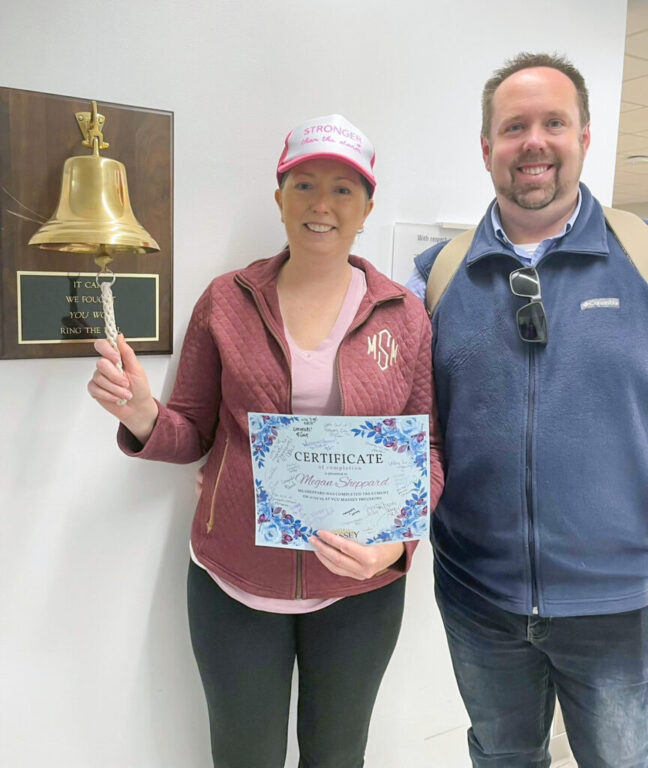
Two days before Thanksgiving, Megan Sheppard received her last round of chemotherapy at Virginia Commonwealth University Massey Comprehensive Cancer Center in Richmond as part of her treatment plan for her second battle with breast cancer.

Sheppard was first diagnosed with breast cancer just shy of her 37th birthday nearly three-and-a-half years ago. Her diagnosis came shortly after she completed genetic testing that showed that she had a mutation in the BRCA gene, which makes her more susceptible for developing breast cancer.

Genetic testing was recommended for Sheppard and her sister because of their family history of breast cancer. Their mother was diagnosed at 40 and lost the battle just five years later.

“She died at 45,” said Sheppard about her mother. “I knew it was something to look out for.”

Sheppard was initially anxious about starting genetic testing. “What if they find something and my fate’s the same,” she worried at the time.

Since Sheppard tested positive for the mutation, she had to undergo more testing. “On my very first MRI, they found something,” she said.

Though she had recently had a mammogram, the cancer was so small that the routine test had completely missed it.

“It probably would have grown for years before I felt it,” she said.

She underwent a bilateral mastectomy to get rid of the cancer and decrease her chances of the cancer returning. Chemotherapy was not a part of her treatment plan.

This spring, soon after the birth of her second son, Luke, Sheppard learned her battle with breast cancer was not over yet.

“They actually found a lump this time,” she said.

The cancer required her to go through two more surgeries, chemotherapy and radiation. She finished chemo last week, but will be starting preventative radiation after Christmas.

“Hopefully, I’ve got that part behind me,” said Sheppard about the chemo.

She is grateful that her cancer was caught early both times, as opposed to her mother’s which was not caught until it was more advanced.

“I was in college when she was diagnosed,” said Sheppard.

In the final year of her mother’s life, Sheppard stayed home to help take care of her. “She was still taking care of us.”

This is a sentiment Sheppard understands as a mom of two young boys. She has strived to look as healthy as possible for her older son Aiden, who is now in the second grade.

“It’s too serious and too hard to explain,” said Sheppard. Aiden knew that his mother had to receive medicine at the hospital and would be tired in the days that followed, but did not know much more.

One part of the normalcy was keeping her hair by using a cold cap during chemotherapy. The cold cap froze her hair follicles to keep them intact.

“I didn’t have to lose a ton of my hair,” said Sheppard.

To anyone who has a family history or is at a higher risk of developing any type of cancer, she encourages them to get tested.

“Don’t be afraid of what the answer’s going to be,” said Sheppard. “Catching it early makes a big difference.”

Learning your family medical history, advocating for yourself and undergoing routine testing, like mammograms, can all help improve cancer outcomes.

“It can be so much worse if you don’t find it,” she said.

After two battles with cancer, Sheppard has decided to share her journey with others to encourage them to be proactive about their health.

“I want to get my story out there to help somebody. There’s so many people in the same boat. You’re not alone,” she said.

Before her second diagnosis, Sheppard was on a yearly checkup routine. She now has to go about every three months, which is giving her much-needed peace of mind.

“It clears your mind to know someone’s watching you closely,” she said about these appointments.

Although she’s starting radiation in the new year, Sheppard is looking forward to celebrating Christmas with her two children and her husband, Quinton.