
For most people, retirement is a time when life slows down. We may take up a new hobby, start volunteering, or spend more quality time with the grandchildren.
However, Gloucester resident Don Tolefson is not most people. When he hung up his boots, Don took a creative leap into the unknown and founded a unique business.
While his peers were teeing off, traveling on cruises, or hitting the shuffleboard court, Don was hard at work doing the next best thing—creating historically accurate replicas of 19th-century American Civil War cannons.
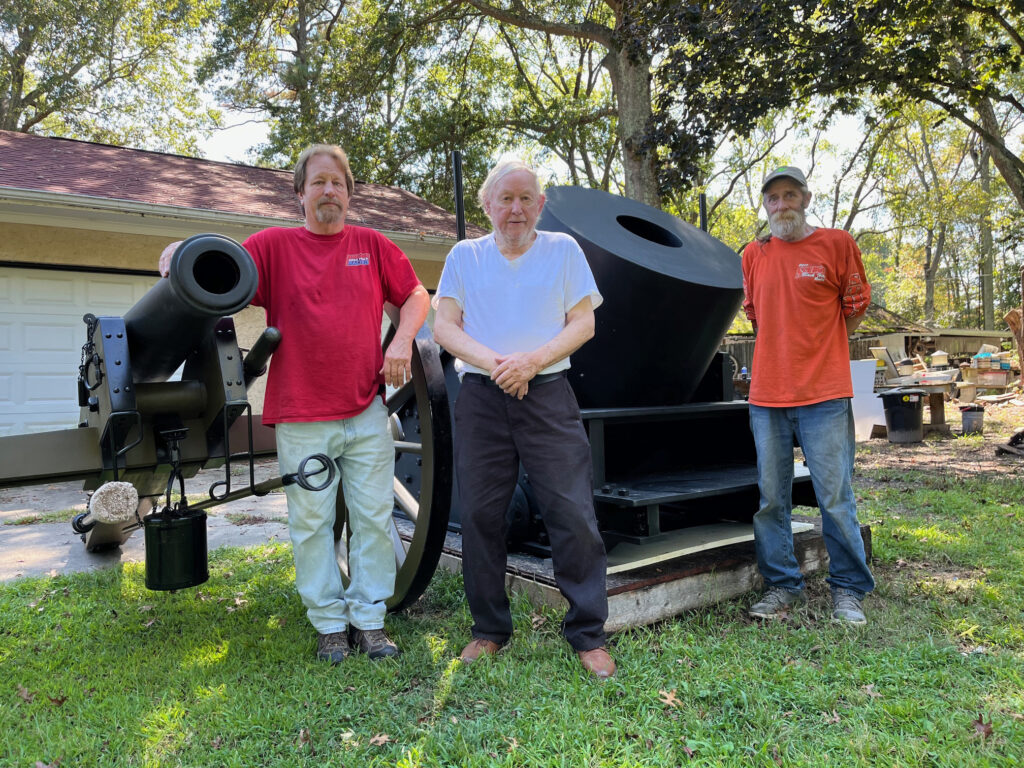
Today, Don sells these replicas through a website. It is a family business he runs with his son, Jeff Tolefson, out of their family home in Ware Neck. Their front yard doubles as a showroom for their latest creations.
Currently, two cannons are on display: a #2 field carriage with a 12-pound gun barrel called “Napoleon,” and a 13-inch seacoast mortar named “The Dictator.” Both cannons are as formidable as they sound—weighing in at over a thousand pounds apiece. The two models have already been sold and are awaiting transport to their final destinations in Kentucky and Missouri.
For the most part, these cannons are used for ornamental and educational purposes. Since the pieces are made using authentic schematics, they have an inherent historic value. Don says that his biggest customers are VFW chapters, town managers, museums and overseers of American Civil War gravesites.
Although the cannons are faithful to the specs used by foundries in the 1800s, some changes have been made. For example, Jeff explains that the original cannons were “made of oak” and would “rot over time.” To ensure these replicas are made to last, wood is replaced with materials like PVC and steel. These modifications were carefully considered and implemented with respect for the original design.
Building things from scratch comes naturally to Jeff, who previously worked as a carpenter throughout the 1990s and 2000s. Jeff joined his father in business in 2009, in part, to be “closer to his mom and dad.” But the Tolefsons are not alone.
Rounding out the team is Nate Hogge, a true craftsman with decades of experience in carpentry, welding, fabrication and hydraulics. His workstation is filled with an assortment of tools, parts, and piles of leftover shavings—the remnants of his custom handiwork.
The dedication to detail is evident in each replica. Nate explains that the models are fitted with everything a soldier would need to fire the cannon. Having spent several hours with the cannon schematics, Nate quickly refers to all components by their proper names. He points to “the sponge, rammer, worm, pointing sticks, and handspikes.” His descriptions are so detailed that you can imagine the deafening sounds and earth-shaking magnitudes of a real cannon blast.
While the Tolefsons do not claim to be historians, they possess a high level of competency with regard to these machines. The team can easily answer questions about cannon parts, their range, and history. For instance, they explain the Dictator model could hit a target up to roughly one mile and took a team of six soldiers to operate.
They enthusiastically demonstrate how a system of rods was used to “angle” the cannons in a specific direction. According to Jeff, the whole team has taught themselves by reading books, magazines, and seeking out companies like Antique Ordnance Publishers in Port Huron, Michigan. According to Antique Ordnance’s Facebook page, they sell “copies of original U.S. Ordnance Department and U.S. Navy drawings. […] Most are very detailed right down to the thread dimensions on the bolts.”
These cannons are not the first creations dreamed up by Don. He first made replicas of lighthouses. Don proudly recalls that one used to grace the parking lot of Ware Neck Produce, until someone “accidentally ran into it.” The cannon replicas project came afterwards. According to Don, he was first inspired by a cannon he saw at Fort Monroe. It took roughly four painstaking years of trial and error before he felt his cannons met his high standards. When asked about his creative process, Don says, “I love making things. Original things.”
Before his venture into Civil War artillery, Don worked for Deep Sea Ventures. For 20 years, he mined the seabed for manganese. After traveling up to 15,000 feet under the water, Don, with the assistance of 400 individual pipes, hoses, and “a big vacuum cleaner,” would carefully extract the manganese lumps that he describes as “looking like potatoes.” Afterwards, the raw material was sold to various companies and used to harden steel and bronze brushings.
It is important to note that despite intimidating names like “Dictator” and “Napoleon,” the Tolefson cannons are safe. Even though they are faithful replicas down to the trails, cheeks, and trunnion caps, they are not functional for warfare. Jeff explains that they are innocuous enough that some people use them as residential “yard ornaments.” According to Jeff, they are “great conversation starters.”
During the American Civil War, the Napoleon and Dictator cannon models were tragically used by both armies. These weapons contributed to the largest loss of American life in the history of our country. The Tolefsons’ commitment to accuracy and detail translates that history into touchable reality. Whether you see their work in a town hall, cemetery, or museum, these cannons inspire people to reflect on the American experiment in a visceral way. Such powerful weapons of war can be simultaneously appreciated as a paragon of 19th-century battlefield engineering, as well as a cautionary reminder of the brutality of war.
In either case, it is the Tolefsons’ precision and artistry that commands such appreciation. Moreover, their story reminds us that, no matter what stage in life you are in, it is always a good time to try something new.
For more information about the Tolefson family cannons, visit www.civilwarcannons.com.


