
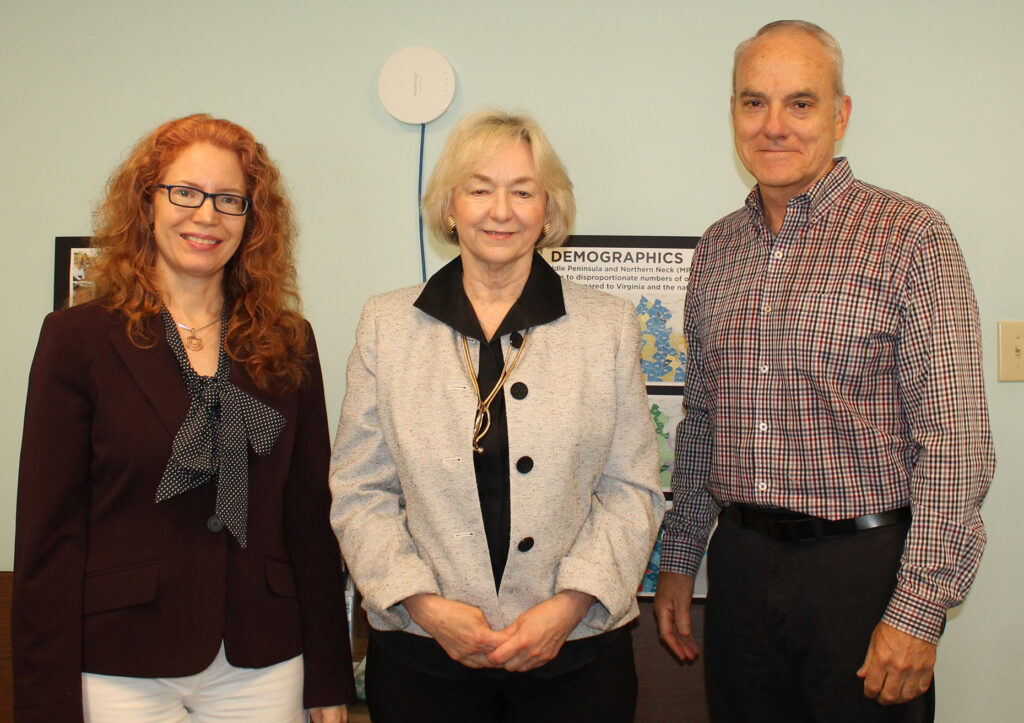
Over the past 12 years, Bay Aging, a Gloucester-based nonprofit organization that provides services for seniors and other vulnerable populations, has worked to develop income sources that don’t rely on government grants and private contributions.
It has been so successful with its business model approach that its revenues have increased from around $12 million in 2015 to a projected $64 million or so in 2025, with 81 percent of its total budget for 2025 coming from contract work rather than grants and contributions, which have remained essentially flat over that time.
“We work for a living,” said Bay Aging’s CEO Kathy Vesley proudly.
Vesley, who has been at the helm of Bay Aging throughout this economic transition, said the additional money has allowed the organization to make up the difference in programs whose funding from state, federal and local grants and contributions regularly falls short of the growing need in a 10-county region that contains four of the five oldest counties in Virginia, in terms of the age of its residents. Those counties are Mathews, Middlesex, Lancaster and Northumberland. The fifth county, Highland, is in the western part of the state.
The transformation began around 12 years ago, said Vesley, when projections increasingly emphasized a rapidly aging society, leading to the concern that “if we live long enough, services will eventually decline—grant funding would not keep up.”
“We needed to do something other than rely on government funds,” said Vesley. “We looked at what we could do. Bake sales were not gonna cut it, so we looked to sell services.”
A natural fit for an organization that works with a vulnerable population was to contract with hospitals to work with chronically ill patients who were transitioning out of the hospital and into their homes after an acute illness, said Vesley.
“When an acute care patient left the hospital, we went into the home to work on setting goals,” she said. “We reviewed the discharge plan and made sure the patient had the proper medications and understood them and how to take them. We made sure food was available, that patients who needed oxygen had it.”
The cost for those services was reimbursed by the Centers for Medicare and Medicaid Services, said Vesley, with funding that was in the form of payment for services rendered rather than a grant.
That was just the beginning, she said. Bay Aging expanded the services it offered, contracting with insurance companies to provide health care screenings and with the Veterans Administration to provide patient-directed in-home services for veterans.
“By using this approach, the growth was phenomenal,” she said.
Tinsley Goad, Bay Aging’s chief financial officer, said that the 10-county area covered by Bay Aging is the size of the state of Delaware, and that Bay Aging additionally serves the counties of Charles City and New Kent and has a veteran’s program that reaches into multiple states.
VAAA Cares is the income-producing division of Bay Aging that contracts with insurance companies and health care providers to provide health screenings and care transition services, said Goad. Veteran Directed Care is the other income-producing division, and it has seen substantial growth in the past few years. Bay Aging’s contract with the U.S. Department of Veterans Affairs has the organization providing services not just to Virginia veterans but also to veterans throughout 10 states and U.S. territories, he said. The result is unrestricted funding that Bay Aging can direct toward the programs it considers most beneficial.
“Meals are more expensive and wages for workers are higher, but federal grant funds are the same,” said Goad. “We’re able to run those programs despite deficits because of the programs that contribute unrestricted funding.”
The Veteran Directed Care program is very popular with veterans, earning a 98 to 100 percent approval rating because of the model it uses, said Goad. The veteran enrolls in the program and then hires his or her own caregiver, which may be a family member already providing care. Most of the budget for the program is payroll, he said. Bay Aging’s job is to manage the program, including processing the payroll and time sheets of the employees. The program is providing services for 850 veterans and has more than 1,000 employees, he said.
Vesley emphasized that those 1,000 employees do not work for Bay Aging but are hired directly by the veterans themselves. According to its annual report, Bay Aging has 340 employees.
The money Bay Aging earns with its contract work goes into such programs such as Meals on Wheels and Active Lifestyle Centers, non-emergency transportation for medical specialty care and treatments, in-home care and durable medical equipment for people largely confined to their homes, housing support services to help people remain in their homes, home repairs, and caregiver counseling and support, said Vesley.
“The budget is a good way to quantify success,” she said. “One of the things we’re most proud of is that we’ve increased services in partnership with local governments, but we’re able to keep their contributions relatively small compared to the growth in the budget.”
Vesley said that, while local governments are providing more money now than they did in the past, the percent of the budget those contributions make up is just 2 percent, down from the previous 6 percent because of the agency’s business model growth.
“It’s a return on investment for Gloucester and Mathews,” she said. “You give us $1 and we give $10 in value in real money.”
A fact sheet provided by Julie Northcott-Wilson, Bay Aging’s statistician, shows that in fiscal year 2023, the organization served 34,439 people, about a third of whom received care services. The second and third greatest numbers were served through information and referrals (16 percent) and publications and educational materials (15 percent). Others were served in the areas of transportation, counseling, training, meals, housing, and more.
Northcott-Wilson said that the 2022 American Community Survey had found that, while 22.3 percent of Virginians and 23 percent of all U.S residents are age 60 and older, 34 percent—a full third—of the population of the Middle Peninsula and Northern Neck is 60 and older. And, while the median age nationwide is 38.5 years, and the median age in Virginia is 38.7 years, the median age of this 10-county region is 48.5 years.
“We’re like a whole generation older than the rest of the country,” she said.
The fastest growing segment of homeless people in the U.S. is older individuals who can no longer afford to rent or who have to sell their homes because of taxes, said Vesley. But that demographic is also the fastest-growing segment of the workforce, she said, with people having to go back to work in their “golden years.”
The special funds that are earned through Bay Aging’s business model approach address the issues of housing, homelessness, and other support, she said, adding, “That was my motivation in 2010, 11, and 12.”
Northcott-Wilson said that another reason for increased homelessness in the aging population is the change in the structure of retirement, with people no longer receiving big pensions.
“Social Security is not always enough,” she said, “especially if the house you own doesn’t work with mobility issues.”
Neither government nor Bay Aging is going to solve all of these problems, said Northcott-Wilson, “but at least we’re working to come up with solutions.”
Vesley pointed out that when she came to work for Bay Aging, Bay Transit had one bus for transportation, with limited stops. Now it has a fleet and provides transportation to “pretty much anywhere in the service area” for $2, along with a New Freedom program that offers rides outside of the service area for special care for $5 up to 50 miles and $10 for 51-100 miles, round trip.
The other area the agency has focused on has been food, operating on a policy set by the agency’s board of directors of no waiting list for Meals on Wheels. The ultimate goal is to set up kitchens to provide hot, fresh meals for all MOW recipients, as Mathews County does, instead of ordering them from a Richmond company. Two such facilities are already in operation on the Northern Neck, said Vesley, and another commercial kitchen in this area is the next goal.
She said she’s proud of Bay Aging’s record, and of the fact that it’s been recognized many times over with awards. There are 622 Area Agencies on Aging across the U.S., she said, and last year, Bay Aging won the leadership award nationally over all of the others. This year, of the 38 awards given out for various accomplishments across all 622 agencies, Bay Aging received four. One award was in the area of Community Care Innovation Collaboration for teaching other agencies “how to do what we do,” she said, while another in the same category was for the agency’s Leadership Institute, which helps employees develop the skills necessary to become community leaders. The agency also received two achievement awards, one for Healthy Harvest, a program operated in partnership with Northern Neck Food Bank to provide seasonal deliveries of fresh fruits and vegetables along with Meals on Wheels, and one for Caregiver Support, providing in-home counseling, support groups, and activities for caregivers.
Vesley emphasized that none of Bay Aging’s accomplishments would be possible without its board of directors.
“We are very, very blessed to have excellent directors,” she said. She especially praised Dr. Barry Gross of Gloucester, currently serving as the board’s vice chair; Ron Saunders of Gloucester, who is retiring; and Lynda Smith of Mathews. She said they’re always active participants on the board and work to promote the agency.
“We are what we are because of them,” she said.
Finally, Vesley emphasized the importance of constantly moving forward, of innovating, of “trying to find what else is needed.”
“It’s really important that we keep stretching,” she said, “that we keep thinking, ‘What next? What should we be doing?’”