
Press "Enter" to skip to content

Working waterfront sites topic of public meeting

Eleven sustainable, convenient water access sites for commercial watermen to offload their catch could be coming soon to the Middle Peninsula. Developing such sites was the topic of a public engagement meeting held last Wednesday at Rappahannock Community College at Glenns. Six of the potential access sites that were discussed are in Gloucester and Mathews.

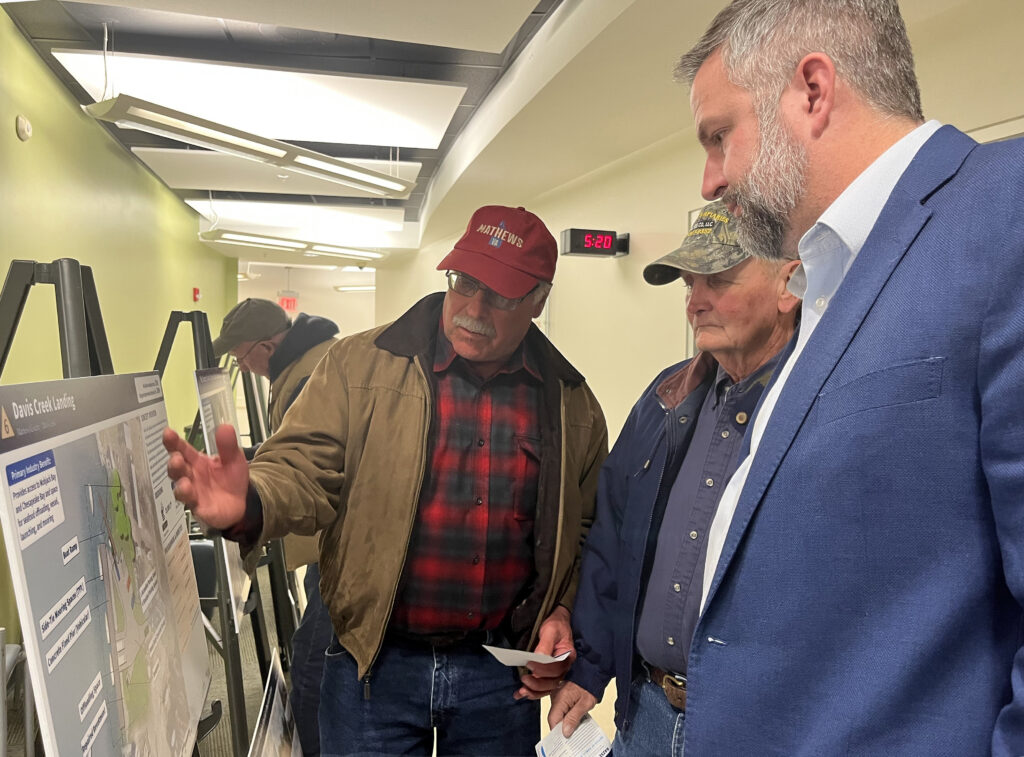
Co-sponsored by the engineering firm VHB (Vanasse Hangen Brustlin) and the Middle Peninsula Planning District Commission, the meeting was held to get community feedback on the project, titled “Designing Multimodal Working Waterfronts.”

The project, funded by a planning grant from the U.S. Department of Transportation’s “Rebuilding American Infrastructure with Sustainability and Equity” (RAISE) program, identified 11 publicly-owned working waterfront sites across five counties that can be developed to support the rural coastal seafood and maritime industries, said VHB Project Manager Ricky Wiatt, a landscape architect. With the sites identified and 30 percent designed and permitting underway, VHB and MPPDC can now apply for a $25 million RAISE grant to fund construction.

The sites identified in Gloucester are Williams Landing on Timberneck Creek in Gloucester Point, Perrin Wharf on the Perrin River in Hayes, and Captain Sinclair’s Recreational Area on the Severn River in Naxera. The Mathews sites are East River Boat Yard on the East River in Bohannon, Davis Creek Landing on Davis Creek in Bavon, and Winter Harbor Landing on Winter Harbor in Peary. In Middlesex, the sites are Whiting Creek Landing, Mill Creek Landing, and Stamper’s Bay Landing. There is also a site in Tappahannock at the Rappahannock River Park and one in King and Queen County at the Mattaponi River public access site.

The work in general will involve replacing deteriorating docks with longer-lasting concrete structures that are higher above the flood plain, will more readily withstand wave action and flooding, and are large enough for vehicles to drive on for offloading product such as oysters, crabs and fish. Each site is planned to also have a concrete boat ramp that can be used by the public and, possibly, spots where watermen can leave their boats. The sites will be managed jointly by the localities where they’re located and the Middle Peninsula Public Access Authority, possibly with fees assessed to cover costs.

No new buildings or large infrastructure is being planned for any of the sites, said Wiatt, but buildings that currently exist, such as at East River Boat Yard, will be retained in some form. The idea is to make sure the pavement doesn’t have potholes or isn’t underwater and that there are dumpsters and lighting and, possibly, porta-potties at each site, he said. Vehicle accommodations are tight at some of the sites, with no space to park a truck and trailer, but wherever possible, a turn-around for box trucks will be provided. Some sites will require some dredging to be effective, said Wiatt, but any major dredging projects will have to be taken care of by other means. All the sites will be handicapped-accessible to meet the terms of the “accessibility” part of the grant, he said.

Wiatt said that he and his colleagues Stephen Tally, deputy project manager, and Connor Burke, planner, had begun the project by visiting 65 Middle Peninsula sites, some of which were commercial and some recreational. They then worked with administrators in each of the area’s counties and towns to identify the sites that would likely be most beneficial to the commercial seafood industry. They looked at site conditions, historical environmental impacts, sea level rise, water depth, what permits would be required, and other issues that would affect site development, and they worked with former VMRC Commissioner Bill Pruitt and went to watermen’s association meetings to gather information to help them narrow the number of potential commercial sites to just 11.

“We wanted to make sure we were fair to the region,” said Wiatt. “Some gaps in the region will need to be addressed later.”

One of the issues the team looked at was how quickly each site could be accessed. Tractor-trailers are the best way to transport the catch, said Wiatt, but some of the roads where the sites are located can’t readily be navigated by these big rigs.

“But you’ll be able to get a pickup truck right up on the dock, reducing time,” said Wiatt. “We wanted to make it more efficient to get to the buyers.”

Some of the issues that had to be taken into consideration, he said, were the long run-time to a site, its wind and rain exposure, and the problem of poorly-maintained channels.

“Dredging is a big component that’s being addressed by the MPPDC,” said Wiatt.

The team also looked at the product that would be transported. Oysters have the biggest value, said Wiatt, and the plan is to not only take them out but to also put their shells back. Crabs are the highest-volume catch, he said, but they move around a lot, so having 11 sites helps the watermen move to where the catch is. One of the biggest-growing fisheries is the blue catfish, he said, and the King and Queen and Tappahannock sites should help address that need.

The number of sites that actually get developed will depend on the amount of grant funding the project receives, said Wiatt. The $25 million being requested should be enough to fund construction of all 11 sites. However, it will be the summer of 2026 before all permits are in hand and construction can start.

“We need to make it happen as soon as we can,” he said.

general working waterfronts meeting 2
SHERRY HAMILTON / GAZETTE-JOURNAL Dan Knott, at left, founder of Hold Fast–Knott Alone, a nonprofit organization that helps veterans find employment in the commercial fishing industry, among other things, talks with landscape architect Ricky Wiatt, center, of VHB (Vanasse Hangen Brustlin) and Curt Smith, deputy director of the Middle Peninsula Planning District Commission, during last Wednesday’s public engagement meeting on Designing Multimodal Working Waterfronts at Rappahannock Community College, Glenns.