
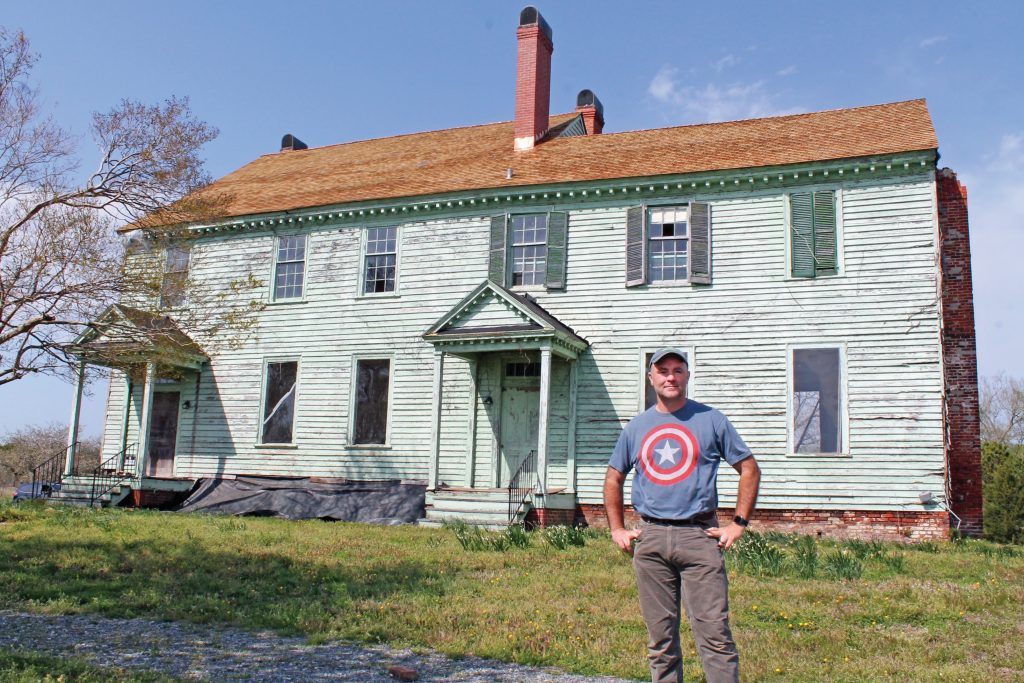
Dave Brown points out Timberneck’s original clapboard siding, which is still intact on a wall that was later enclosed by an addition.
After the new Machicomoco State Park opens next week in Gloucester, visitors will have a chance to see Timberneck, the historic home built by the Page family in the early 1800s that is being preserved by the Fairfield Foundation.
With a 49-year lease on the property and some initial funding through the Conservation Fund, the foundation is working to secure and restore the interior and exterior of the structure so that it can begin to accommodate tours and even eventually house some guests who might want to stay overnight.
Dave Brown, co-director of the Fairfield Foundation, said that money from room rental will help sustain both the building and related programs that are planned. One of those programs will include Native American-authored exhibits that focus on the last 400 years of the long history of the local indigenous peoples.
“We hope to have a sustainable operation that includes quality, long-term maintenance of the house and that’s complementary to the park’s interpretation,” he said.
Brown described a future in which the house and the three acres surrounding it serve as a gateway to other historical and archaeological sites throughout Gloucester County, bringing together the stories of the civilizations that have lived on county lands throughout history, both recorded and unrecorded.
In a collaborative effort with the Virginia Institute of Marine Science at Gloucester Point the foundation is also working on compiling an oral history of the adjacent Catlett Islands, preserving and studying any cultural resources they may yield.

One of Timberneck’s foundation walls is crumbling, and efforts have begun to shore it up and repair it. Steel girders provide support until the work can be completed.
“We hope this will lead to exhibits illustrating the relationship between the environment and culture,” said Brown.
During a brief walk-around, Brown shared some of the highlights of the house, which was originally half its current size, he said. The front, which faces the York River, had a broad porch that ran from one end to the other. Accounts by local residents Carter and Ben Borden indicate that porch was blown off the house in 1943, when the Yorktown Naval Mine Depot, located across the river, exploded.
An 1850s addition doubled the size of the living space in the home, and it was enlarged once again in the 1930s or 1940s when a kitchen was added on the back side.
Downstairs along the water side of the house are a large entry hall with a staircase and two large main rooms with a connecting entry hall containing a second set of stairs. On the land side are the kitchen, a large dining room, and a good-sized office. Pointing out the staircase in the older part of the home, Brown said that a representative from Colonial Williamsburg had told him humorously, “You should charge people to touch it.”

An old smokehouse and a smaller outbuilding are the only structures besides the house that still stand on the Timberneck property, although two graveyards are still in place.
Upstairs, two large bedrooms and two smaller bedrooms occupy the older part of the house, while the addition contains a large bedroom, a bathroom, and closet space. There is substantial attic space, as well. The plaster is crumbling in every room.
The basement, long rumored to house Native American dugout canoes, instead contains two salt meat troughs that have a similar appearance to canoes. A foundation wall that’s caving in has been temporarily shored up with timber by Storybound Construction, and large metal beams have been installed to support the house during restoration of the foundation.
Anyone interested in more information about the restoration project, who would like to tour the house, or who would like to participate in the Catlett Islands oral history project is urged to contact the Fairfield Foundation at 804-815-4467 or fairfield@fairfieldfoundation.org.

The large dining room at Timberneck shows signs of both its former beauty and current state of disrepair.

