
Press "Enter" to skip to content

Stabilization of T.C. Walker House underway

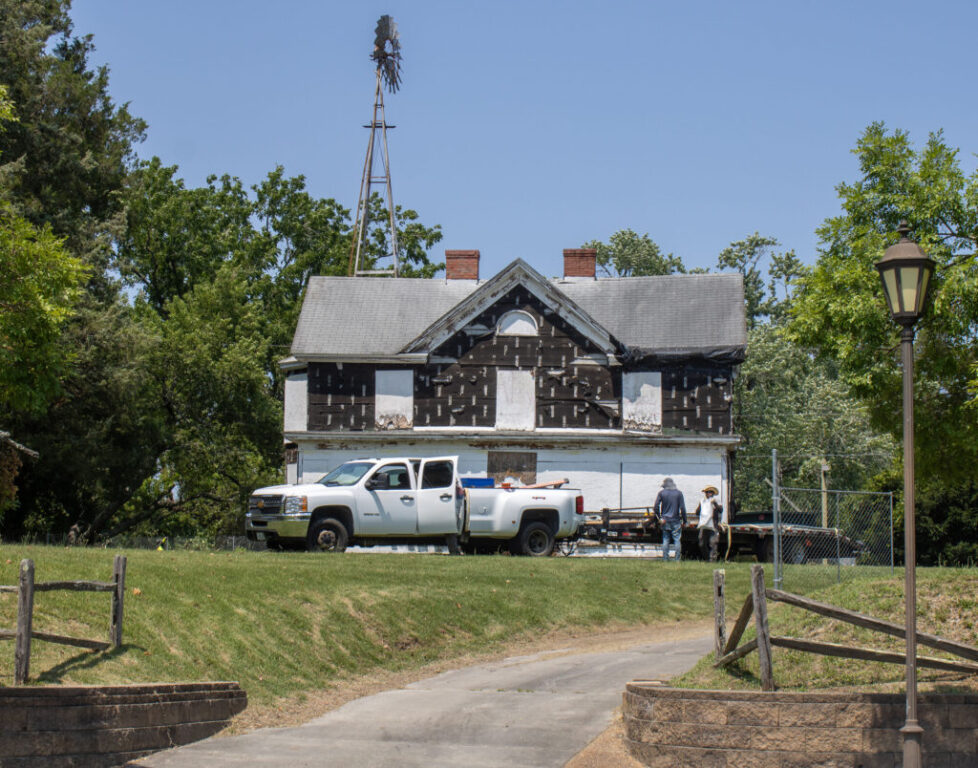
The T.C. Walker House on Main Street in Gloucester now has construction fencing around its perimeter, and new changes are expected to come soon for the historic structure.

Hampton University has begun its stabilization of the former home of civil rights pioneer and attorney Thomas Calhoun Walker, located across the street from the Edgehill Town Center.

According to the building permit issued by Gloucester County in June, the project includes adding foundation support walls and piers with thin brick to follow foundation walls, new siding/roofing, soffit repairs, restoration to exits, windows, a new roof as well as roof repairs/structural repairs. The project will cost approximately $830,586 and the contractor is Mark Turner Construction LLC of Glen Allen. At this time, it is unknown how long the project will take or what the future plans are for the building.

Violation

Hampton University was issued a notice of violation in May as a result of the deteriorating conditions of the home. According to the notice from Gloucester County Office of Code Enforcement, the conditions violated the Virginia Uniform Statewide Building Code for Unsafe Structures. Conditions cited included wood rot along the foundation and deterioration thereof, siding down to felt paper with no replacement siding to the elements, and roofline soffit and fascia board rotting and exposing interior to weather and elements. 

Over the last two months, representatives from both Gloucester County and Hampton University (the owner of the historic home) sat down to discuss the response to Gloucester County’s notice of violation as well as the future of the T.C. Walker House.

County Administrator Carol Steele said that the meetings were very productive and there were discussions about Hampton University’s spending plans as well as its next steps. She said that Gloucester County initially reached out to HU regarding the future of the home. As the condition of the home worsened, the county issued a notice of violation.
Though the Gazette-Journal reached out to Hampton University for comment on the stabilization plans to the T.C. Walker House as well as future plans for the site, there has been no response. The T.C. Walker House is listed on both the National Register of Historic Places and the Virginia Landmarks Register.

History of T.C. Walker

Thomas Calhoun Walker was born into slavery on the Spring Hill Plantation on June 16, 1862. He attended Hampton University, then known as Hampton Institute, from which he graduated in 1883. He later became a lawyer and was certified to practice law in 1887. He also taught students at Zion Poplars Baptist Church.

Walker was the first black attorney to practice law in Gloucester and served two terms on the Gloucester County Board of Supervisors. He also was Virginia’s first black Collector of Customs. He was named to that post by President William McKinley in 1896. He was also appointed the advisor and consultant of Negro affairs for the Virginia Emergency Relief Administration by President Franklin D. Roosevelt in 1934.

Walker helped found the Negro Organization Society to raise funds for black secondary education in the state and he also founded the Gloucester Land and Brick Company to assist black people in buying property and owning their own homes.

Walker passed away on Nov. 5, 1953 at the age of 91. His daughters inherited his home which was later donated to Hampton University, in 1977.

The house was built around 1880 and was purchased by Walker in 1900. Walker also owned multiple other properties in Gloucester. A state historical marker can be seen on the front lawn of his home. It was unveiled during a dedication and unveiling of the marker in 1986 on the same day that T.C. Walker Elementary School was named in his honor—or renamed, as the structure had previously been named T.C. Walker High School and Gloucester Middle School.

Walker played a huge part in the establishment of Cappahosic Academy, the Rappahannock Industrial Academy, six Rosenwald Schools in Gloucester County as well as a teachers’ house, and the Gloucester Training School.

Walker’s autobiography, “The Honey-Pod Tree,” was published posthumously in 1958. The manuscript was drafted in 1952 by Florence L. Lattimore.

In 2001, the manuscript came to the attention of people in Gloucester and the desire to acquire this book grew. In 2006, the manuscript showed up for auction in New York. Dr. Dorothy Cooke, Ronnie Cohen and other Gloucester residents made a trip to New York with the goal to purchase this manuscript. The book was purchased at auction for $632.50.
The manuscript was returned to its home and was kept at the Gloucester Museum of History, where it would sometimes be displayed. In 2015, museum leaders decided that the College of William and Mary’s Special Collections of the Swem Library would be a better place for the manuscript, where it would be better preserved.

Bill Lawrence, a local historian and volunteer at the Gloucester Friends of the Museum of History, brokered a relationship with Jay Gaidmore, the Director of Special Collections at W&M. The manuscript was sold to the college in 2015 for $632.50 with the condition that it would be digitized and made available online. The original manuscript is about 346 pages and is still available to download for free through the college’s library website.

The Gloucester Museum Foundation published a book earlier this year called “Lawyer Walker of Gloucester.” This book is Lattimore’s manuscript, which was the basis for “The Honey-Pod Tree: The Life Story of Thomas Calhoun Walker.”

Gloucester Museum of History interns Trina Dugan and Tori Bridges committed hundreds of hours to the yearlong project of editing the manuscript. This was done under the help and direction of the Gloucester Museums Coordinator Robert Kelly with the main goal to enhance the accessibility of the manuscript to the public.