
Press "Enter" to skip to content

New museum exhibit focuses on life of T.C. Walker

A new exhibit is now on display at the Gloucester Museum of History depicting the life of T.C. Walker.

The exhibit, “Awakening: The Life & Legacy of T.C. Walker,” is the result of a collaboration between the museum, the Cook Foundation, the Woodville Rosenwald School Foundation, and various individuals.

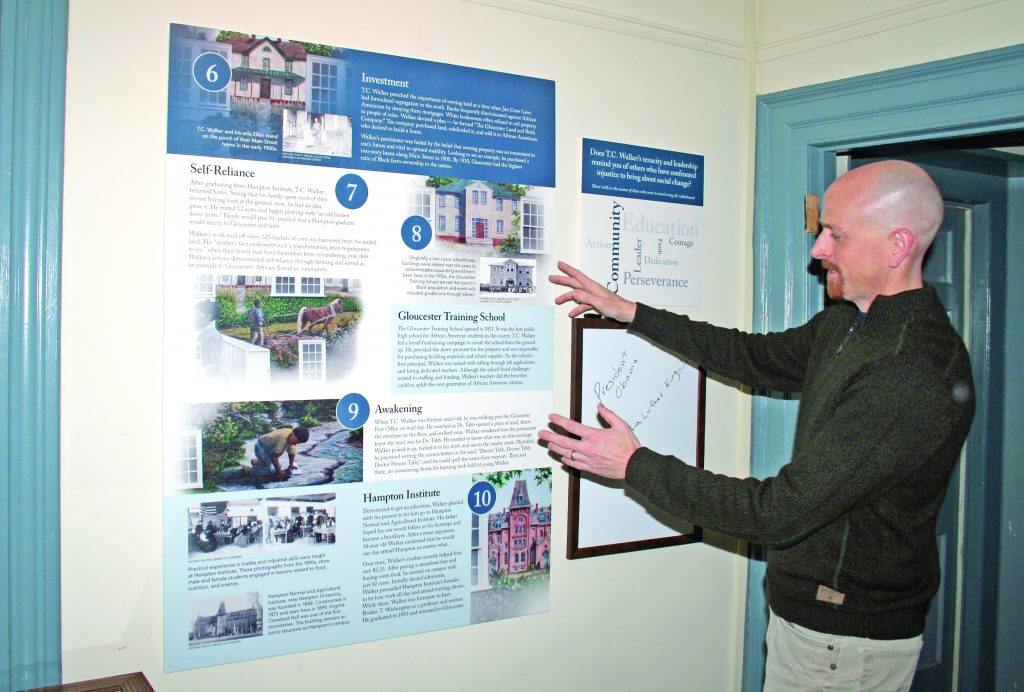
Museum coordinator Robert Kelly explained that the exhibit corresponds with the T.C. Walker mural on Main Street, and dives into the 10 scenes it depicts. Kelly said that he, Cook Foundation Executive Director Jenny Crittenden and Dr. Dorothy Cooke held meetings to look deeper into the history of one of Gloucester’s more famous residents.

FILE PHOTO
Gloucester’s T.C. Walker at the age of 90 in a photo taken in 1952.

Kelly said that one of the main resources for the exhibit is T.C. Walker’s autobiography, “The Honey-Pod Tree.” Kelly’s team at the museum read from the original manuscripts of the book that Walker sent to the book’s editor, Florence L. Lattimore, and he said the manuscripts were like a conversation between the two, providing greater detail to Walker’s life events.

For Kelly, the more powerful aspects of the exhibit are those that look at the time in which Walker lived. Walker was born into slavery and lived through southern reconstruction and the Jim Crow period. The exhibit shows that, despite his circumstances, Walker was a man of action who accomplished much in his life.

Walker received a formal education at Hampton Institute, and upon returning to Gloucester, he was expected to become a teacher, said Kelly, but he noticed how poorly his community was faring at the time and decided to work the land himself and become self-sufficient. Kelly said it was important for Walker to be self-reliant, and he encouraged other African Americans to do the same. Kelly said that this was Walker’s way of inspiring those in his community.

The first African American to practice law in Gloucester County, Walker served on the county’s board of supervisors and was Virginia’s first Black Collector of Customs, named to that post in 1896 by President William McKinley. In 1934, President Franklin D. Roosevelt appointed Walker as the advisor and consultant of Negro affairs for the Virginia Emergency Relief Administration.

Walker created the Gloucester Land and Brick Company because he believed a person should own their own land, said Kelly, but in Jim Crow-era Virginia, banks discriminated against people of color and wouldn’t loan money to purchase land. Walker made the Land and Brick Company to work around those obstacles.

Featured in the exhibit are artifacts from the museum’s collection and from supporting organizations. One piece on loan is one of the original desks from the Woodville Rosenwald School located along Route 17 at Ordinary. The school, which was for African Americans, was built in large part thanks to efforts of Walker, who served as a superintendent for Gloucester’s Black schools.

From the museum’s collection are letters and job applications from teachers at the Gloucester Training School, which would later be named for Walker. There is also a pair of horse blinders that would have been used during the time of Walker’s life. Kelly said the blinders represent the story of Walker returning home after receiving a formal education in Hampton.

Part of the exhibit is a whiteboard and a marker. Guests are encouraged to write the names of people who have inspired change, whether they be historical figures or a close loved one. The exhibit is designed to tell a story, and whiteboard allows visitors to add a bit of their own to it.

Finally, the Cook Foundation provided a video of the creation of the mural by artist Michael Rosato, and the video is played on loop.

Like the mural, the exhibit does not cover the entire life of Walker, said Kelly. He hopes that buzz generated by the exhibit and an end to the pandemic will lead to more opportunities in the future to cover the stories and milestones from his life. He also hopes the exhibit is able to inspire visitors to seek change where change is needed.

The museum, located at 6539 Main Street, is open Monday through Saturday from 11 a.m. until 3 p.m. Admission is free, and visitors are encouraged to practice safe, social distancing measures while visiting.