
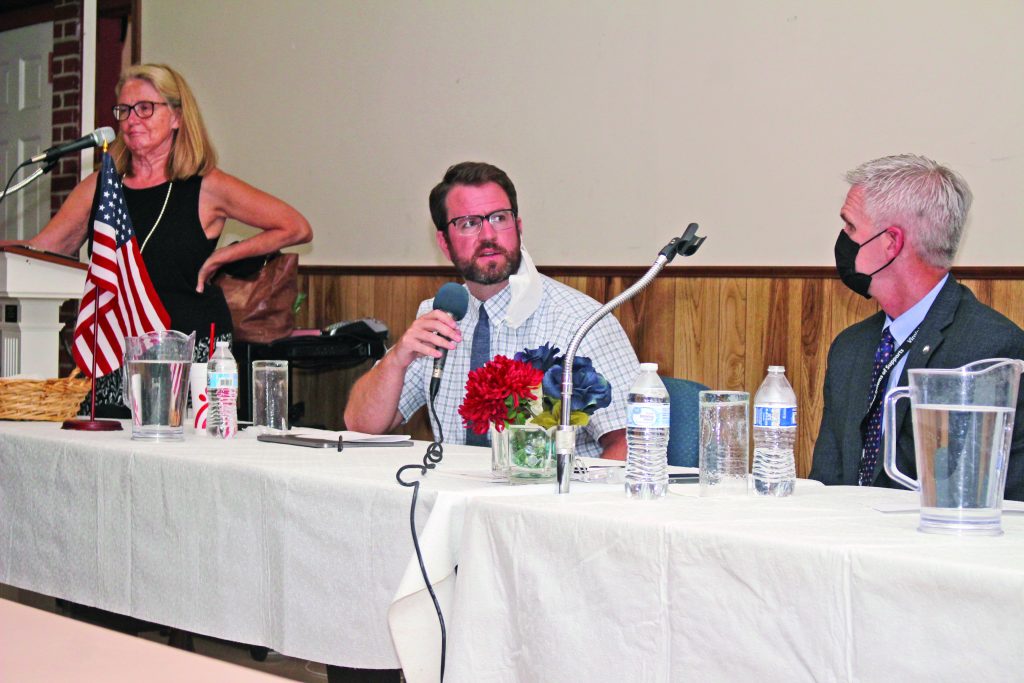
“I’m not quite sure what all the hubbub’s been about all across the country,” Dr. Chuck Wagner said addressing the crowd at Monday night’s CircleUp Middle Peninsula meeting at the First United Baptist Church, Gloucester.
Wagner, assistant superintendent of instruction for Gloucester County Public Schools, was referring to the recent uproar over concerns about the teaching of Critical Race Theory.
“Is CRT something that Gloucester is teaching,” Wagner asked, posing the question to himself. “The short answer is no,” he said in reply.
CRT, he said, is not part of the curriculum. “Our school division [along with the rest of the Virginia] follows a state-approved curriculum framework,” Wagner said. “No, CRT is not something we teach in Gloucester County.”
Critical Race Theory is “a body of legal scholarship and an academic movement of civil rights scholars and activists in the United States that seeks to critically examine U.S. law as it intersects with issues of race in the U.S. and to challenge mainstream American liberal approaches to racial justice. CRT examines social, cultural and legal issues primarily as they relate to race and racism,” according to a definition from Wikipedia.
A capacity crowd filled the church’s Fellowship Hall to attend the public forum, titled “Know The Facts: American History Instruction in Gloucester.” It came one day before a Gloucester County School Board Town Hall meeting to address CRT and other school issues (See related story).
Moderated by Sheila Crowley, panelists also included Gloucester social studies teachers Dianne Carter De Mayo and Brian Teucke. A fourth panelist, Dr. Cassandra Newby-Alexander of Norfolk State University was also supposed to participate, but was unable to do so following difficulties with her online Zoom connection.
The state curriculum is reviewed and revised every seven years, Wagner said, and the history component of the SOL review will take effect in the 2022-2023 school year. This is done, he said, to ensure “that the history that we teach is as representative and reflective” as possible.
Students are encouraged to make their own judgment “so that they can learn to be critical thinkers,” he said. Both teachers taking part in the forum emphasized that SOL instruction relies increasingly upon the examination of primary source material, whenever possible.
“We are doing some really cool things in Gloucester,” De Mayo said, including bringing back African American and Native American history elective courses to Gloucester High School.
“We’re just trying to tell all of American history,” she said. She illustrated her point by speaking of Barbara Johns. As a 16-year-old student at R.R. Moton High School in Farmville, Johns led a student strike for equal education and brought suit against Prince Edward County. Her case was eventually consolidated into the landmark Brown v. Board of Education Supreme Court case. De Mayo said her students “get fired up” when they learn the story of the teen civil rights leader.
Gloucester “is in the history books” as the first county in Virginia to desegregate its schools willingly, she said. “That is our heritage.”
Teucke, a middle school civics and economics teacher, said the curriculum is scrutinized very carefully, is very balanced and neutral. The SOLs are, he said, “the bare minimum … a great resource as a starting point.” Students are taught to respect the law. “We teach them to be patriots,” Teucke said.
Claims that students are taught to have distain for America, its economic system and government are “just not true,” he said. “If anything, Marxism is getting a pretty negative portrayal in the classroom,” Teucke said.
“I consider myself an anti-racist educator,” he said, adding that racism “doesn’t have a fertile ground” in his classroom.
During public comment, Teucke came under fire for a number of Tweets on his personal Twitter social media account. One such post read: “Non-rich white people: Rich white people are not your friends. They don’t care about you-never have & never will. They love to see you embrace racism. It safeguards their wealth. Your way out of poverty is to unite with other working class folk of all races. That’s how you win.” Another one of his posts cited Monday night laid the blame on capitalism for a number of societal ills.
The person questioning Teucke had asked how he can say that his teaching is not biased as a result of such statements.
“He’s got our babies, our children,” the speaker said.
“My politics are not the foundation for what I do or say in the classroom,” he said. Teucke said he encourages students to question those in power, “including me,” adding that among the highest compliments he’s received are from parents who thank Teucke for his balanced approach to instruction.
Another speaker challenged why America is referred to in school as a democracy when it is, in fact, a republic. Both teachers indicated that a republic is a form of democracy. “We’re a democratic republic,” De Mayo said.

