
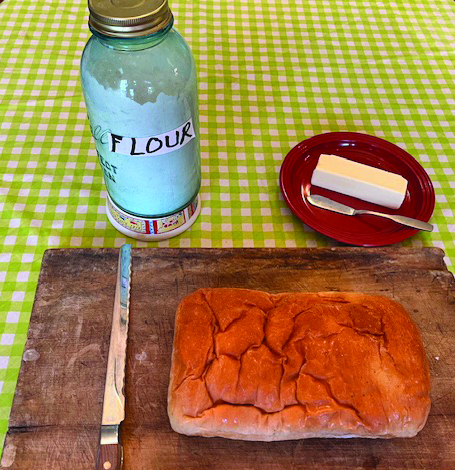
About 32,000 years ago, it was thought that humans made flour from wheat for the first time using homemade tools as well as combination pestles and grinders.
In today’s world one can step into a store and pick up one or all of the most popular flours: Unbleached, Refined, Bleached, All-Purpose (the most widely used), Self-Rising or Enriched.
Who brought flour to America?
Indigenous people had ground corn and other substances into flour for cornbread and mush. European settlers in the Lawrence River area in the 16th century brought with them their technology of flour milling. Jamestown colonists introduced both wind-powered gristmills and water-powdered gristmills. In the late 18th century, merchant milling blossomed in Virginia. Before the advent of these mills, colonists had to grind their grains by hand using a mortar and a pestle or a quern (two round stones on top of one another).
Tips for storing flour
Keep flour (out of the bag) in an airtight container in a dry and dark place such as the pantry. You can put oxygen absorbers inside the container to prevent oxidation and or add a bay leaf to deter bugs. Flour can also be stored in the refrigerator up to one year (grain flour for six months) in a sealed container. It can also be frozen in a airtight container or vacuum seal; will keep two years, whole grain one year. Any cold-kept flour should be brought to room temperature before using.
Fun facts
In 1879 at the beginning of the industrial era the first steam mill was erected in London. In 1930 some flour began to be enriched with iron, niacin, thiamine and riboflavin. Bread heads the list of uses. The U.S. imports most of its flour from Canada. China and India are the largest consumers of flour. China is the largest producer.
March is National Flour Month.
In Gloucester there is still one old mill standing but not in use, Cow Creek Mill on Route 14. Mathews also has one old mill still standing but not in use, the tide mill at Poplar Grove on the East River. It was burned during the Civil War, rebuilt around 1875 and operated until 1912. In the Shenandoah Valley of Virginia for over 270 years, a miller has been stone-grinding local grains at Wade’s Mill. It continues today.
HOW TO MAKE A ROUX
Light Roux
Melt 1 part butter or fat in a skillet or saucepan over medium-low heat. Then sprinkle in 1 part flour. Stir the butter and flour constantly with a wooden spoon in a figure-eight motion for even cooking. In 3 to 5 minutes, you’ll have a light roux that should puff slightly.
Brown Roux
Follow the same steps for making light roux except continue stirring and cooking about 6 to 7 minutes of total cooking time. It will smell a little nutty and turn pale brown.
Dark Roux
To make a dark roux, you’ll make a brown roux, detailed above, and then take the roux even further, about 8 to 15 minutes or longer total.
No matter what the color, let the roux cool slightly before adding a liquid, like stock or milk. Use a whisk to incorporate and simmer to desired thickness.
HOW TO MAKE SELF-RISING FLOUR
There are a few differences when it comes to all-purpose flour and self-rising flour. Self-rising flour contains baking powder and salt; all-purpose flour does not. Additionally, self-rising flour is made with wheat and is lower in protein than all-purpose flour. It is possible to make a substitute for self-rising flour with all-purpose flour, but keep in mind it won’t be exactly the same because you are changing the protein level.
For every 1 c. flour you use, you need 1 tsp. fresh baking powder and ¼ tsp. table salt.
QUICK BREAD
1½ c. self-rising flour
½ tsp. salt
3 Tbs. mayonnaise
¾ c. buttermilk
Mix together all ingredients until a biscuit-like dough forms. Line a loaf pan with parchment paper and then dump in the dough. Smooth out dough in pan. Bake in a 350°F. oven for 35 minutes. Remove bread from pan by lifting the parchment paper. Place on a wire rack or a flat surface to cool. Peel off parchment paper.
CHOCOLATE CUPCAKES
3 c. flour
3 c. white sugar
1 c. unsweetened cocoa powder
2 tsp. baking soda
1 tsp. salt
2 large eggs
1 c. milk
1 c. vegetable oil
1 c. water
1 tsp. vanilla extract
Filling
2 c. powdered sugar
¼ c. butter, softened
¼ c. shortening
3 Tbs. milk
1 tsp. vanilla extract
1 pinch salt
Frosting
1 c. chocolate frosting
¾ c. vanilla frosting
Preheat the oven to 375°F. Line 36 muffin cups with paper cups. Whisk together flour, white sugar, cocoa, baking soda, and salt in a large bowl. Add eggs, milk, oil, water, and vanilla extract. Mix with an electric mixer at low speed until smooth, about 2 minutes. Fill prepared muffin cups a little over half full. Bake until a toothpick inserted in centers comes out clean, 18 to 22 minutes. Remove from pan to cool completely on wire rack.
Filling
Combine powdered sugar, butter, shortening, milk, vanilla extract, and a pinch salt in another large bowl. Mix with an electric mixer at high speed until fluffy, about 5 minutes. Insert a large round tip into a pastry bag; fill with filling. Push tip through top of each cooled cupcake to fill; wipe excess frosting off to create a smooth top.
Frosting
Frost tops with chocolate frosting (your choice). Insert a small round tip into a clean pastry bag; fill with vanilla frosting. Pipe designs of your own over the chocolate frosting. Can be kept in an air tight container at room temperature for 3 days or can be frozen up to 3 months.
For a smooth finish, put chocolate frosting in a microwave-safe bowl and microwave until pourable, about 20 seconds. Dip each cupcake top in warmed frosting.
BEST PANCAKES EVER
2 c. all-purpose flour
2 Tbs. sugar
½ tsp. salt
½ tsp. baking powder
½ tsp. baking soda
2 c. buttermilk
2 eggs
3 Tbs. unsalted butter, melted
½ tsp. unsalted butter, plus more to serve
Maple or pancake syrup, to serve
In a bowl, add the flour, sugar, salt, baking powder, and baking soda, and whisk to combine. In another bowl, whisk the buttermilk, eggs, and melted butter until smooth. Add the buttermilk mixture to the dry ingredients, incorporating with a spatula. Make sure not to over-mix. Add the butter to a pan over medium low heat. Once the butter begins to bubble, add ⅓ c. batter to the pan. Cook until the top side begins to bubble and the bottom is golden brown. Flip the pancake and cook until the underside is golden brown. Repeat with the remaining batter.
GRANDMA’S LARD BISCUITS
2 c. all-purpose flour
1 Tbs. baking powder
1 tsp. salt
1/3 c. lard
2/3 c. milk
Preheat oven to 450°F. with rack in middle of oven. In a large bowl whisk together flour, baking powder and salt. Cut in lard until it resembles small peas. Stirring with fork gently add milk making a soft dough. Flour hands and gently knead dough in bowl four times. Put dough on lightly floured surface. Roll or pat the dough to about ¼ inch or ½ inch thickness. Cut with a floured 2″ cutter. Place the cut-out biscuits about 1 inch apart on ungreased baking sheet. Bake until biscuits are golden brown, about 12 minutes.

