
Press "Enter" to skip to content

Century-old recipes roar back to life

The 1920s roared; the decade was known as the Roaring Twenties. Between 1920 and 1929 America’s total wealth doubled. And in the world of food, things were really looking up. Food was plentiful and cheap, thanks to the American farmer.

Gas stoves and electric refrigerators and other labor-saving kitchen devices enabled easier preparations and safer storage. The Women’s Institute of Domestic Arts ran a correspondence course on how to properly use what was then the new luxury equipment. The Twenties brought to homes the “modern kitchen.”

The rise of packaged and processed foods was another huge development. Many such introductions still on the market today include Log Cabin Syrup, Baby Ruth candy bar, Wheaties, Popsicles, Wonder Bread, Reeses Peanut Butter, and Maxwell House Coffee, to mention a few. Birds Eye frozen products appeared in 1922. Now, women had to spend less time in the kitchen.

Finger foods like deviled eggs, tea sandwiches, salted nuts, prawn cocktail, salmon rolls and canapes are some of the favorite foods in the 1920s.

The most popular cocktail of the era (despite Prohibition) was the Sidecar, a concoction made by mixing cognac with sweet Cointreau and sour lemon juice served in a glass rimmed with sugar. With Prohibition in effect, soft drinks were introduced and became very popular.

This was also a decade for baking. Popular baking ingredients included things such as beef suet, cocoa powder, pineapple and maraschino cherries. The yeast cake, introduced in 1868 by the Fleischmann brothers, was already on the market.

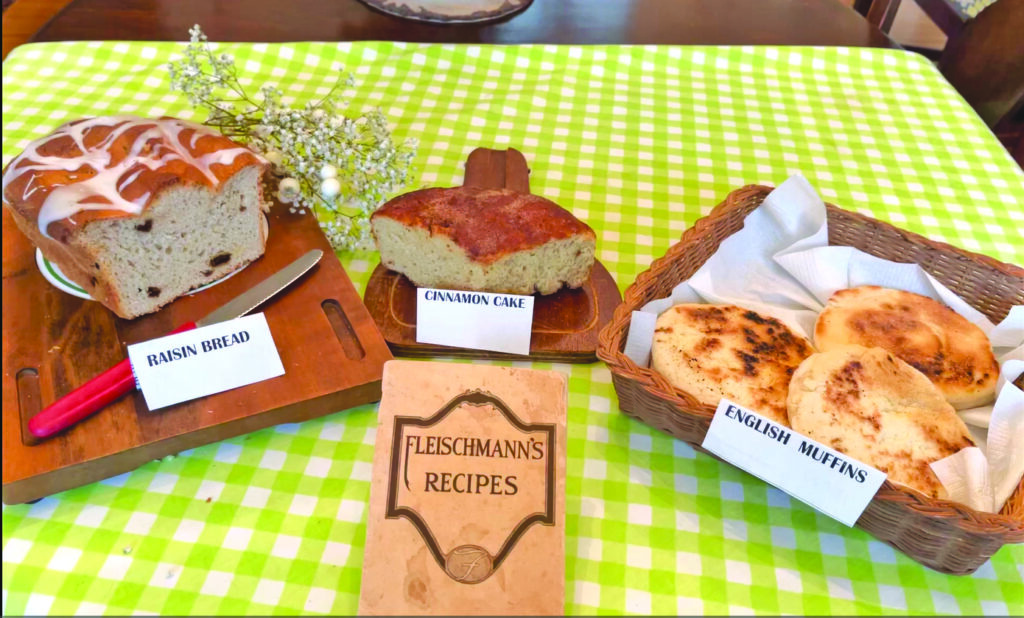
These recipes were copied from one of the Fleischmann’s recipe booklets issued in 1924. It’s not known how many or how often these giveaway booklets were issued. It is known there is a 1900 edition still in existence and being consulted for recipes until the 1960s. The 1924 booklet even has a page where you send in a friend’s name. They would receive a booklet that explained itself as follows: “—This book is addressed to the housewives, who bake at home. No matter how inexperienced or untried a housekeeper, you need not hesitate to attempt the most elaborate of these recipes.”

It is a mistaken idea that it requires “a born knack” to bake.

A lot of good has come from the past 100 years.

References: “Cuisine in the Roaring Twenties,” “America in the 1920s,” “Overview of the 1920s,” “American Fads and Crazes in the 1920s” an “George Mason Research Library.”

These recipes are written exactly as they were 100 years ago. A note: a “moderate oven” could be 350°, a hot oven could be 375°-400°. Do some research and experiment before trying one of these recipes for company.

RAISIN BREAD

1 cake Fleischmann’s yeast
1 c. lukewarm water
1 c. milk scalded and cooled
1 tablespoonfuls sugar
6 cups sifted flour
4 tablespoonfuls shortening
¼ c. sugar
1 cup raisins
1teaspoonful salt

Raisin bread stands for “queen quality” among breads. Made after this recipe it will give you Bread enjoyment that you never knew before. Whole wheat or graham flour used in place of white flour affords a pleasing variety.

Dissolve yeast and one tablespoonful sugar in lukewarm liquid, add two cups of flour, the shortening and sugar well-creamed, and beat until smooth. Cover and set aside to rise in a warm place free from draught until light—about one and one half hours.

When well-risen add raisins well-floured, the rest of the flour or enough to make a moderately soft dough and the salt.

Knead lightly, or “throw and toss” *. Place into a well-greased bowl covered and let rise until double in bulk—about one and one half hours.

Mould into loaves, fill well-greased pan half full, cover and let rise until light—about one hour. Glaze with egg diluted with water and bake forty five minutes.

This recipe makes two loaves.

CINNAMON CAKE

1 cake Fleischmann’s Yeast
1/2 c. milk, scalded and cooled
1 Tablespoonful sugar
2 cups sifted flour
2 Tablespoonsful butter
1 egg
1/4 teaspoon salt

Cinnamon cake, always satisfying and delicious, is one of the most popular raised cakes. Surprise your family with one made by this recipe. Dissolve the yeast and one tablespoonful sugar in lukewarm milk. Add three-fourths cup of flour to make sponge. Beat well, cover and let rise forty-five minutes in a moderately warm place.

Add butter and sugar creamed, egg well beaten, about one and one-fourth cups flour, or sufficient to make a soft dough, and salt. Knead lightly, place in a greased bowl. Cover and let rise in a warm place about two hours or until doubled in bulk.

Roll one-half inch thick and place in well-greased pan and let rise until light–about an hour and a half. Cut across top with sharp knife. brush with egg, sprinkle liberally with sugar and cinnamon. Bake twenty minutes in a moderately hot oven.

ENGLISH MUFFINS

1 cake Fleischmann’s yeast
1 cup milk, scalded and cooled
1 cup lukewarm water
2 tablespoonfuls sugar
4 tablespoonfuls melted shortening
6 cups sifted flour
1 teaspoonful salt

Make your afternoon tea or Sunday supper “events” by serving these tempting muffins with marmalade or rich golden honey. They are the acme of deliciousness when split and toasted on a griddle.

Dissolve yeast and sugar in luke-warm liquid., add shortening and three cups of flour. Beat until smooth, add rest of flour or enough to a soft dough and the salt. Knead until smooth and elastic or “throw and roll” *. Place in well-greased bowl cover and set in a warm place to rise. When double in bulk, which should be in about two hours, form with hands into twelve round biscuits. Cover and set aside for about one-half hour.

Then with rolling-pin, roll to about one-fourth inch thickness, keeping them round. Have ungreased griddle hot and bake ten minutes. Brown on both sides. As they brown, move to a cooler part of stove where they will bake more slowly, keeping then warm in the oven until all are baked.