
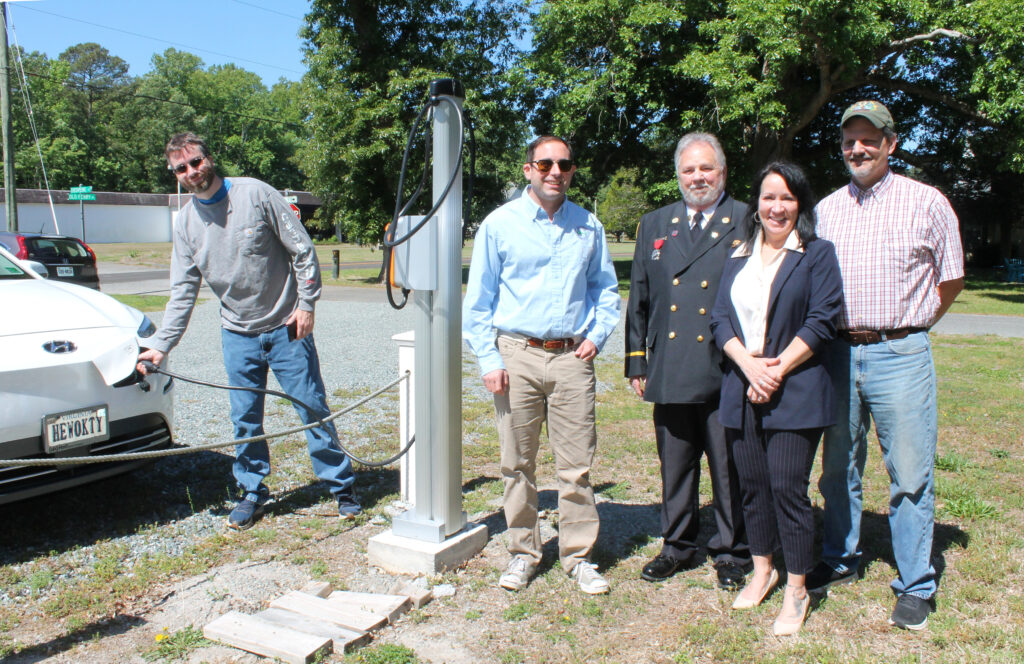
Two electric vehicle charging units have been installed in Mathews by the Mathews Volunteer Fire Department—one each at Gwynn’s Island Station 3 and Cobbs Creek Station 4—with plans for additional units at the other stations.
Mathews supervisor David Walsh, Mathews County Administrator Ramona Wilson, and Graham Sheridan, Virginia Clean Cities Development Director for Central and Eastern Virginia, were at Station 3 on Friday for the official unveiling of the new units.
“Communities that invest in EV charging infrastructure have the potential to improve air quality, strengthen energy security, and drive economic growth,” said Sheridan. “As this network continues to expand, it also opens the door for new jobs and tourism development in the region.”
“This is great for tourism,” said Wilson. “People with EV vehicles can now charge up. Before, you could get here, but you couldn’t get home.”
“People who will benefit most are short-term rentals,” said Walsh. “I think it’s great for the county.”
The chargers were the idea of Troy Garrett, vice president of Mathews Volunteer Fire Department and project manager for the renovations to the new Station 1 on Church Street. Garrett said his niece has an electric vehicle, and she rented an Airbnb in Mathews several years ago and couldn’t find a place to charge her car. It made him realize there’s a demand for the stations.
In 2024, Garrett applied for a Virginia Clean Cities grant to purchase EV charging stations for all the fire stations and was awarded funding through the U.S. Department of Energy Mid-Atlantic Electrification Partnership. The grant was overseen by the Virginia Department of Energy and administered by VCC. Garrett figured it would bring in some income for the fire department.
Other grants were awarded across the state, and VCC purchased charging stations to place at several hundred sites across Virginia, Maryland and the District of Columbia. But before the project could go into effect, the grants were cancelled by the current administration, so there was no money for installation. Garrett said that Sheridan called him and asked if he still wanted the chargers, and Garrett decided he would take them and have his construction crew at Garrett Industries LLC install them, donating the cost.
“If it helps the fire department and gets more people to come to our area, it’s worth it,” he said. “I think it’s a wonderful addition to the community.”
Garrett said that VCC had no sooner put information about the new chargers on its website than he started receiving calls from people who wanted to know when they could use them.
Brent Payne, a Gwynn resident who has a Hyundai electric vehicle, stopped by the station to test it. He said he had a similar Stage 2 charger installed at his house because, although a regular 110-volt outlet can charge an EV, it would take a very long time. He demonstrated how to use the charger by tapping his phone on the electronic screen. The charger immediately recognized his car and the location of the charger he was using. He then hit the button to start charging, plugged in the car, and the charging began. Because he was being charged for the cost of electricity, he only ran the charger for a couple of minutes.
A fully charged battery will get Payne’s Hyundai to Northern Virginia and back to Gwynn’s Island, he said, a distance of around 280 miles. He said if he’s going farther than that, he takes his pickup truck instead because of how difficult it is to find charging stations and because of how long it would take him to charge his battery with his portable 110-volt charger cable.
Garrett said the single-mount ChargePoint Stage 2 charger that was installed at the fire stations will deliver around 11.5 kilowatts per hour at 50 amps of charging power. The cost of charging will be 30 cents per kilowatt hour, he said.
A typical Hyundai battery holds about 77.4 kWh, said Sheridan, so if the battery were empty, getting it up to a full charge at one of the fire department chargers would cost around $23, but it could take several hours to fully charge.
Garrett said he sees the charging stations more as an option for people to use when they’re in the county and need to get back home rather than a primary source for fill-ups. While he initially thought they might make the fire department some money, he said that further research has shown him they’re more likely to just help offset the electric bill.
“I look for it to be more a convenience for people traveling here,” he said. “A reason for people with electric vehicles to come here.”
A third charging station will be installed within the next month or so at Bohannon Station 2, said Garrett, while a fourth one, intended for New Point Station 5, will have to wait until the old building on firehouse property has been demolished. The charging station will go in its place, he said.
When Mathews Station 1 is finally completed, he said, two charging stations will go there.


