
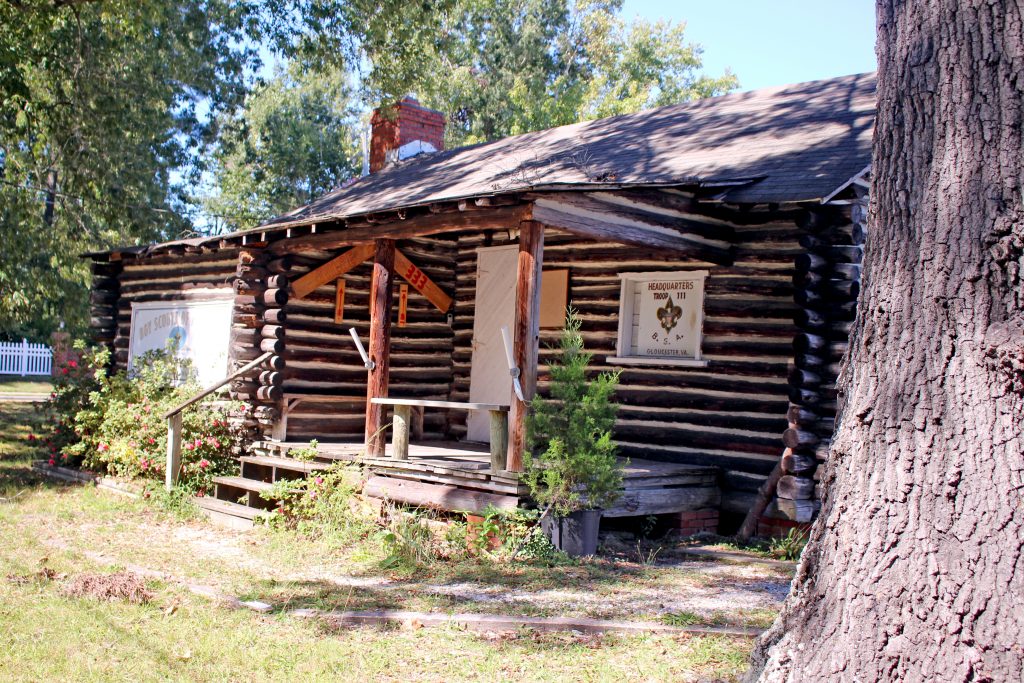
It’s one of those buildings that everybody in Gloucester just knows where it is, often using it as a landmark when giving directions.
The Boy Scout Troop 111 log cabin has now earned official landmark status. The cabin, located on school property at the corner of Main Street and Roaring Springs Road, was one of eight historic sites placed last week on the Virginia Landmarks Register, according to a Sept. 23 announcement by the Virginia Department of Historic Resources.
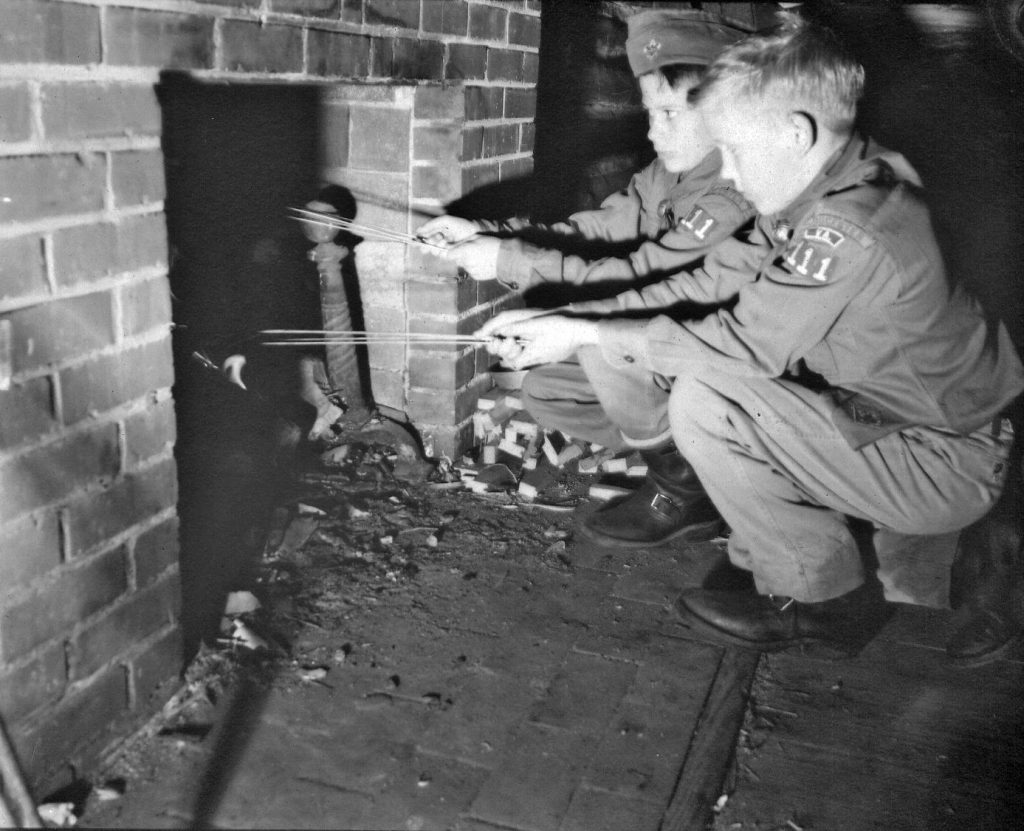
In this undated photo, believed to be from the 1950s, members of Boy Scout Troop 111 hold sticks over the fireplace inside the log cabin.
The designation codifies something that generations of county residents have known soon after it was first constructed by the Works Progress Administration in 1937—this log cabin is an essential part of Gloucester Court House.
The cabin is “iconic because it represents a unique style of architecture found nowhere else in Gloucester County … a rare survival [seldom found] anywhere in eastern Virginia,” said Dr. David Brown, co-director of the Fairfield Foundation.
“It’s been a landmark for anyone whose been in Gloucester for any time”—one of a handful of places in the court house like the Edge Hill House or the foundation’s own Center for Archaeology, Preservation and Education (the former Texaco gas station), Brown added.
The Fairfield Foundation did the work necessary to get the log cabin listed on the state register and Brown hopes the National Register of Historic Places (national-level approval is expected in about three to six months). Brown said the work was done pro bono, with architectural historian Dr. Libby Cook conducting all the necessary research and preparing the form.
“The Boy Scouts would very much like to make sure the building doesn’t fall down,” said Brown. Troop 111, as well as Venturing Crew 111 (a co-educational, senior division of Boy Scouts of America) continues to use the building for their meetings.
The log cabin was originally constructed under the New Deal program to provide space for home economics classes and serve as a meeting place for student clubs and organizations such as the Future Farmers of America on the grounds of the former Botetourt High School.
“The Troop 111 Boy Scout Cabin stands as a testament to a community’s resourcefulness and tenacity in utilizing available funding, materials, and labor sources at a time of national crisis,” according to a summary on the Virginia Department of Historic Resources website.
In 1956, Boy Scout Troop 111 took over sole use of the cabin, in return for its repair and maintenance, and it’s been that way ever since.
“It’s almost like a time capsule … at least from a Scouting point of view,” said Frank Evans, head advisor of Venturing Crew 111. The cabin is covered from floor to ceiling with photographs and other mementoes of Boy Scout Troop 111 over the years.
“That cabin has been an integral part for my children … [and for] so many people I run into,” he said. “The movers and shakers of Gloucester have all been through that cabin at some point … and done their duty as Scouts.”
“I am absolutely tickled,” Evans said of the historic designation. “We need to protect these things and remind Gloucester where we came from.”
Evans praised the work of the Fairfield Foundation in getting this approval, especially the research work of Cook. “She’s been wonderful. She did all the grunt work,” he said. “She found stuff none of us knew.”
The log cabin once even held high school dances. That’s something Gloucester native Harvey Morgan, longtime representative in the Virginia House of Delegates, told Evans about. And years ago, there was a sink in it. “Even Harvey couldn’t remember the sink,” Evans said. At one point, there was a stable on the back side of the building heading toward where the bus loop is now (Troop 111 was a mounted unit). Gloucester’s school board used it as a meeting place, Evans added.
The historic designation, Evans said, should make it easier to raise funds for its maintenance. Storybound Construction recently did an inspection, he said, and the structure itself; the floor, ceiling and rafters are in pretty good shape, and termite damage has been taken care of.
“Part of the outside of it needs a little TLC,” Evans said, and “it will need some care.” The roof, he said, is in need of replacement or “heavy adjustment.”
At some point in the future, Evans said that they hope to hold an induction ceremony, putting up the state and national landmark plaques.
Although no date has been set, he indicated that might be a good time to kickstart a fundraising campaign to ensure that the historic building stays around for a long time.