
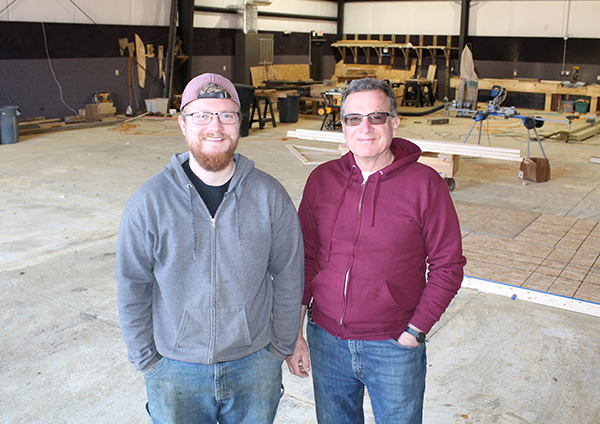
A year after a massive fire destroyed almost everything Bayside Joinery owned, the company is in new quarters in Cobbs Creek and getting ready to tackle some major projects.
Rick and Luke Andrews, the father-and-son duo who run the business together, are making some changes to the building to accommodate the large structural components they plan to manufacture there. On Monday, employees cut a large opening in the wall so a massive loading door could be installed. They’re also installing racks and exhaust fans and a dust collection system.
Without the type of facility they needed, the Andrews kept their business going over the past year by doing mostly small jobs out of Rick’s garage and a tent, using tools that were stored on a jobsite at the time of the fire. One employee stuck with them throughout, they said.
But with a major project waiting for them in the Florida Keys, they needed a place where they could manufacture the lighthouse-style homes they design, engineer, and build using their own specially-designed fiberglass-clad structural insulated panels. When one of the two buildings that previously housed New Creation Ministries in Cobbs Creek became available for rent, they knew they had found what they needed.
“This opportunity came along, and it was way better than what we had,” said Rick Andrews.
The owner, Josie Thorpe, had to go through the process of having the building rezoned to permit a manufacturing business, and she has allowed the company to equip the structure as needed. Bayside recently hired three new employees, and the owners plan to hire at least two more so they can ramp up production on a hurricane-resistant house for Monroe County, Florida, which has one of the toughest building codes in the nation.
The octagonal-shaped building will be similar to lighthouse-style structures that Rick Andrews conceived of and designed using his knowledge of and ability to work with geometry. But now the company has a much more efficient way of designing the structures because Luke is proficient in computer-aided design systems. He even built a special computer to handle the large files that such a system generates.
“We can build every part of the structure beforehand in the computer,” he said.
Not only that, but new software allows him to create photo-realistic images of a building so the customer can see exactly what it will look like when it’s finished.
“There’s no miscommunication about what they’re getting,” said Luke.
“And he can not only do the computer work,” said Rick, “but he can get out there and build it by hand.”
Every part of the structure is built as a component that can be shipped, said Luke, adding that an entire building can be moved to a building site on three small flatbed trailers.
“The whole house will fit together like a puzzle,” said Rick.
He said he’s excited because he expects his design to “make a huge impact on the building market in Florida.” Luke said that the structural engineer’s assessment of the proposed building shows that it will be able to withstand a Category 5 hurricane.
“We’re pretty proud of that,” he said. “He only made a few small changes.”
Rick said Bayside Joinery is small, “but we’ve seen some of the hurricane-resistant homes in Florida, and we think we can compete. This job is giving us the opportunity.”
Among the design components that make the house wind-resistant are the octagonal shape, roof angles that are designed to minimize the effect of the wind, lack of a roof overhang, and lack of shingles. The entire building, from the bottom up, is clad in fiberglass to virtually eliminate the effects of weather.
“There’s nothing the wind can blow off,” said Rick. “Everything is part of the structure itself.”
The two men are grateful to the customer, who agreed to put his project on hold a year ago, even after he learned that Bayside Joinery had burned to the ground. The past year has been spent designing and engineering the structure and obtaining county approval and permits. Now it’s just a matter of getting started.
Rick said that Monroe County, Florida is one of the hardest places in the U.S. to build because it’s located “practically in the ocean” at the southern-most tip of the nation. Building officials there have a lot to worry about and a lot to prove, since even houses that were designed to withstand hurricanes have been destroyed, and they have to do more to make sure that homes don’t get wiped out. Rick said he expects he’ll run into some issues with building officials here and there, but he’s ready for them.
“We’re going to go down there and show ’em how it’s done,” he said with a grin, adding that “we’re making some pretty bold claims for a small company in Virginia.
“But,” said Luke, “we have the numbers to back it up.”

