
Local waterways are much cleaner than they were at this time last year, according to the standards applied by the Virginia Department of Health for the harvesting of oysters and other shellfish.
Total acreage of waters partially or completely limited for shellfish harvest dropped from 8,322.9 in July 2022 to 6,764.2 on an effective date of July 15, 2023—that is, on Saturday.
The Virginia Division of Shellfish Sanitation tests the waters regularly and maintains the inventory of open and closed waterways. The state has several levels of gradations of waters not completely open for shellfish harvest. These range from prohibited, restricted, and seasonally or conditionally approved.
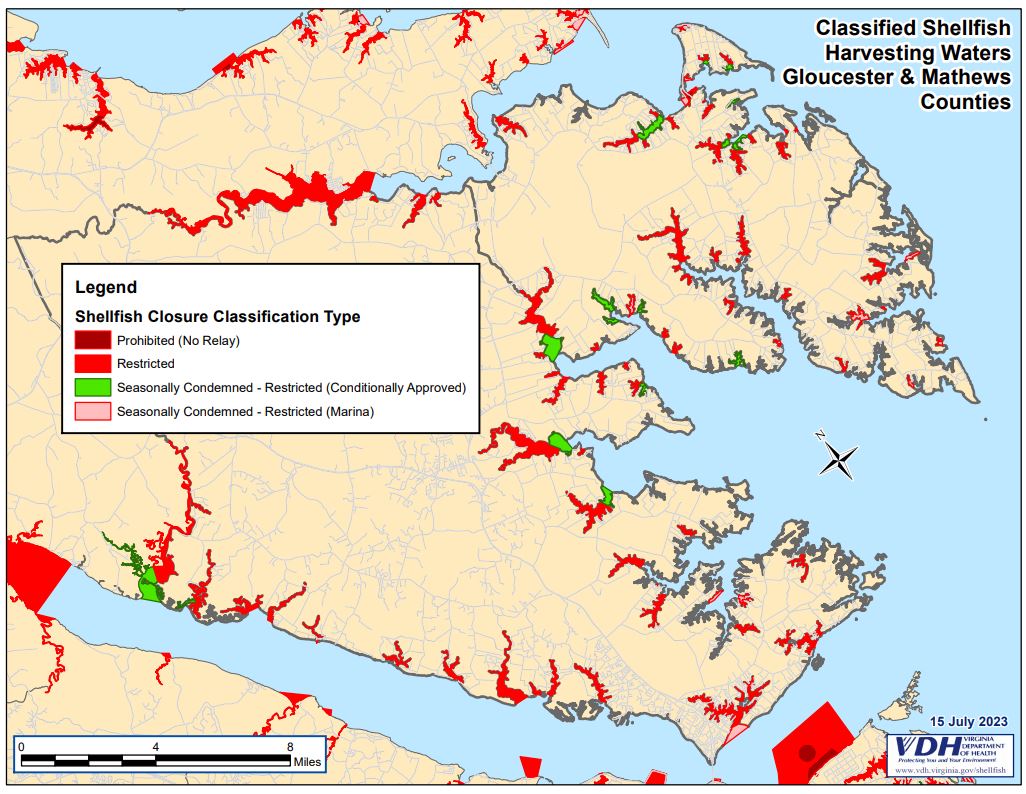
A map with this article shows the areas closed to shellfish harvest in red and those that are less restrictive in green. Waterways shown in blue are open.
A very few areas in dark are prohibited, with no relay permitted for eventual harvest.
Areas shown in red are restricted. Shellfish from these areas must be relayed to clean waters for an approved length of time before harvest.
Areas in lighter cross-hatched red are seasonally restricted; in these, oyster harvest is restricted to April through October.
If the area is green, it is in a conditionally approved status, meaning it is open unless some condition has been met such as excessive rainfall washing contamination from the shoreline.
Blue areas are open.
Some waterways with condemned areas in 2022 are free of restriction this year, including Belvins Creek, Brown’s Bay, Heywood Creek, Hole in the Wall, Mill Creek, Tabbs Creek, and Whitaker Creek. A table with this article shows that measurements for Tabbs Creek and Heywood Creek were combined with those of other waterways, so there is no separate “zero” line to compare with the year before. No new waterways were added.
The Virginia Department of Health regularly checks all waterways for the presence of fecal coliform, and measurements of local waters are made both for shellfish safety, and also for swimming safety.
Of these two tests, the standards for shellfish harvesting are more restrictive because the bivalves are filter feeders and are sometimes eaten raw. According to VDH, “Since these shellfish may be eaten raw, which includes their intestinal tract, care has to be taken to ensure that shellfish harvested for direct marketing are taken from very clean water. Waters approved for the direct harvest of shellfish therefore must be much cleaner than waters approved for swimming, fishing, etc.”
To make its classifications, the state’s Division of Shellfish Safety, an agency of the Virginia Department of Health, conducts periodic shoreline surveys, to look for contamination spots on land. It also measures the presence of fecal coliform in local waterways at least six times a year.
The division said, “Fecal coliform organisms are used as an indicator of fecal pollution from warm blooded animals and the national standard is a geometric mean of 30 samples not to exceed 14 fecal coliforms per 100 ml of seawater.” Analysis is done in state labs.
A restricted status does not usually equal a blanket prohibition on taking molluscan shellfish (oysters, clams, etc.) from these waters. Large areas of many of the waterways are seasonally open, and oyster harvesting may be permitted on them in winter months.
In fact, many of the areas are listed as “conditionally approved,” meaning, the state says, “Shellfish harvesting waters in Virginia classified as “Conditionally Approved” are in the OPEN status unless a ‘condition’ has been met. If the condition has been met, the waters identified immediately below will convert to closed (Restricted) status for a set duration of time.”
In fact, in all of these waterways, in only an 18.8-acre portion of Milford Haven in Mathews is shellfish harvesting absolutely prohibited. The state says, “Some portions of shellfish growing areas are either permanently or seasonally closed to direct shellfish harvesting due to the presence of either marinas, wastewater treatment facility discharges or other seasonal activities affecting water quality.”
Even in areas termed “restricted,” oysters and clams may be relayed to clean waters and later harvested if state regulations are followed.
Swimming safety
The Division of Shellfish Safety notes that the shellfish standard is more restrictive than the state’s upper limit for swimming. At present, all beaches in the Middle Peninsula are open for swimming, with acceptable water standards.
Details on the Shellfish Safety program may be found at www.vdh.virginia.gov/environmental-health. Follow links to Shellfish Safety.
Details on the swimming program may be found at www.vdh.virginia.gov following links to waterborne hazards control and beach monitoring.

