
Press "Enter" to skip to content

Stinging caterpillars are back!

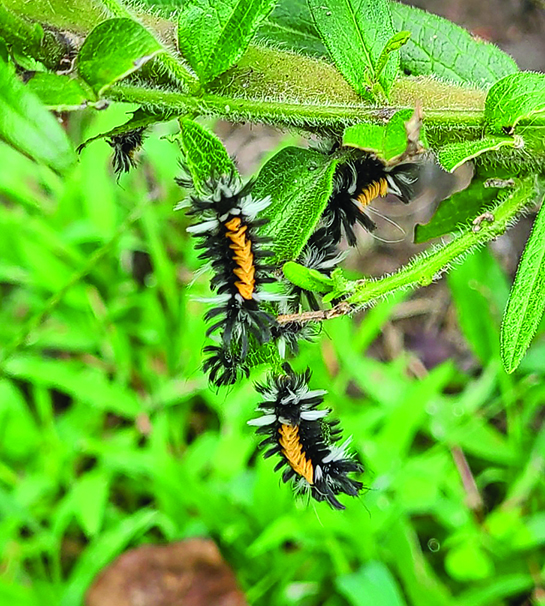
Last week, I read a Facebook post from a friend who lives in North Carolina. She had posted a pretty photo of a Monarch caterpillar (Danaus plexippus) munching on a leaf. Next to the Monarch was a slightly blurred orange and black caterpillar with fuzzy white ponytails. My friend’s comment was, “They’re growing!”

I thought, “Well, they may be growing, but what are they?” I seemed to remember that after a Monarch caterpillar’s first or second instar, or molting stage, it looks to the untrained eye much like every other Monarch in instars three to five. The Monarch’s appearance doesn’t change appreciably in the later stages as does that of some other species, such as the Black swallowtail. So, what caterpillar was my friend referring to?

Jim and I walked up to the field to check the raised bed where a healthy crop of butterfly weed (Asclepias tuberosa) had fed a bunch of hungry Monarchs this summer. Some of the plants had been stripped of leaves, but half of one plant remained intact, sporting a large yellow, black, and white-striped Monarch caterpillar. Jim noticed three black and orange caterpillars with fuzzy white ponytails perched nearby on a butterfly weed stem. They were identical to the one in my friend’s photo.

In 2020, I wrote a column about the puss caterpillar (Megalopyge opercularis), also called the southern flannel moth or asp for its painful, burning sting. My warning at the time was to look but not touch any fuzzy caterpillars, most of which are brightly colored or have distinctive markings to scare predators away. They are active in late summer and early fall, just when we may be clearing out leaves and other debris to prepare for fall planting.

The fuzzy orange, black, and white caterpillars feasting on the butterfly weed were the larvae of the milkweed tussock moth (Euchaetes egle), also called the milkweed tiger moth for its orange, black, and white coloration. The adult moth is mostly a nondescript gray. The milkweed tussock moth is native to North America from the East Coast to the Rocky Mountains.

Milkweed tussock moth caterpillars feed in small clusters to large masses, and gardeners often worry that the caterpillars will decimate their milkweed plants, leaving nothing for the Monarch larvae to eat. In fact, Monarch caterpillars prefer the young leaves and stems of milkweed, while the tussock moth caterpillars appear later in the summer to eat the older vegetation. There is no need to destroy the tussock moth larvae; the adult moths will provide food for some birds and predatory insects.

Like Monarch caterpillars, milkweed tussock moth caterpillars ingest the cardiac glycosides in the milkweed plants, making them toxic to many birds and animals. Humans won’t be ingesting these caterpillars, but touching them could provide a painful surprise. Like the puss moth and other fuzzy caterpillars, the milkweed tussock moth is covered with spinelike urticating hairs that can cause painful burning and itching.

If you are stung or bitten by any insect or animal, try to take a picture of it in case you need to seek medical attention. Before you touch or wash the site of the sting, apply duct, adhesive, or packing tape to the site and quickly pull it away to remove as many spines as possible. Use a fresh piece of tape for each area to avoid reinjecting the spines into the skin. Wash the area with soap and water to dilute the venom. Apply an ice pack or isopropyl (rubbing) alcohol to the site. Antihistamines like diphenhydramine don’t seem to offer relief, but hydrocortisone cream, calamine lotion, or a slurry of baking soda and water may help to decrease the pain and inflammation.

Virginia Cooperative Extension (VCE) Publication ENTO-347NP “Stinging Caterpillars: Slug Caterpillars and Flannel Moths”; University of Kentucky Entomology article “Stinging Caterpillars”; and the University of Maine Cooperative Extension article “Tussock Caterpillars” provide information on various species of fuzzy caterpillars.