
Press "Enter" to skip to content

Soft and furry, but don’t touch!

t is still 2020, and many strange, even bizarre events have occurred this year. Why shouldn’t we expect a new species of stinging caterpillar to appear in eastern Virginia? Not just any stinging caterpillar, but according to some scientific authorities, the most venomous caterpillar in North America. Nothing really surprises me anymore.

That was my thought last week when I spotted a headline on an online news site: “There have been multiple sightings of a hairy, venomous caterpillar in Virginia.” It wasn’t exactly a report of a Mothman sighting, but intriguing enough to entice me to read the article.

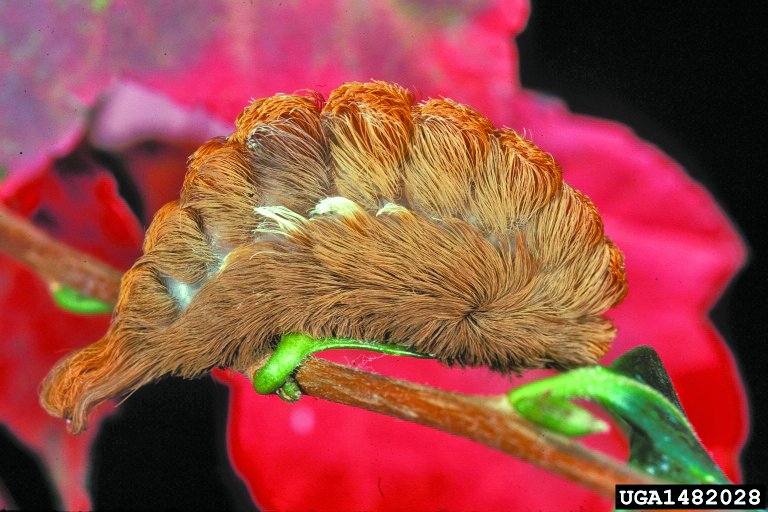
The hairy, venomous caterpillar, reportedly a newcomer to eastern Virginia, is the puss caterpillar (Megalopyge opercularis), also called the southern flannel moth or asp, for reasons which shall become apparent. It ranges from New Jersey to Florida and west to Arkansas and Texas.

The puss is one of several species of stinging caterpillar in North America. It is the larva of a small, attractive, creamy tan and white moth with brown shading on the head, thorax, and forewings. The moth’s body is covered with a thick coat of setae, or fur-like structures. Adult puss moths are not venomous.

The puss caterpillar is so named because of its thick coat of setae, which ranges from tan to dark brown, causing it to resemble a soft, fluffy kitten. It is neither soft nor fluffy. The larva’s setae are hollow, barbed, quill-like structures called urticating hairs. Each urticating hair is connected to poison sac. If you touch the quills, they pierce the skin, releasing venom that causes immediate and excruciating pain. Stinging spines are located under the “fur.” Some of the quills and spines will break off in the skin, causing more pain if the area is rubbed.

The burning, stinging pain can continue for up to 12 hours, with irritation of the area lasting for one or two days. Redness, swelling, rash, and blistering of the site sometimes occur. Some victims may experience, headache, abdominal pain, nausea, and inflammation of the lymph nodes. If you are allergic to bee stings, you should seek medical attention.

Before you rub or wash a sting site, apply adhesive, packing, or duct tape to the spot to remove as many quills and spines as possible. Use a fresh piece of tape for each area to avoid reinjecting the spines into the skin. Wash the area with soap and water to dilute some of the venom. Apply an ice pack or isopropyl (rubbing) alcohol to the site.

Antihistamines like diphenhydramine don’t seem to offer relief, but hydrocortisone cream, calamine lotion, or a slurry of baking soda and water may help to decrease the pain and inflammation.

Even if puss caterpillars are moving into our region, it is unlikely that you will encounter one unless you are working in a wooded area. The caterpillars feed on the leaves of oak, elm, birch, fruit and nut trees, and roses. Puss and other stinging caterpillars are brightly colored or have distinctive markings that serve as a warning not to touch.

They cause minimal damage to trees and shrubs, so preventive spraying is not recommended. If you find a colony of puss caterpillars on your property, you can spray with Bacillus thuringiensis (Bt), a species of soil bacteria that is toxic to some insects, but not to mammals, or with carbaryl, a chemical product. Follow package instructions for safe use of any pesticide.

Several other stinging caterpillars exist in Virginia, including the colorful saddleback (Acharia stimulea) and the white flannel moth caterpillar (Norape ovina).

Virginia Cooperative Extension (VCE) Publication ENTO-347NP “Stinging Caterpillars: Slug Caterpillars and Flannel Moths”; University of Kentucky Entomology article “Stinging Caterpillars”; and the University of Florida Entomology and Nematology “Featured Creatures” entry for puss caterpillar offer detailed information and photographs to help you identify and avoid this critter. Both the UF entry and the Merck Manual entry “Puss Moth Caterpillar (Asp) Stings” describe signs and symptoms and treatment of painful stings.