
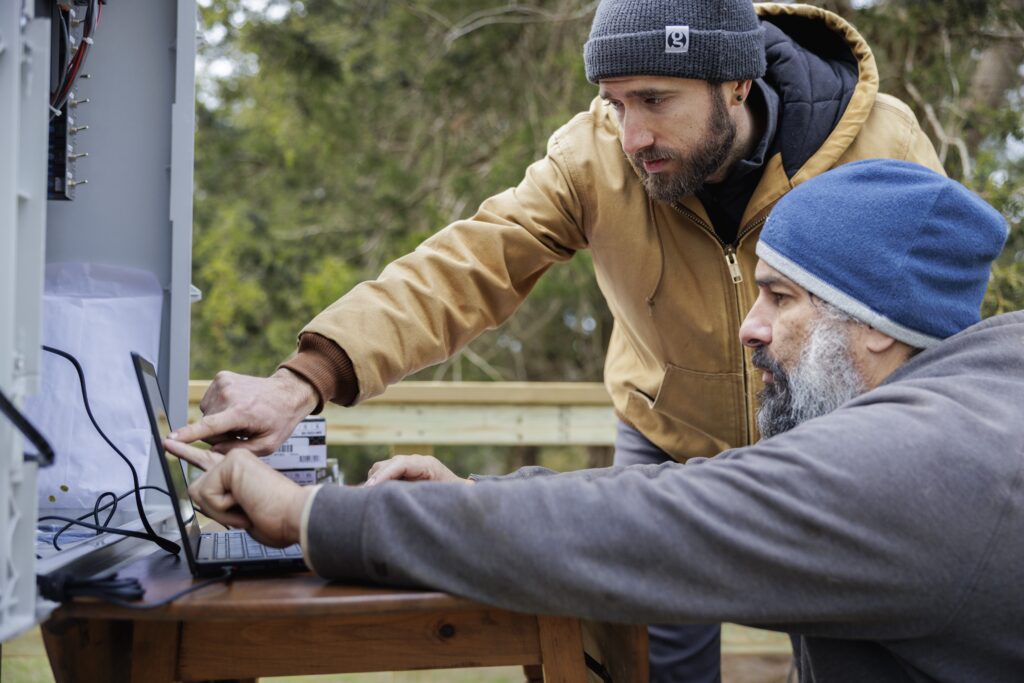
An innovative new method of treating and reusing wastewater now being tested at the Middle Peninsula Chesapeake Bay Public Access Authority’s Captain Sinclair facility on the Severn River in Gloucester could provide a cost-effective alternative to failing septic systems.
Developed by the Durham, North Carolina-based company Triangle Environmental for use in international refugee encampments, the technology has been scaled down for use in a single-family dwelling and is being tested at a home rented by the Gloucester-based nonprofit veteran support organization Knott Alone/Hold Fast.
Tate Rogers, founder and principal of Triangle Environmental, said the system developed by him and his partner Aaron Forbis-Stokes, research and development manager, can accommodate wastewater from sinks, toilets and laundry and can reuse the treated water for anything other than drinking. About the size of a large heat pump, the system is elevated above the flood plain so it’s not impacted by rising sea levels or flooding, and it doesn’t require a drain field.
The project is the result of a challenge issued by RISE Resilience, a nonprofit organization that channels federal and state funding into innovative challenges that help entrepreneurs develop and test solutions to environmental issues. Betsy Hnath, chief strategy and communications officer for RISE, said her organization was approached by Troy Hartley, director of the Virginia Sea Grant program at the Virginia Institute of Marine Science, and Lewie Lawrence, director of the Middle Peninsula Chesapeake Bay Public Access Authority and the Middle Peninsula Planning District Commission, about finding solutions to several coastal Virginia problems—wastewater treatment, shoreline protection, and upcycling dredge materials.
RISE put challenges out to the business world, offering almost $3 million in award money for research and development, funded by GO Virginia. Out of 20 applications, four projects were chosen, and Triangle Environmental’s septic treatment system was one of them. Other companies that benefitted from the grant funding have developed products that are also being tested at the Captain Sinclair site, including Natrx Inc. out of Raleigh, North Carolina, which reuses dredge materials for oyster substrate and provides nature-based shoreline stabilization and living shorelines, and local businesses Biogenic Solutions, Ready Reef, Golden Oyster, and Dive Locker, which provide alternative nature-based shoreline stabilization. Knott Alone/Hold Fast has also become a partner in the effort, providing marsh plant production. The site where the technologies are being tested has now been named The Coastal Resilience and Adaptation Ecosystem.
Hnath said the project is “like lightning in a bottle.”
“There’s not a program we’ve run that’s like this,” she said. “This partnership is really unique.”
Hartley said that flooding in coastal zones creates issues with septic systems that lead to greater contamination of the Chesapeake Bay, and the Middle Peninsula was seeing these challenges 10 to 20 years before other places. Virginia Sea Grant, a university-based federal-state partnership through the National Oceanic and Atmospheric Administration that focuses on helping communities solve marine and environmental problems in the coastal zone, saw this as an opportunity to support businesses that could come up with solutions to the problems. Thus, Sea Grant funding was paired with GO Virginia funding to provide businesses with workforce capacity and university capacity to test their innovations to see if they work. The MPPDC and PAA’s network of waterfront properties provided places where the tests could be carried out in real-world situations.
Triangle Environmental has begun to get inquiries about its technology even before the tests are completed, said Hartley.
“They’re getting demand before they’re ready to put the product on the market,” he said.
Sea Grant is hoping to see Rogers and Forbis-Stokes develop a system that can be integrated into the design and build of a house, said Hartley.
“That’s the excitement about business and entrepreneurs,” he said. “They’re constantly improving and innovating to meet future needs.”
Even more exciting, he said, is that they can be creating a national hub for resilience and innovation “right here in Gloucester.”
Lawrence said that much of the success of the project can be attributed to the Middle Peninsula Planning District Commission, which looked at the intractable problem of sea level rise about a decade ago and “resolved that it was a clear and present danger” to business in the coastal communities the commission represents. Rather than floundering helplessly, commissioners launched efforts to seek innovative solutions to the problem.
“They decided that water is not the enemy,” said Lawrence, “and they set out grow an economic base around water management solutions.”
The commission has now attracted over 40 companies to the Middle Peninsula that are providing water management solutions, said Lawrence, “and has driven over $40 million into the Middle Peninsula economy that offers flood mitigations products and solutions.”
The innovations occurring on the Middle Peninsula don’t exist anywhere else in the nation, said Lawrence, adding that “Problems, solutions, and money create the economic engine for this water management economy.”
Lawrence gave credit to Del. Keith Hodges (R-Urbanna) for his continuing efforts to drive through legislative changes in the Virginia General Assembly that make innovative solutions easier. He said laws and regulations enacted to protect the Chesapeake Bay had worked when the problem was cleaning dirty water that was flowing downhill before it could reach rivers and streams. But when the seas began to rise, they pushed water uphill and created problems the then-existing legislation never contemplated.
“The regulations weren’t right-sized for the problems of today,” he said. “Keith has been instrumental in reshaping that to make sure companies can come in and build solutions … Every single year he has changed state law to help companies do what’s needed to protect the tax base. He exercised political courage.”
In the past, people “would’ve thought it was crazy that you’d put a septic system up on blocks,” said Lawrence. But the cost of septic systems has steadily increased, and some can now cost as much as $60,000.
“Why put it in the ground and gamble it won’t flood?” he said. “And there’s no insurance for it.”
Communities can keep doing the same thing or they can design better technologies “and take it above the flood hazard,” he said.
“The water’s coming,” said Lawrence. “You deal with it, or you drown … Doing nothing is no longer an option.”

