
Press "Enter" to skip to content

Cooking with magic: Baking Powder

In the 1840s an English chemist is given credit for creating the first baking powder, to help his wife who was allergic to yeast. The business did not do well. Eben Norton Horsford, a chemist and professor at Harvard, revolutionized the baking world with the creation of double-acting baking powder.

Horsford’s new formula combined an acid (monocalcium phosphate) with baking soda and a drying ingredient (cornstarch) in a single powder. He eliminated cream of tartar, a byproduct of winemaking, which was expensive and not always readily available. His baking powder released carbon dioxide, both when mixed with liquid and when heated in the oven, giving a more consistent rise. He patented his baking powder in 1856.

In 1858 Horsford and George Wilson established Rumford Chemical Works in East Providence, Rhode Island, initially retailing under his name but later changing to Rumford named after his professor of chemistry at Harvard.

So successful was Rumford Chemical Works that in 1894 the surrounding village called Rumford was named the kitchen capital of the world. After 94 years of business, Rumford Chemical Works was sold to Hulman and Company. By 1980 baking powder production at the Rumford Chemical Works ceased. After the closing, the Rumford Chemical Works and Mill House Historic District were added to the National Register of Historic Places. In 2006 Rumford Chemical Works was designated a National Chemical Historic Landmark.

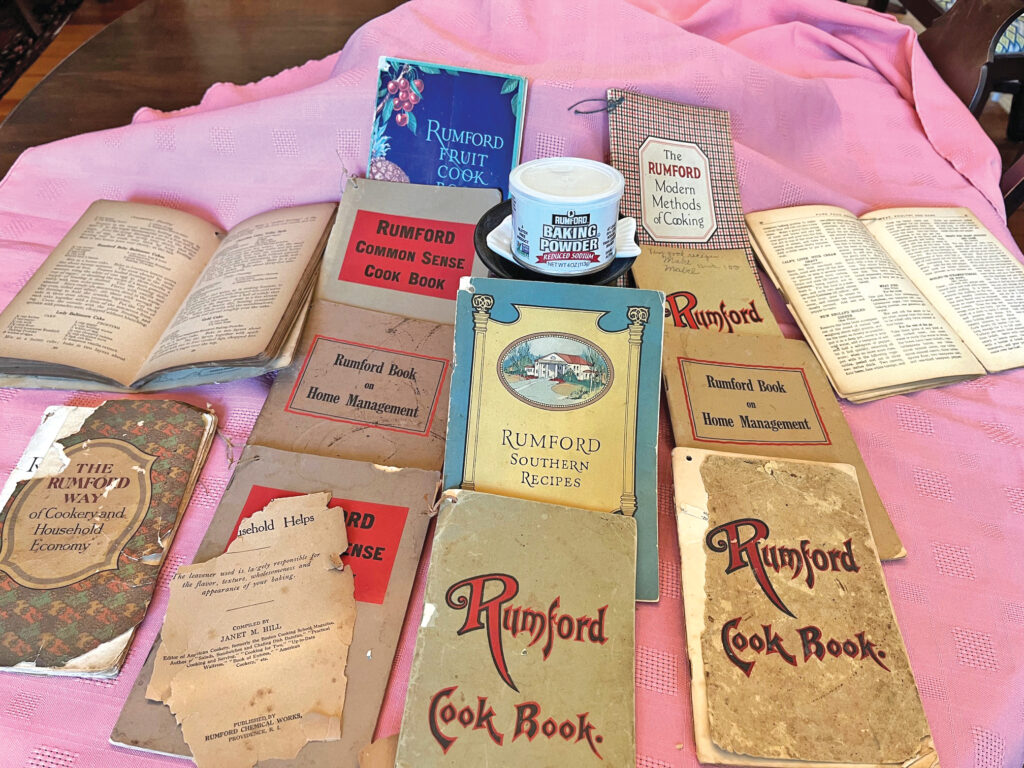
During its years of production Rumford went into printing cookbooks showing how to use baking powder. Its first edition of “The Rumford Complete Cook Book” with recipes of standard American dishes appeared in 1908. It has gone through numerous editions. In the early 1900 through the 1920s, ’30s and into the ’40s the company published small booklets of recipes and included just about any subject containing to a kitchen and its function. The books primarily focused on the use of baking powder. For 10 cards from a one pound can of Rumford Baking Powder, they were shipped free.

Rumford Baking Powder is still on the market but the cooking pamphlets are long gone. Its home site has changed to Terre Haute, Indiana, at the Clabber Girl facility.

References: “History of Baking Powder,” “History of Rumford Center Rumford Chemical Works,” “Rumford Chemical Works,” “Rumford Chemical Works and Mill Historical District and Baking Powder.”

The following recipes were taken from several Rumford Chemical Works booklets. The earliest pamphlets do not give temperatures or cooking times. As kitchens stoves improved, recipes gradually began including the time and temperature.

SEED COOKIES

From the 1908 Rumford Complete Cook Book

1 cup butter
2 cups sugar
2 eggs
½ cup water
3 cups flour
½ teaspoon salt
2 level teaspoons Rumford Baking Powder
2 tablespoons caraway seeds

Cream the butter and sugar together, add the well-beaten eggs and water. Sift together and add the flour, salt and baking powder, and then the seeds. Turn onto a well-floured board, roll out thinly, cut into rounds and lay on greased, flat pans. Bake about ten minutes in a moderate (350°F.) oven.

ELECTION CAKE

1 c. bread dough
1 c. brown sugar
½ c. butter, scant
½ c. milk
1 egg, well beaten
1½ c. flour
1½ level tsp. Rumford baking powder
1 tsp. salt
1 tsp. cinnamon
¼ tsp. cloves
¼ tsp. mace
¼ tsp. nutmeg
2/3 c. raisins, stoned and cut in pieces
8 chopped figs

Work the butter into the dough with hand; add egg, sugar, milk, then the fruit. Sift together thoroughly the flour, baking powder, salt, cinnamon, cloves, mace, nutmeg and add to the mixture. Turn into a well-buttered bread pan, and let rise one and a quarter hour. Bake in a slow oven one hour.

PEANUT COOKIES

1 Tbs. butter
2 Tbs. sugar
1 egg, well beaten
2 Tbs. milk
½ c. flour
½ level tsp. Rumford baking powder
½ tsp. salt
½ c. finely chopped peanuts

Cream the butter add the sugar, milk and egg. Sift together thoroughly the flour, baking powder and salt, add to the mixture, then add the peanuts. Drop by teaspoonfuls on an unbuttered tin one-half inch apart; place one-half peanut on each and bake in a slow oven.

RUMFORD BEATEN BISCUITS

4 c. flour
1 tsp. salt
1 tsp. Rumford baking powder
1 Tbs. shortening
7/8 c. ice water

Sift the dry ingredients together, cut the shortening in thoroughly, add ice water and work and knead to a smooth dough. Turn onto a board and pat with a wooden rolling pin until the dough blisters, folding it together as it spreads on the board. This usually requires about 20 minutes. When full of blisters, roll the dough about one-fourth inch thick, cut into biscuits, prick with a fork, place on a baking sheet and bake 15 minutes in a moderately hot oven.

TOAD-IN-A-HOLE

1 c. flour
1 tsp. salt
1 tsp. Rumford baking powder
1 egg
1 c. milk
6 sausages
2 Tbs. drippings or bacon fat

Sift together the flour, salt and baking powder into a bowl. Make hole in the center, break the egg into this and add half the milk. Mix and beat to a smooth batter, adding the remaining milk gradually. Parboil the sausages, skin and split them, then place in a roasting pan in which the drippings have been melted and heated. Pour the batter over them and bake in a moderate over (350°-375°F.) about half an hour. Cut into squares for serving with plain, with brown gravy or tomato sauce.

HOT CROSS BUNS

Rumford Complete Cook Book, 1934

1 cup milk
¼ cup shortening
½ level tsp. cinnamon
1 quart flour
1/3 tsp. salt
2/3 cup currants and raisins mixed
1/3 cup sugar
½ yeast cake
1 egg
1 tsp. sugar for yeast

Scald the milk with the shortening and sugar and allow the mixture to cool till lukewarm. Work the yeast, with the teaspoon of sugar, till it liquefies, and add it to the milk; add also the egg lightly beaten. Put in the currants and raisins, then sift and add the flour, salt and cinnamon. Knead to dough the same as for bread, and let it rise in a warm place free from draughts till very light. Divide into portions a little larger than biscuits, work till smooth, roll into rounds and place on a greased baking-pan, a little distance apart. Let them rise once more till light, then bake in a moderate oven. Just before baking, mark a cross on top of each bun. When nearly done brush over with milk or white of egg, sprinkle with sugar and return to the oven for a moment.

OATMEAL CRISPS

Rumford Complete Cook Book, 1934

¼ cup butter
¾ cup flour
⅓ tsp. salt
2 tsp. Rumford baking powder
⅓ cup sugar
½ cup oatmeal or rolled oats
1 small egg
A little milk, if needed

Sift together the flour, salt and baking powder; rub in the butter, add the sugar and oatmeal and mix to a rather stiff dough with the egg, adding milk if necessary. Roll out on a floured board, cut into rounds, and bake about 12 minutes in a moderately hot oven.

A WEEK OF WORK

taken from The Rumford Book of Home Management

A special program for the special work which can be fitted into each day while still carrying on the routine of the regular daily work. The program should always include a daily rest period and at least one afternoon away from home. Monday: Mend, count and prepare laundry. Tidy house. Wash “fine pieces.” Tuesday: Washing. Mop kitchen and laundry floors. Basement stairs and back porch. Wednesday: Ironing. Thursday: Clean bed rooms. Friday: Clean living room, clean bath room and do special occasional cleaning. Saturday: Clean kitchen, ice box. Weekend marketing, and extra cooking.

1908 seed cookies, and hot cross buns and oatmeal crisps, both from a 1934 cookbook.