
Press "Enter" to skip to content

Zimmerman Marine now employee-owned company

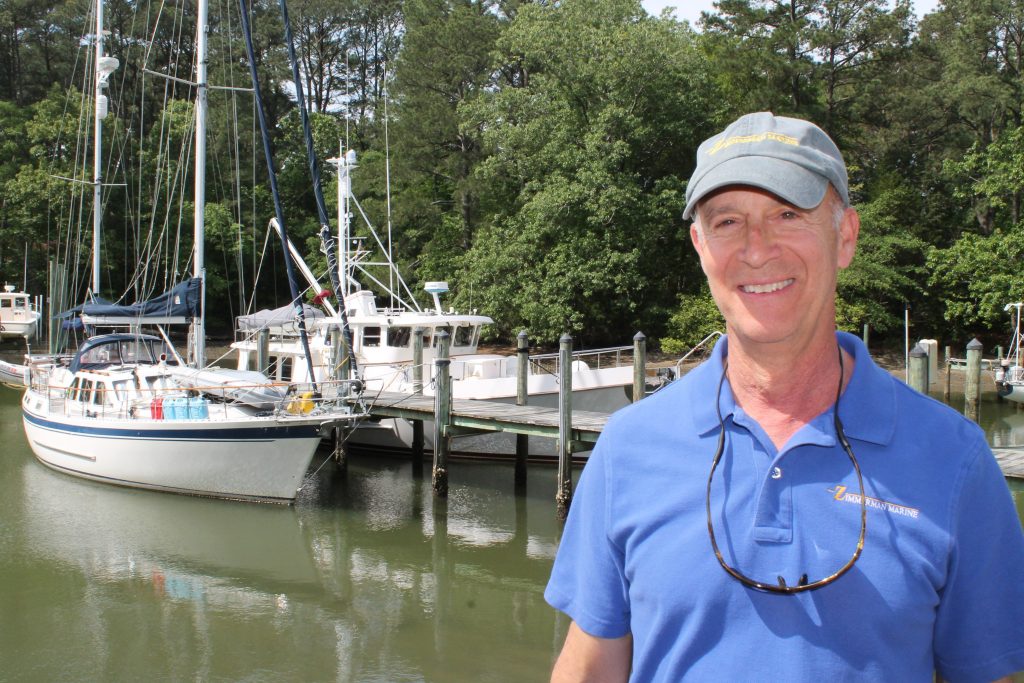
Zimmerman Marine in Mathews, now entering its 40th year in business, has grown significantly over its four decades, with 65 employees who now own the company themselves.

Owner Steve Zimmerman said the business he started those many years ago continues to both service and custom build boats at the Mathews site on the East River, but most of the company’s growth has not been local. Instead, Zimmerman has established maintenance and repair facilities at four other locations along the Eastern Seaboard—in Deltaville; Annapolis, Maryland; Southport, North Carolina; and Charleston, South Carolina.

Expansion to other areas began years ago when Zimmerman, stymied by local resistance to his request for a zoning permit to work on RVs at the Mathews site, decided his best bet for growing the business would be to look outside the county for opportunities.

“The Mathews site is now 20-25 percent of the company,” he said. “Boat maintenance and repair is the heart and soul of the business.”

A major difference in the business these days, said Zimmerman, is that as of Dec. 31, 2019 it became an employee-owned company with a seven-member board of directors. Zimmerman is no longer a shareholder, although he remains employed as president. The vice president is Kathryn Perry, who originally worked for Zimmerman as the bookkeeper.

In an article he wrote for Professional BoatBuilder magazine, Zimmerman said that selling marinas “seems to be all the rage,” but that being acquired by a conglomerate “can also bring unwelcome changes.” He said when he decided to slow down and create more space in his life, his four goals were to get paid fairly for the company he built, have an exit strategy that would avoid a forced ending for him, reward the people who helped build the company, and maintain a vibrant boat business that could outlast him. An employee stock ownership plan, or ESOP, seemed the best answer.

Such a plan doesn’t require employees to put up money and take on risk, said Zimmerman. Rather, the owner forms a trust and hires a professional trustee who, working at arm’s length from the seller, negotiates on behalf of the trust for the purchase of stock. Once a price is agreed on, the company borrows the funds to acquire the stock. The purchase is affordable, he said, because an ESOP does not pay state or federal income taxes.

Employees become vested on a gradual scale tied to years of employment, said Zimmerman, with the schedule accelerated for long-term employees. Each year, the trust disperses shares to employees as a percentage of compensation, with the company’s value established each year. When fully vested employees leave, they can cash out their shares and receive a check.

The IRS views this as a retirement plan for employees, said Zimmerman, providing “a powerful incentive to stay longer and a compelling reason for others to join us.”

“On New Year’s Eve I sold all my stock to the trust,” said Zimmerman. “I am happy to report it feels wonderful. I sold the company to buyers who share our history, culture, and values—buyers who know this company extremely well.”
The people out in the yard painting bottoms own more stock than Zimmerman does now, and he said, “I don’t mind a bit … I can’t think of a better strategy than engaging all our people in our longevity and success.”

History of business

A University of Virginia graduate who had been accepted in the university’s law school, Zimmerman said he got a job the summer after graduation working on a boat in New England. When the boat docked at the yard where it had been built, he said, “I fell in love with the whole scene.” He asked the law school for time off and was granted a two-year extension on his acceptance.

“I went to work as an apprentice in Boothbay Harbor, Maine, for minimum wage,” he said, “and after two years, decided it was what I wanted to do.”

While his vision was of working as a craftsman building boats, Zimmerman said he didn’t want to count only on that for an income, so decided that maintenance and repair would be a part of his business, as well.

In 1981, at age 27, Zimmerman purchased the current site of Zimmerman Marine. It was a boatyard that had been owned by Tom Colvin, a designer and builder of aluminum and steel cruising sailboats. Colvin had stopped using the site and had rented it to others, who had left it abandoned, overgrown, and piled with junk, said Zimmerman. It was to become the nexus of his life’s work.

Over the years, Zimmerman Marine has built 20 custom boats of all sizes, from a 16-foot sailboat to a 56-foot sailboat, and powerboats ranging from 27 to 46 feet. A recent expansion of its railway has made it the only marine facility on the Chesapeake Bay that can haul the widest catamarans, said Zimmerman.

The yard is currently building a custom 28-foot center console fishing boat as a pleasure boat for a Maryland customer, he said. The Mathews site also offers indoor winter storage for larger boats.