
Press "Enter" to skip to content

Two women examine exodus of black families from Gwynn’s Island

Two women on coastlines 3,000 miles apart have joined forces to examine the mystery of the early 20th century exodus of black families from Gwynn’s Island in Mathews.

Maria Montgomery of Norfolk is the great-granddaughter of James Henry Smith, a black Gwynn’s Island resident who, on Christmas Eve in 1915, was accused of assault of a white man and found guilty by a jury. Montgomery said she believes this episode initiated the exit of black residents from the island.

GWYNN’S ISLAND PROJECT IMAGE
James Henry Smith is at the center of the mystery of the exodus of Gwynn’s Island’s black families in the early 20th century.

Allison Thomas of Los Angeles is the great-great-great-granddaughter of Mary T. Edwards of Gwynn’s Island, whose diary lists “people seized as contraband by the Union Navy in 1863,” among them James Henry Smith’s parents, William M. “Billy” Smith and Dolly Jones.

Montgomery found Thomas in 2016 through their linked family tree on Ancestry.com. She asked Thomas if she had probate records listing the people her family had enslaved on Gwynn’s Island. As it happened, Thomas’s family had discovered Mary Edwards’s diary and hundreds of letters in the Hudgins House at Cricket Hill, where Mary Edward’s son, William Houlder Hudgins, once lived.

Thomas read the material in 2015, and was shocked to find accounts of people her family had owned as slaves prior to the Civil War. She wanted to figure out how to provide information about them to their descendants. She was thrilled when Montgomery reached out to her, and sent the diary to Montgomery, who found her ancestors’ names.

The shared interest in their linked past led to a collaboration that has resulted in a website dedicated to compiling information and exploring the history of Gwynn’s Island. The focus is on the island’s black inhabitants, who were taken there as slaves, eventually freed, obtained land, built homes, and established businesses and a community on the island; and had left there by 1920.

The women said they hope that other descendants of the black population of Gwynn’s Island will be able to benefit from the information. The website is www.gwynnsislandproject.com.

The research

Thomas said she visited the Mathews courthouse and pulled all the records she could find on black families living on Gwynn’s Island beginning in 1910. She traced them to find out as much as possible.

“The real challenge was to find out why they left,” she said. “I couldn’t find anyone who knew.”

The pair delved into probate records, old newspaper articles, the holdings of the Gwynn’s Island Museum, and Library of Virginia archives. They read countless documents, as well as a book written in 2001 by Gwynn’s Island resident John Dixon, “The Black Americans of Mathews County.” In it, Dixon recounts the incident involving Montgomery’s great-grandfather that the two women are convinced was a turning point for the black population of Gwynn’s Island.

Dixon noted that the account as he relates it in the book was “second hand” and had been passed on by people who learned about it from their parents or other older people.

As Dixon relayed the story, a number of white and black patrons were gathered on Christmas Eve at the Hudgins and Mitchem Store, which was located on property where the current fire station sits. Reportedly, an intoxicated black man (James Henry Smith) who was known as a troublemaker insulted one of the customers. A young white man whom Dixon said was “known for his impertinence” jumped on the store counter and verbally attacked the black man, who then grabbed him. A fight ensued “with soda bottles being used as weapons.” Outnumbered, the black man fled, chased by several white men, and ended up at the Grimstead and Adams Store, which was located across the road and down a bit from Scrooch’s Market. The store’s owner, Herbert Grimstead, sent the black man upstairs and “trained his gun on the pursuers, telling them that an arrest would be the sheriff’s job.”

While Dixon provides statistics in his book about worsening economic conditions in Mathews and suggests that the primary reason for the exodus of black people from Gwynn’s Island had been a financial one—a search for jobs elsewhere—Thomas said she was a skeptic, and believes the fracas on Christmas Eve played a greater part in the exodus.

“It didn’t make sense that they would leave just to get jobs,” she said. “Many had been there for generations and owned the land. Even if they were looking for a job, you’d see the man leaving and working, but the family staying behind.”

Montgomery said she recalled one of her aunts talking about “a situation” on Gwynn’s Island, and Thomas decided to go a step further—she hired a research historian, archivist, and analyst who specializes in pre-1900 data to continue the search. That researcher, Kristine Paterson of Heritage Research Consulting LLC, has found more information about the confrontation the women believe to have been the genesis of the Gwynn’s Island exodus. The discovery began with an article in the Mathews Journal on Jan. 20, 1916 concerning the trial of Montgomery’s ancestor, James Smith. It was found that he had been convicted of two counts of felony assault and sentenced to 30 days in jail and a fine.

With that article as a clue, the researcher went to the clerk’s office in Mathews and searched the records room for the trial records, meager on the surface. The researcher didn’t stop there, eventually coming upon a “Dead Papers” file that had “all kinds of references to it … hidden in plain sight,” said Montgomery.

The findings

From those additional court records, Thomas and Montgomery pieced together a story of what they believe happened to Montgomery’s great-grandfather.

In charges filed by Justice of the Peace William H. Miller on Dec. 29, 1915, two island residents, both young white men who lived with their parents and worked as crabbers, alleged that Smith had injured each of them. One of the men charged that Smith “stab[bed] and cut” him, while the other alleged that Smith had wounded him.

Court records show that the jury trial was held on Monday and Tuesday, Jan. 17 and 18, 1916, and the Mathews Journal article reported “a large crowd from Gwynn’s Island in attendance both days.” Under the verdict from the jury, Smith was found guilty and “fined $20 and given a 30-day jail sentence under the first indictment and a $15 fine under the second.”

Jury instructions, presumably written by Circuit Court Judge Claggett B. Jones, who presided over the trial, appear to cast some doubt on Smith’s guilt. The instructions recap the basis of Smith’s defense argument, telling jury members if they believed that Smith approached the white men while they were fighting with Art Respess “and for the purpose of stopping the fuss or attack which was being made on Art Respess” and while so engaged was attacked, “he had a right to defend himself, and if in so doing the jury believes he used no more force than was necessary or would have been resorted to by any other reasonable man in a like position, then they must find the defendant not guilty.”

Respess, a black man, was Smith’s brother-in-law, and it’s clear from these instructions that Smith claimed in his defense that two white men were attacking Respess, and that Smith tried to stop the attack. He claimed that the white men attacked him while he was trying to break up the fight, and he defended himself. All four witnesses who testified against Smith were white watermen, while three of the five witnesses who testified for Smith were black and two were white. One of the white witnesses was the same man who was engaged in the fight with Respess that Smith allegedly tried to break up.

Thomas and Montgomery believe that these records point to evidence of Smith’s innocence. They believe that Smith, a 47-year-old family man and landowner, was drawn into a fight not of his own making. They believe that the all-white jury recognized that, and thus gave Smith a light sentence—only 30 days in jail, along with a fine that would be equivalent to around $800 today (according to officialdata.org)—not pocket change, but surely not outside the realm of possibility for an independent farmer.

Departures

Thomas said that not long after Smith was released from jail, county records show that he sold his land to one of the trial witnesses. “It hit us hard when we saw that,” she said. “He sold it to a neighbor, an older man with a family.”

Smith moved his family to Norfolk, where his wife, Ida Elizabeth Baker, a teacher, was from. The family lived in a series of rental homes and, no longer an independent farmer, Smith worked as a coal trimmer, shoveling coal on the docks.

Thomas said almost all of the 150 or so black residents of Gwynn’s Island had left by the summer of 1916. Only 19 people in six households remained, she said. Out of those 19, three were elderly, ailing black men, two were a childless couple, and two were working for white people on the island.

“The last black family departed Gwynn’s Island in September 1920 after the death of an elder,” she said.

While no record has been found to document why the black families left the island, Montgomery and Thomas believe there was more to the story than economic reasons and that feelings in the deeply segregated South may have prompted threats. One oral history by an unnamed writer appeared in 2009 on the Chesapeake Bay Woman blog. It relates a family story about a white man nicknamed Daddy Jim who, learning of threats to Smith after his release from jail, assembled the island’s black residents for a meeting and a decision was reached that the safest path forward was to leave.

Thomas said there will never be absolute proof of what happened unless they’re able to uncover someone’s diary. She said they’re hoping to help more descendants find their roots. She spoke with one such descendant, who told her if he had known what had happened to his ancestor, it would have changed his life.

“I thought I came from nothing,” he said to her.

About the researchers

Thomas is a film producer in Los Angeles who has worked on such well-known projects as “Seabiscuit,” “Pleasantville” and “The Tale of Despereaux.” She is an active member of “Coming to the Table,” a group that works to “create a just and truthful society that acknowledges and seeks to heal from the racial wounds of the past, from slavery and the many forms of racism it spawned.”

Montgomery is an operating room nurse. She said she started researching her family history at the age of 14, reading about several generations of her ancestors in the family Bible. In the 1990s, she began visiting places and looking through old census and death records, trying to decipher the hand-written information. She found the marriage bond for James Smith and Ida Baker, written on paper so delicate it had to be handled very carefully.

“I’m like, this is the actual paper my great-grandparents signed,” she said. “It’s so nice finding that and seeing where this person came from and who this person married.”

Montgomery has had some difficulty researching her ancestry, but only partly because few records exist for those who were enslaved.

“I find out that, as a black person, when I reach out to white families, they deny their family owned slaves,” she said. “It can be frightening thing for them to think that this person may be angry or want reparations. I let them know I’m not angry, I just want to clear up some things.”

Thomas said she and Montgomery are anticipating the release of more records currently being indexed by the Freedmen’s Bureau that they hope will help their research still further. Montgomery explained that the bureau helped former slaves find homes and occupations after the Civil War.

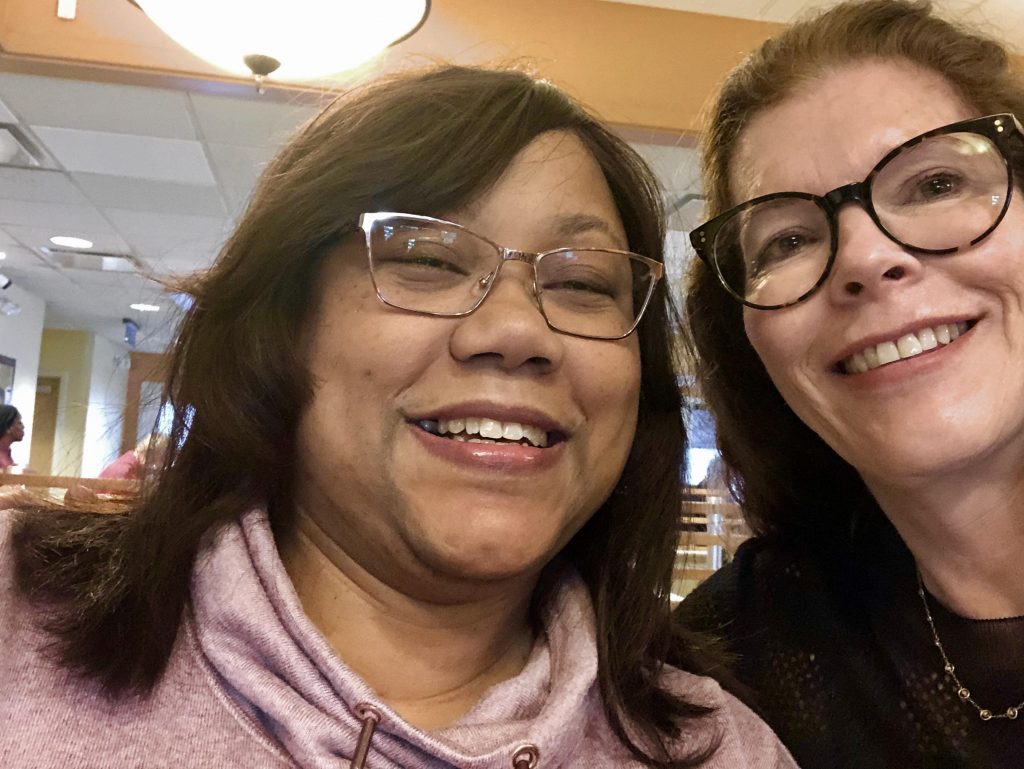
Thomas and Montgomery have only met once in person, when Thomas visited Virginia just before COVID hit and decided to fly out of Norfolk to return home. They met at a restaurant near the Norfolk airport. Once the pandemic is over, Thomas hopes to return.

Personal discovery

The women were well into their research when they made yet another, more personal, discovery. Their DNA results show that they are related to each other—distant cousins. Thomas said she considered Montgomery a cousin even before they knew about that.

“We’re linked because my ancestors enslaved her ancestors,” said Thomas. “We’re doing this to repair the harm.”

For more information about Thomas and Montgomery’s project, visit www.gwynnsislandproject.com. Other information about research on black genealogy may be found at https://ourblackancestry.com, https://linkedthroughslavery.com, and https://comingtothetable.org.

NOTE: Edited to delete extraneous reference to Allison Thomas’ ex-husband, to correct the number of Black residents on Gwynn’s Island in 1916, and to correct the name of the ancestor who lived at Hudgins House. Edited additionally to include the name and background information on the researcher hired by Thomas to delve further into the incidents that occurred on Gwynn’s Island.