
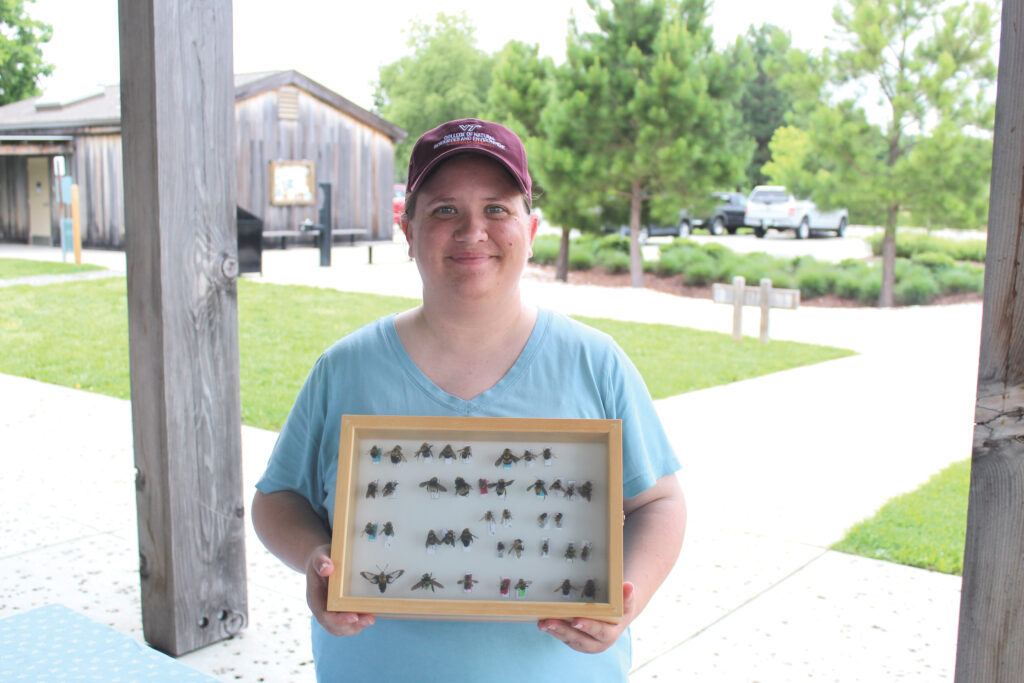
Pollinator ecologist Jennifer Webber from Virginia Tech’s Conservation Management Institute was sponsored by Friends of Machicomoco for a recent talk on various species of bumble bees that inhabit our region. Bumble bees play a vital role in the ecosystem as highly effective pollinators and currently facing impacts causing their decline.
“Today we’re going to talk about one particular group of bees that you know as bumble bees, I know as the genus bombus,” Webber began. “We’re going to start with an introduction to these Bumble Bees, their ecology, their habitat, and what you can do to help them.”
“All the species that we commonly call bumble bees … belong to the genus bombus,” she said. “There are about 250 species worldwide, about 46 species in North America, and about 16 here in Virginia.” As research continues and scientists develop a better understanding of the species, sometimes they discover that species have been misidentified.
“The genus bombus belongs to the family apidae,” she said. “So, apidae is what we consider the typical bees … so these are the bees that we are very familiar with and are really common for us to see on the landscape.”
These bees are generalists and will go for any flower you put in front of them, she explained. “They do not require any particular special plant, they can live wherever we can find flowers … They can be found in pretty much any habitat that supplies enough floral resources for them to exist … I like to say: if there’s enough flowers there, the bumble bee will try.”
“Most of these species just do the general—dive into the flower, suck up the nectar, take the pollen with them—but we do see some species that display a behavior that we call nectar robbing,” she said, explaining that the bee will bite the top of the flower to access the nectar, without having to get pollen all over. “This is not great for the flower because the flower’s goal is to get the pollen out there. But the bee just kind of takes the nectar and runs. This is not super common behavior, but we do see it from time to time.”
“Bumble bees are actually what we consider cavity nesters,” she said. “A lot of these nests are underground, so abandoned rodent burrows, hollowed out logs and stumps that have rotted away and left a cavity there—prime habitat, that’s exactly what they want … They don’t really have that regular hexagon, pentagon shape in the cells, they sort of make more like a sack-like bulb … it sort of looks like a little clump of cups all together and each of these little cups has an egg cell in there.”
Webber described finding nests in the base of grass tussocks and even at the bottom of cattail clumps, in the mud. “If they can make themselves a nice little cave in those little clutters there, they’ll try.” The word hive is often used for bees; however, she explained that “hive” refers to manmade structures. “If you didn’t put the bees in it, it’s not a hive, it’s a nest. If the bees make it for themselves, we call it a nest,” she said.
“Bumble bees are considered eusocial. This means that they do have a true sort of social division within each of their little nests.” Bumble bees do have queens, who scientists often refer to as the gyne, she said. “She’s in charge. Her role is predominantly egg-laying and essentially producing the next round of eggs and generations to come.”
There are also workers who are female and the ones most commonly seen around. “They’re out there collecting pollen, collecting the nectar. Maintenance and building on the nests is mostly done by workers and defense is also left predominately to the workers.” She explained that for the males, they don’t contribute much to the nest, their focus is on finding a queen from a different colony, to keep genetic diversity of the population up, and reproduce, she explained.
“The queen is usually the largest individual in the nest, followed by the female workers which can range in size from little bitty to quite visible depending on how much nutrients they get as they grow … The males are usually medium to small size; they do not get to the size of the queens and they usually do not get to the size of the large defense workers,” she said.
Webber described the life cycle of a bee over the seasons. “Only the queen overwinters, none of the females from the nest survive … she overwinters in a nice pile of leaves and brush and all that sort of stuff. If you see the ‘Leave the Leaves’ campaigns, that’s what this is targeting … If they die over the winter, then the colony is lost.”
If the queen survives the winter, she emerges in the spring, looking for food. “Once she has enough food to keep her going for a little bit, she will go find her own nest … and she will lay her first round of eggs,” Webber explained. “While she is the sole member of her colony, she has to provision all of the eggs that she lays. So, the queen is the establishment … She is very important and her survival is key to the colony.”
When it comes to making more queens, Webber explained that queen eggs are laid specifically. “A nest will produce multiple queens. She’ll lay that first round of workers and once those workers are fully mature they will fully take over the foraging duties and the defense. The queen will remain solely in the nest and her only job from that point on is to lay more eggs: to lay more queens, to lay more workers, to lay more males,” she said.
“There are two broad life strategies that we see in bumble bees,” she said. “Most of them are free living, which means they’re out doing their pollinator job, they’re running around collecting flowers, bringing pollen and nectar back to the hive, but, we do have parasitic bumble bee species.” In the parasitic strategy, “the female’s job is to find an existing bumble colony of her host species and kill the queen,” Webber explained. If the parasitic female manages to kill off the queen and the unhatched eggs, she will lay her own and the colony will care for her and her eggs. “The parasitic males function the same as the males in the free-living colony,” she said, with their goal being reproduction.
Bumble bees, like other pollinators, face many conservation concerns. “We’re losing our pollinators at a very alarming rate, this is absolutely including the bumble bees,” said Webber. “We’ve had some species that have lost up to 80 percent of their former range … This poses a problem. Part of my research takes into account the fact that you cannot separate a pollinator from a plant; they both rely on each other for survival. If we take away our pollinators, then our plant species are going to have a serious problem. I think about two thirds of all floral, flowering species require some sort of insect to assist in pollination; bees are by far the most efficient and most common pollinators used out there.”
There are multiple issues the bumble bees are facing and they’re happening all at once. “The biggest ones that I see are habitat loss,” she said. “Especially here in the east coast, we have developed a lot of our grass lands and a lot of our open habitats into urban spaces, into impermeable spaces that don’t really have suitable habitat left over. Again, they need flowers to survive; if there are no flowers, then they’re kind of out of luck.”
The second biggest problem Webber included is pesticides. “Pesticide over-usage, or in some cases, usage in general. Some pesticides are worse than others,” she explained. “We also see problems in things like invasive species. As we just talked about, the honey bee is not native here and they do compete directly with our bumble bees and our native bees for resources. So, if the honey bee takes all of the food, there is no food for the bumble bee and the bumble is out of luck, and that’s not great.”
Another issue the bumble bee faces is pathogen spillover from honey bees. “They’re very closely related, they’re in that same family and their genuses are closely related. Honey bee illnesses can spread to wild bumble bee populations, so if a hive gets sick, there is a very decent chance that whatever illness they have can catch and essentially spread to the wild population.”
The temperature change also poses an issue. “We just now had our first day above 90 degrees. It’s June. Usually we expect that at the end of May, so as we see these warming patterns change, that affects the plants … If you change the blooming periods of the plants and the bees are not out to help the plants, then it doesn’t matter how many plants you have because you have no bees. So if that mismatch continues, that’s going to be a problem.”
There’s a simple way people are able to help the pollinators as they face these struggles: plant native flowers, she offered. “Even if it’s just your back garden, if it’s changing the seed mix you put on, if it’s a larger area you have to work with. Prioritize our native flowering species, because they’re going to be the ones that are best able to deal with any sort of weird changes that we will inevitably encounter in our climate, they’re going to be the hardiest and they’re going to be the ones that our bumble bees work with the best.”
“Then, once you have planted these native flowers, do not spray them. Please do not spray them with pesticides; that is—again—the biggest issue is pesticides. A field could be fully in bloom, but if it’s covered in neonicotinoids, then that’s a field full of poison.” She also urges leaving abandoned rodent burrows and hollow logs that don’t pose a safety issue. “Maybe you’ll get some new visitors, you’ll have some new neighbors in the form of some bumble bees.”
There are some events you can participate in to help the bumble bees, like No Mow May and Leave the Leaves. “This [No Mow May] is particularly critical for our very early season,” Webber explained. “The queens are out in March/April. If they do not have floral resources for them, then the queen is kind of stuck. So if you could not mow your lawn and let the dandelions come up, that’s a floral resource … That gives time for the queen to establish her colony to get her workers out and once they are foraging more widely and have access to more floral resources, pull up your dandelions.”
“We talked about Leave the Leaves,” she said. “Our queens overwinter in those piles of leaves as well as other invertebrates and vertebrates, honestly. We have little rodents that will also overwinter in the leaf litter and they rely on it for warmth.” She included that you shouldn’t leave wet leaves on sidewalks and those sorts of areas as it poses a safety hazard, but piles of leaves off to the side can help.

