
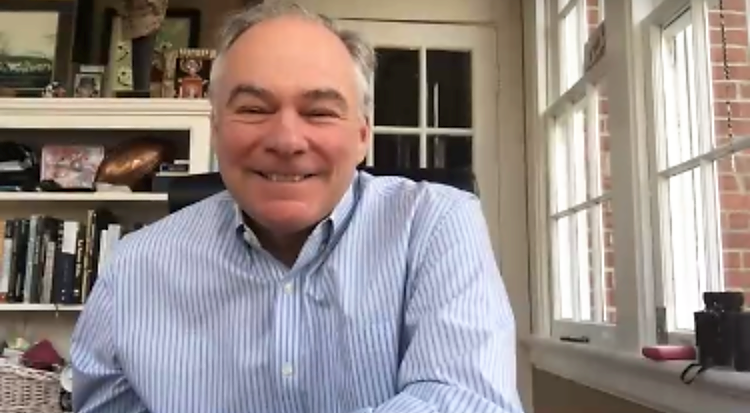
Sen. Tim Kaine paid homage to Dr. Martin Luther King Jr. on Friday morning by discussing the civil rights leader with students of Gloucester High School social studies teacher Dianne Carter De Mayo. Included among the students attending virtually were several members of the school’s W.E.B. DuBois Honor Society.
Speaking from his home on the Zoom platform, Virginia’s junior senator talked about the impact King had on his life and on the nation as a whole. But he didn’t stop there. He went on to talk about civil rights in general, including about local civil rights figure Irene Morgan, and to respond to questions from students about current events, including the recent insurrection at the U.S. Capitol.
Born in 1958, Kaine said he grew up in an all-white neighborhood in Missouri, but still some of his earliest memories were connected to civil rights issues. He recalled coming home from kindergarten to find his mother crying because President John F. Kennedy had been assassinated.
“When you see adults cry, it makes an impression on you,” he said.
That incident was followed by seeing King’s marches on the news and by reading about what he was trying to accomplish. Although there were “very divided opinions” about King across the nation, Kaine said the civil rights leader was someone his parents admired, and he was raised to admire and respect him, as well. That was why one experience he had stood out to him.
Kaine said he was 10 years old when King was assassinated, and his parents were away on a trip. Kaine and his siblings were left with a family friend who regularly babysat for them, a 70-year-old lady whom they loved like another family member. They were all watching television together when a bulletin came on saying that King had been killed, and the woman vehemently commented that “it serves that (N-word) right.”
“That was like the end of childhood,” said Kaine. “You tend to think the adults who love you are perfect, and that confused me. In church they always said ‘love thy neighbor.’ How could a person who loved us say such hateful things? It was a pivotal time.”
Kaine said that Dr. King wasn’t a revolutionary. Instead, he “embraced the mission” of “bringing us back to our principles.”
Reiterating a story that’s familiar to many local residents, Kaine spoke of Irene Morgan, the Gloucester native whose civil rights case led to the U.S. Supreme Court ruling that public transportation that crossed states lines must have a uniform set of rules and therefore could not practice discrimination against Black people.
Kaine said that the struggle for civil rights will go on forever because people aren’t perfect. While the creator of the Declaration of Independence, Thomas Jefferson, was a very flawed person who owned slaves, said Kaine, he nevertheless created “a perfect idea.”
“He had the moral insight to articulate the notion that we’re all equal,” said Kaine.
A statue of Robert E. Lee was recently removed from the U.S. Capitol building and will be replaced with one of then-teenager Barbara Johns, who led a school walk-out in the early 1950s to protest segregation. Kaine said the idea was to emphasize that young people have a role to play in the future of the nation. “Students can tour the Capitol and realize they don’t have to wait until they’re adults to have an impact,” he added.
U.S. Capitol breach
In response to a question from a student, Kaine described his experience during the breach of the Capitol as “very, very bizarre.
“I never would’ve imagined it would happen, I’ll never forget it, and I hope it never happens again,” he said.
The counting of the Electoral College votes normally “is not a big deal,” said Kaine. “It took 17 minutes in 2016.”
But because the president encouraged people to flock to Washington, D.C., to object to the results of the election, and because some lawmakers did object, the Senate and House of Representatives had to go in separate chambers to debate the matter, he said. Kaine had left his cell phone in his office because he didn’t want any distractions from the matters at hand, but he said other senators began getting texts. Then Vice President Mike Pence was told to get out. Sen. Mitt Romney (R-Utah) tried to leave, as well, but was turned around, said Kaine, and everyone was told the Senate was under attack and the doors would have to be barricaded. The large, heavy doors were all slammed shut.
Kaine said he could tell from the noise that the situation was “very serious.” It took about 35 minutes for officers to clear the protesters from one part of the building and allow senators to get to the basement, then into the tunnel, and finally to the Hart Senate Office building. At one point while they were exiting, protesters saw them and began yelling at them, he said. They remained at the Hart Building for around five hours, until the Capitol was cleared out and prepared for their return. Kaine said the sergeant-at-arms suggested that they could continue their debate while waiting, “but we said no, we will go back and finish in public.
“My overwhelming emotion was not fear,” said Kaine. “My overwhelming emotion was anger. I was so mad at the president for spewing lies and trying to get the crowd to stop us from doing our Constitutional duty.”
Statues and monuments
On the issue of statues and monuments, Kaine said that the removal of monuments such as the Stonewall Jackson statue that was previously located on Monument Avenue in downtown Richmond is “not trying to erase history, but to determine who is worthy of honor in 2021.” The Lee statue from the U.S. Capitol was taken to the Virginia Museum of History and Culture, where it will be displayed, he said. Such statues may be taken to museums, cemeteries, or ancestral homes. Each state is allowed to have two statues on display at the U.S. Capitol, he said, and Capitol rules allow them to be changed once every 10 years.
“It’s just a reality that over the course of history there might be a whole lot of people you want to honor,” he said.
Other discussion
Asked whether polarization in the country is real or if the media exaggerates it, Kaine said that issue has been magnified by both the media and by irresponsible leaders. He said that it’s never been President Trump’s intent to try to unify the nation, but to divide it and stoke division.
One student wondered whether Kaine, a known devout Catholic, had ever had his faith challenged, and his reply was, “all the time.
“I’m completely into trying my best to live out the gospel teachings—to save others,” he said. “Whether as a civil rights lawyer or a senator, in every walk of life, you can be a servant.”
Kaine said he approaches every job from a service lens, seeking “the greater good.” While he personally believes the death penalty and abortion are wrong, “My job as an elected official is not to take Catholic doctrine and make it law.”
Following his talk with GHS students, Kaine held a similar roundtable discussion with students at Oscar Smith High School in Chesapeake.

