
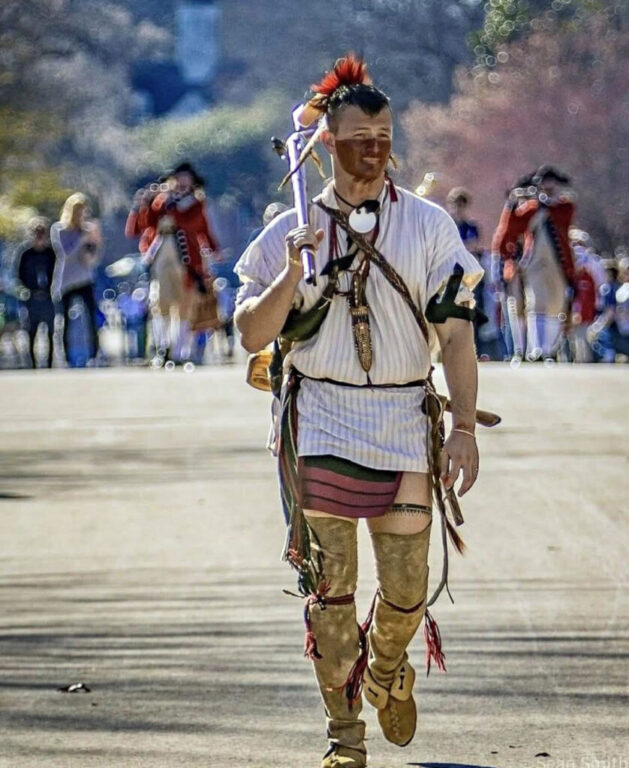
If you have ever wondered what it was like to live in 17th century North America, then Russell Reed is your man.
He has spent the last 15 years of his life learning about Native American culture, technology and history. His expertise in this area was recently highlighted in a nationally televised PBS documentary. In his segment, Reed discussed the Tomahawk, one of the most widely used and coveted weapons of the era.
Reed’s expertise comes from a combination of on-the-job training, formal education, and natural curiosity. After graduating from Mathews High School in 2011, he attended Longwood University to study anthropology on an athletic scholarship. While still a student, Reed started working at Jamestowne Settlement. He demonstrated traditional native life, wore historical garb, and gave tours. Reed describes Jamestown as a “360-day living history museum.” It began as a summer job but continued long after Reed graduated from college. Altogether, he worked at Jamestowne for 10 years.
Reed’s years of experience give him the ability to transport people back in time. For example, he describes the Tomahawk as a blade made of stone set into a wooden handle. They were easy to use and carry, but completely deadly. Reed explains that they could be used for everything from building a home to cutting down an enemy on the battlefield. He says the design was so impressive that English settlers took the Tomahawk (both the idea and design) back to Europe, where they were produced in mass for trade.
Reed’s expertise isn’t limited to weaponry. He also has extensive knowledge of the Anglo-Powhatan Wars. He can describe battles with accuracy and nuance—even providing details about the songs Powhatan warriors would sing after battle. Reed can even quote Powhatan’s brother, Chief Opechancanough, who commanded Native American armies into his 90s.
Reed himself has deep ties to the Native American community. He is a descendant, through his father, of the Atakapa Tribe, located in Louisiana and Texas. Reed even moved to Louisiana, for a time, to be closer to his Atakapa roots. He has also dedicated himself to learning the Atakapa language. Unfortunately, the last fluent speakers died in the 1930s. However, Reed participates in an active language group and studies via a dictionary that was compiled by linguist Albert Gatschet (d. 1907) and anthropologist John Swanton (d. 1958) on behalf of the Smithsonian Institution.
In keeping with his commitment to native traditions, Reed gets a tattoo when it is time to celebrate a major life event. They appear on his arms and legs. One represents his graduation from college; another represents his first successful hunt. Reed says that, in native culture, tattoos tell a person’s story. According to Reed, tribal leaders were known to strip away a tattoo from someone who did not earn it. To the native peoples, a stolen tattoo, similar to the concept of stolen valor, was a “deadly serious” infraction.
During his time at Jamestown, Reed met many people from all around the world. Everyone from a “group of girls from Taiwan” to a “Russian cyclist” passed through on a tour. He says they all had “one thing in common”—they traveled thousands of miles, at least in part, to learn about Virginia history and its people (both Native American and settler). For Reed, this level of interest is a source of pride for Virginians. And it’s important to him that, when people left Jamestown, they had a deeper understanding of the way people lived in the colonial era.
Some of the biggest myths that he encountered were that people “worked hard, died young,” and lived their lives devoid of technology. Reed says this is not necessarily the case. There was dancing, art, trade, and medicine. For instance, there is ample evidence to suggest that Native American healers could mend serious wounds and perform surgery. They even had an understanding of germ theory. Reed contends that, according to some manuscripts, smoke was used as a disinfectant.
When asked if he would like to return to the days of the Virginia Colony, Reed thinks for only a moment before smiling and nodding in the affirmative. He makes it clear that, even though the colonial past was not a “magical paradise,” it would have had its advantages. He recalls the journal entries of settlers that recorded what Jamestown looked like when they arrived in the 1600s. Reed says waterways were described as completely clear, filtered by oysters that were regularly the “size of a grown man’s hand.” He mentions how the trees were painted as endless. In other words, it was a simpler time when people lived more closely to nature.
Public historians like Reed remind us all that our connection to the past is not as distant as one may think. For instance, we still use words today that come from the Virginia Algonquian language. Raccoon, opossum and hickory are just a few examples. He encourages people to get involved and learn more. He says local museums and public libraries are a good place to start.
Virginia tribes have up-to-date websites, working museums, and regularly host events that are open to the public. When Reed attends such events, he feels part of a larger “movement” in which Native American youth are making an effort to learn their tribal language and the skills used by their ancestors.
Nowadays, Reed lives and works in Mathews. His days are filled making “dug-out” canoes for local tribes and museums. He also interprets at Fort Monroe once a week. His dedication to preserving history is admirable. Reed and other historians like him serve as links between the present and the past. After all, Virginia has a long, rich history full of battles, songs, dances, traditions, hardships, and, most importantly, people. Their stories, struggles, and triumphs echo through artifacts to remind all Virginians that the past is still here.


