
Much has been written about the history of Rosewell Plantation, the 18th century Georgian mansion whose majestic ruins stand today overlooking the York River in Gloucester.
But little if anything has made it into the history books about the men, women and children whose sweat and blood made Rosewell into one of the largest and finest of American houses of the colonial period, building the mammoth structure, tending to its crops and serving the whims and desires of the plantation’s owners—the thousands of enslaved people who once lived and died upon the land.
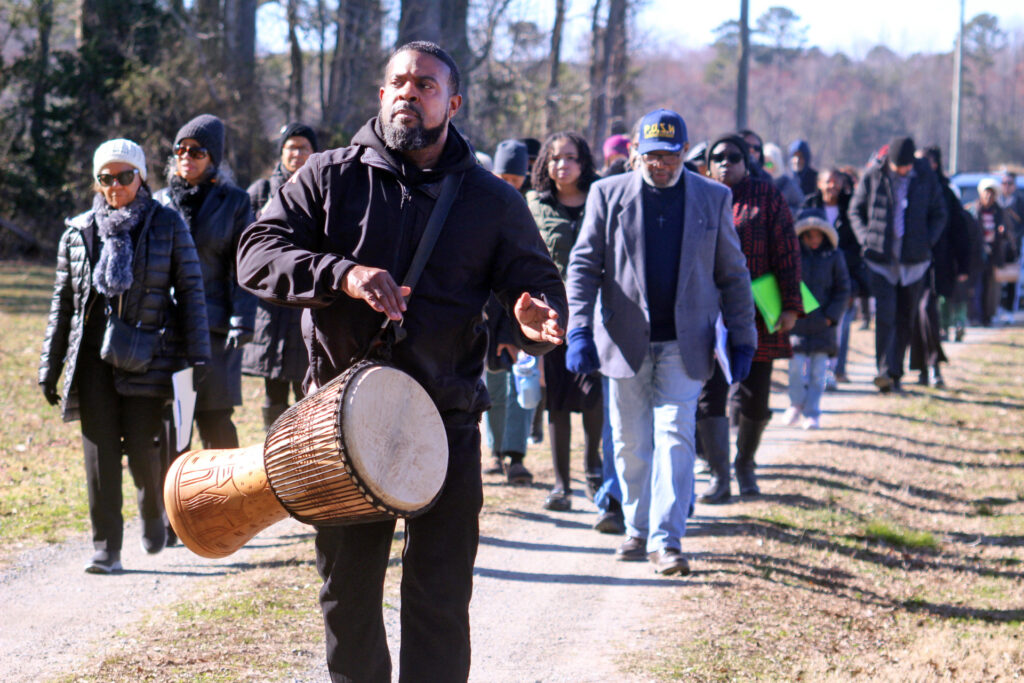
A group of about 75 people gathered at the site Sunday afternoon in an attempt to honor their memory in a “Blessing of the Ground” ceremony.
The ceremony was held to consecrate the ground where a Remembrance Structure will soon be built to recognize those who were held in bondage from the colonial period until Emancipation.
Led by Willie H. Wright, a historic interpreter from Colonial Williamsburg, who played a traditional African drum, the procession made its way from the Rosewell Visitor Center to a field in front of the ruins of the colonial mansion.
“Some of your ancestors may have tread upon this land,” the Rev. Ward Warren Jr. told the assembled guests during his opening prayer. “We are all guardians of history,” he said. “We want the whole truth told … that we may get over our differences,” Warren added. “We want you to open your hearts, open your minds.”
The Rev. Dr. Katrina Brown attempted to provide a history of slavery at Rosewell. Slavery existed long before construction of Rosewell began in 1725. “Historic houses are much more than brick and mortar,” she said, inviting those present to walk in the steps of those enslaved here.
“Most of these names we do not know,” she said. In addition to those who built the magnificent structure, the enslaved served as everything from field slaves to tend the crops, house slaves, cooks, carpenters, etc. “Everything done on this plantation was done by the enslaved,” she said.
“History likes to remove the history of the oppressed,” she said, and not many documented records exist of the enslaved at Rosewell and that omission was meant to obscure their humanity. “Absence of proof is not proof of absence,” Brown said.
Today, she said, we honor those we know and the many thousands we do not. She then read from an account from Josiah Deans, who owned Rosewell from 1853 until his death in 1881. The account was an inventory of a “loss of property,” the value of enslaved men and women who escaped into federal lines in 1862.
The accounts included each of the enslaved’s names, their occupation and their estimated “value”—such as Daniel, age 30, a dining room servant valued at $1,500; and Peggy, 27, a cook “valued” at $800.
“Never again shall we refer to human beings as ‘property,’” Brown vowed. “We will never forget.”
Apostle Markita Brooks led the assembled group in a Prayer of Sorrow and a Blessing of the Ground. “Father, we ask that you cleanse this ground,” she said, a land “defiled by sin, deception and innocent blood.” Rosewell, she said, “set the model for slavery throughout this state, throughout the South.”
“We ask Father that you forgive. We ask Father that you heal,” Brooks said. “We ask that you break every curse … You can break the bonds. You can set the captives free.”
She placed unleavened bread and poured wine onto the ground, symbolizing the body and blood of Christ, asking that “the souls of those who lived and died here” be healed.
She then donned a white robe and conducted a West African libation ritual, pouring water on the ground to honor the ancestors. “This is not the end,” she said. “This is the beginning.”
The program included a closing prayer by the Rev. E. Randolph Graham (who held aloft one of the Rosewell bricks that bore the fingerprint of the enslaved man who made it), as well as musical performances by Margaret Jones, Tristan Butler and the Woodville Rosenwald School Descendants Community Choir.
The Remembrance Structure will be built using period techniques and materials by Salvage Wrights Ltd. of Orange, Virginia, beginning next week. Another service will be held to dedicate the structure at 3 p.m. on Sunday, April 6.
The Rosewell Ruins and Visitor Center is managed by the Fairfield Foundation. A 501(c)(3) organization, the foundation was created in 2000 to promote hands-on archaeology and historic preservation, also managing the Fairfield Archaeology Park, Edgehill Service Station (the Center for Archaeology, Preservation and Education, or CAPE), Walter Reed’s Birthplace and Timberneck at Machicomoco State Park.


Sunday’s program included a performance by members of the Rosenwald School Descendants Community Choir. Shown here singing are, from left, Deborah Billups, Jeanne Weldon Travis and Donna Shannon.


The Rev. Dr. Katrina Brown attempted to provide a history of slavery at Rosewell during Sunday’s program.

“Some of your ancestors may have tread upon this land,” the Rev. Ward Warren Jr. told the assembled guests during his opening prayer.

