
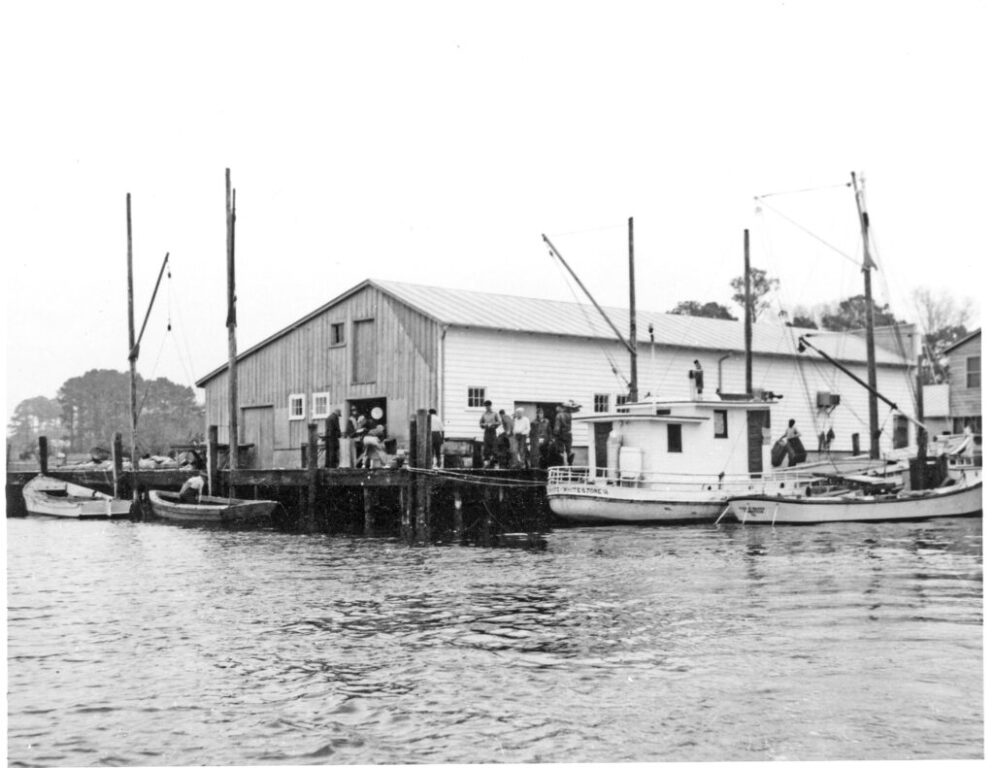
Growing up on Gwynn’s Island in the 1950s had its charms. I was a bike ride or a few steps away from several beaches, afternoon football games, adventures in the woods, playing along the shore, and all of the fun things that come with being a youngster in a small coastal community. Because of my family connection, among those fun things for me were adventures at Callis Wharf.
A typical summer day for a boy would include wearing short pants, tennis shoes, and sometimes, a shirt. There were soft crabs to catch: we would use a dip net to scoop them up as they clung to the many wooden pilings that surrounded the docks. Fishing was done on the end of the dock facing Milford Haven. If you didn’t have a rod and reel, you could go into the grocery store that my family ran and buy a hook, a sinker, and some fishing line. You could tie one end of the line to one of the pilings in the absence of a fishing rod, and then throw the other end with the hook and sinker into the water. For bait, we would use either soft crab or perhaps a bloodworm, also purchased at the store.
The many nooks and crannies in the warehouses and other buildings provided excellent opportunities for hide and seek.
Refreshment was needed after all of the hard work and play. Those little 7 oz. Coca-Cola bottles were a dime, often with a bag of Lance salted peanuts poured in them. There was a penny candy counter, complete with the tiny brown paper bags to hold your selections. Root beer barrels, several kinds of bubble gum, a molasses chew called Mary Janes, fireballs and other sweet confections filled the counter. Candy bars were five cents. Ice cream sandwiches were a dime.
History of Callis Wharf
Callis Wharf has long been a recognized landmark on Gwynn’s Island. The oyster shells that my great-great-grandfather, William James Callis, used as ballast in his schooner on his return trips from Baltimore during the 1860s and 1870s were dumped between log pilings that had been driven to the bottom on a point near his home on Milford Haven. The continued dumping of shells built up the area where the first wharf was built.
My great-grandfather, Walter Eugene Callis, built an improved dock on the same site and the wharf became a stopping point for the Maryland Steamboat Company, which operated from Baltimore to various docks and landings in the Northern Neck and Middle Peninsula in the early part of the twentieth century. This company gave way in later years to the Baltimore, Chesapeake, and Atlantic Steamboat Company.
The steamboat provided not only transportation to cities and towns along its route but also was a means of transporting items to area residents that weren’t available locally. If you ordered something, it usually came on the steamboat. I have a recollection of an antique headboard that some friends bought at an auction. On the back, written in chalk, was the name of the person who had ordered it and the address of Callis Wharf, Virginia. My grandfather, Elwood Eugene, had a fleet of trucks to provide a delivery service of freight ordered by area residents that came into Callis Wharf on the steamers.
By the mid-1930s, the steamboat became an outmoded means of shipping. The steamboat made its final call at Callis Wharf in 1935.
Grandfather Elwood began operating his father’s seafood buying, packing, and shipping business in 1912 at the age of 17. The abundance of seafood in local waters provided the resource, and the seafood industry at Callis Wharf thrived in the first half of the twentieth century, reaching its heyday in the 1950s. At its highest point, the business had over 200 employees. My grandfather was active in the business most of his adult life. At our grocery store one day, I remember someone asking him “How’s fishing?” He replied that he didn’t know … he hadn’t been fishing since 1919.
During the ’50s the docks at the Wharf were bustling during the summer months. Crabbers would bring in their daily catches during the morning hours. The crabs were unloaded and weighed, then put in baskets or barrels before being transferred to the big metal cages that were lowered into the crab steamer to be cooked right there on the dock. I have a vivid visual in my mind of my father, Elwood Callis Jr., standing on that dock operating the steamer with a cigar in his mouth. Once the crabs were steamed, they came out of the cooker and were taken to the picking room. There, workers were waiting to begin getting the prized crabmeat out of the shells before it was packaged in cans, ready to be shipped to market. During this decade, workers picked over 5,000 pounds of crab meat a day.
During the cold weather months, oysters took center stage. In the peak years, over 200 gallons of oysters were shucked daily. I recall the long concrete counters where the oyster shuckers stood in elevated stalls. I remember helping to shovel truckloads of oysters into wheelbarrows as a teenager.
Several grocery stores were operated at the wharf during the century. L. R. “Scrooch” Callis, a first cousin of my grandfather, had a general store at the site prior to going in business with his brother Rodney at the site of the Grimstead Post Office. My grandfather then ran a more modern grocery store after that. My brother Eugene ran the store before he became Mathews County Deputy Clerk, and then Clerk. My mother Charlotte managed it for several years after that. After our family sold the store business, several locals ran a store there before it ceased operations in the late 1970s. As a teenager, I worked at the store: stocking the shelves, unloading the cases of dry goods that came weekly by truck, and delivering groceries to area residents. Someone would phone the store, we would hand write their grocery list then fill the order, and deliver all over Mathews … for free.
Back then, the store stayed open until 8 p.m. On most weekday nights, many of the men came back to the Wharf and congregated in a room at the rear of the store. One side of the room had a built-in storage bench, and the other an old church pew. There they would sit and discuss the day’s catch, politics, and any other topic that was timely. The room was warmed by a gas heater and the air was so thick with cigarette and cigar smoke that you could barely see across the room.
Our family sold Callis Wharf in 1971 and it has changed hands again since then. While the booming days are a thing of the past, commerce at the Wharf continues today. Some business ventures have come and gone. Yet, seafood is still caught, unloaded, and shipped from the Wharf. There is a seed oyster operation going on in what we called the big warehouse where oysters are hatched and then sold to growers in the area. Located on the Milford Haven side of the building, The Hatchery seafood truck is a very popular outside eatery, where diners can enjoy the delicacy while enjoying water views and sunsets.
I’m the last person with the surname of Callis that had any connection to Callis Wharf. I was too young to have any kind of supervisory position with any of the business ventures, but that part of my childhood and the adventures I had there are forever etched in my memories.


