
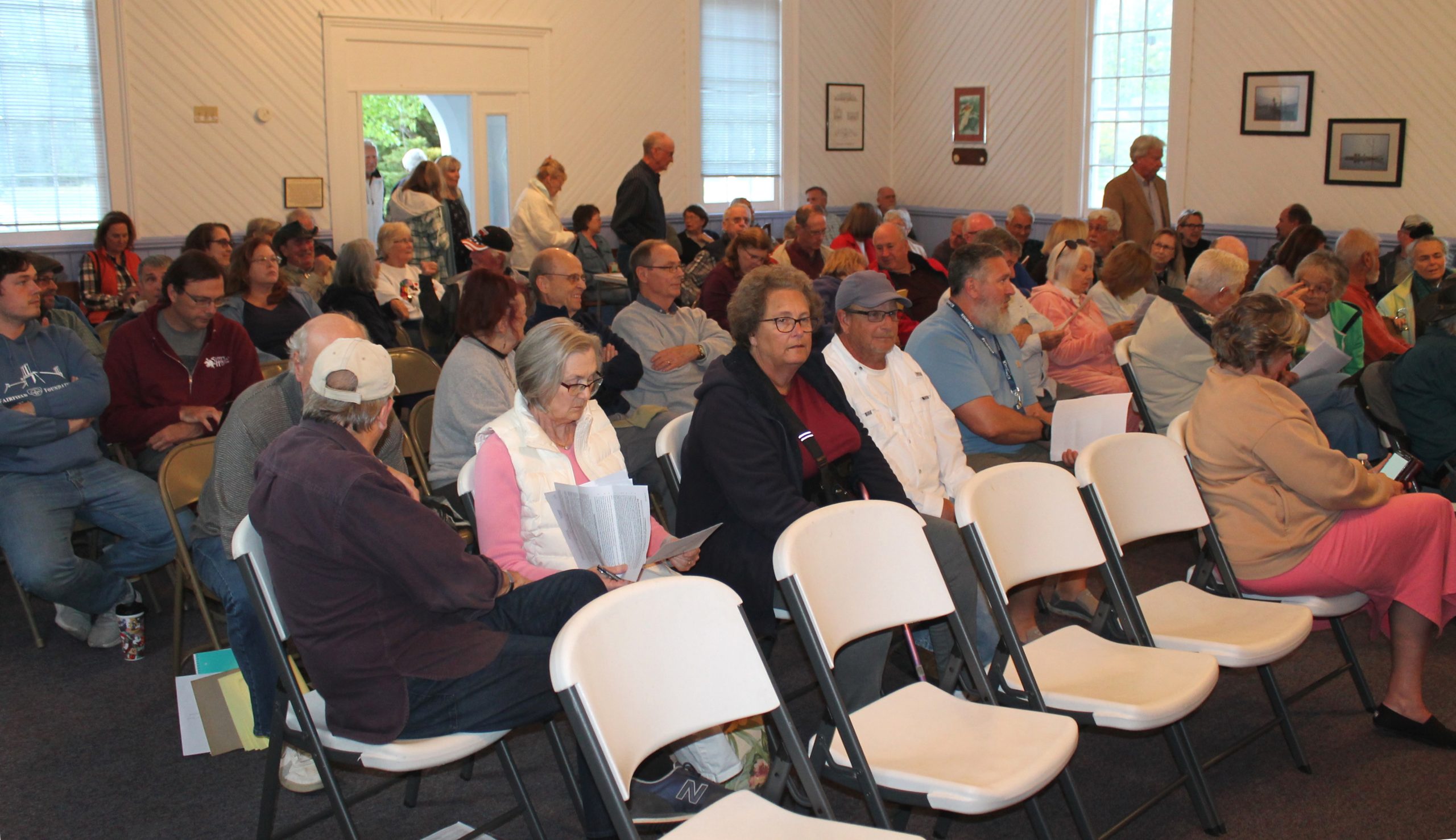
The designation of Gwynn’s Island as a historic district took another step forward last Thursday night as Preservation Mathews and the Virginia Department of Historic Resources held a public hearing on the proposed district before a packed audience at the Gwynn’s Island Civic League.
The next step will be on June 15, when a decision will be reached on the designation during a joint meeting of the State Review Board and the Virginia Board of Historic Resources at Mariners’ Museum in Newport News. If approved at that meeting for a listing as a historic district in the Virginia Landmarks Register, the nomination will go to the National Park Service for consideration for listing on the National Register of Historic Places.
Lori Jackson Black, president of Preservation Mathews, provided residents with a brief history of the project, saying that it began a number of years ago with initial efforts by the Mathews County Historical Society. The preservation organization then took over the project and received grant funding in 2020 to pay Data Investigations of Gloucester to complete a survey of historic properties on the island and to write the nomination for the district.
Joanna McKnight of VDHR gave further information about the project, including that a countywide architecture survey was completed in 2014, paid for with cost-sharing funds, followed in 2015 by an archaeological assessment on Gwynn’s Island, when important sites and critical threats from coastal flooding and erosion were identified.
In 2017, a preliminary information form was submitted to DHR for a Gwynn’s Island Historic District, and the island was found eligible; in 2020, Preservation Mathews secured the grant for the work.
Preservation Mathews and DHR held public meetings about the efforts on March 5, 2020 and June 3, 2021. These meetings had advance notice and follow-up articles. There was also an article about the grant award on March 18, 2021.
McKnight discussed what it would mean to be listed as a historic district in the Virginia Landmarks Register and the National Register of Historic Places. She emphasized that the designation is an honorary recognition of the historical significance of a place, building, site, or area at the state and national levels and does not carry any restrictions for property owners. It doesn’t prevent changes to a structure, including demolition, and it doesn’t require that property owners restore their homes or renovate them or meet any design requirements, she said, and they don’t have to open their homes to visitors.
There are some benefits associated with having a home in a historic district, said McKnight, including increased tourism and associated economic development. In addition, property owners can donate easements, which could help lower their taxes, and they could be eligible for state and federal tax credits.
Finally, McKnight said there could be some limited protections for historic properties that might be impacted by road construction, flooding, and other threats.
In order to be designated a historic district, the island needed to have an adequate number of qualifying structures that could meet one or more of four criteria. The structures must be associated with A. An important event or historical trend, B. A significant person whose specific contributions to history can be identified and documented, C. An important architectural or engineering design; or D. Have the potential to answer important research questions about human history. In addition, each qualifying structure must be at least 50 years old and retain a good amount of physical integrity.
Gwynn’s Island was mentioned in the nomination as meeting all four criteria, said McKnight, but it was determined that criteria A and B were the best fit.
During a question-and-answer session, a handful of island residents expressed concern about being included as part of a historic district without their consent. They said they didn’t know anything about the proposal until they received letters about the meeting.
One woman asked if she could opt out of the historic district, but found that, while she could raise objections in advance, she couldn’t opt out once the designation was made. She further questioned the process, by which anyone raising objections must put their objections in writing and submit them to DHR via notarized letter. She said that, instead, each property owner on the island should have gotten a ballot so they could vote for or against the designation.
“It’s onerous for people who are against it to have to write letters while people for it do nothing,” she said. “It’s not fair.”
McKnight explained that the process for approving a historic district was drawn up by the Virginia General Assembly and that objections to that process would have to be addressed to the state legislature. She said if half of the property owners on Gwynn’s Island “plus one” objected to the project in writing, it would trigger a review by the board.
Other objectors expressed concern about such things as “something hanging over” their property, what might happen at the county level if such a designation is made, increased traffic, increased property values and taxes, and the National Park Service “getting control” and “having domain” over the island.
“They [the National Park Service] have no power over this island. Zero,” Black said.
Preservation Mathews member Tom Karow said he is a certified real estate appraiser who appraises houses in many localities and that a historical designation “means nothing in terms of value.”
A man who identified himself as a general contractor said he had seen the historical designation process play out in several different communities, and that his clients had gotten 25 percent of the cost of their renovation projects offset by tax credits. A $200,000 remodel received a $50,000 tax credit, he said, and while the property owners didn’t have that much tax debt, they were able to sell their tax credits to others.
“It’s very beneficial for residents who want to do things to their homes,” he said.
Island resident Maxine Francisco told those objecting that they were “making a mountain out of a mole hill.”
“We’re trying to get an honorific designation,” she said. “It won’t raise taxes or put any restrictions on us. It won’t make a hill of beans in your everyday life.”
Francisco said she had worked as a realtor and that “I never got a nickel more for a house and they never paid a nickel more because it was in a historic district.” She said further that she had been to all the meetings that had been held, and if others objected, they should’ve made it known.
“This has been discussed for years,” she said.
Black explained further that Preservation Mathews had initially been approached by Gwynn’s Island residents who were proud of their historic homes and wanted them recognized.
“We’ve tried to get the word out as best we can,” she said. “I’m sorry you didn’t know. We’re all just volunteers doing something to try to help the community. We’ve followed the rules from the ground up, and this is the first time anybody has raised any objections.”
To comment on the district, send a letter to Julie Langan, director of VDHR, at Julie.langan@dhr.virginia.gov. To object to the district, send a notarized letter to Langan at 2801 Kensington Avenue, Richmond, Va. 23221.

