
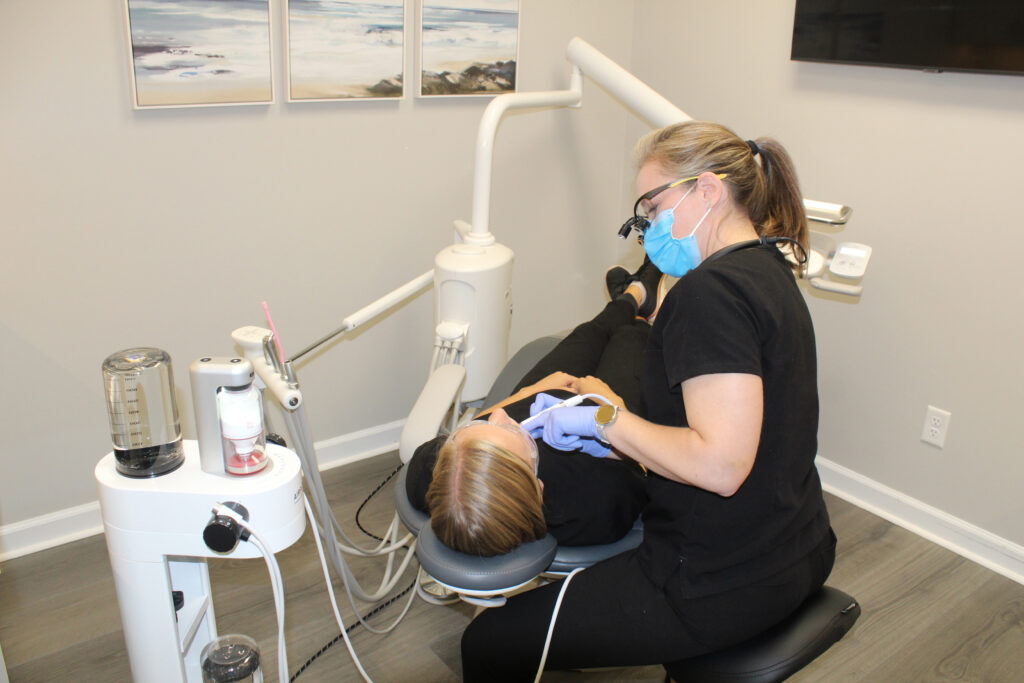
Point Periodontics and Implants, Hayes, is moving out of the past with current, innovative technology and procedure that enhances Dr. Jennifer Anderson and dental hygienist Erin Davis’s work.
A periodontist, Anderson specialized in gum disease and works with dental implants and gum tissue grafting. Davis focuses on clients in periodontic maintenance who have already had gum disease treated and are trying to maintain a healthy mouth.
Anderson, who became owner in early 2024, has worked to ensure the practice is using up-to-date and evidence-based knowledge and procedure to offer clients the best care possible. “We’re always trying to follow the latest [information] that has solid evidence, not just the latest fad,” she explained.
As leaders in their field, Anderson’s team is looking at what is showing excellent results, repeatedly. Point Periodontists had already been using Piezoelectric dental equipment, which is supposed to be a bit gentler on the teeth.
Recently, they were introduced to a new system and protocol that looks at the biofilm in the mouth, rather than just the teeth. “Bacteria are everywhere, not just on the teeth,” explained Anderson. “You have the traditional model, largely ignoring a lot of places in the mouth where bacteria were, so we shifted to this system that really looks at biofilm everywhere.”
Knowing change can be difficult, Anderson and Davis were pleasantly surprised to find that the experience reminded clients more of a dental spa day than anything else. “We’ve been using it for a little over three months, I’d say, and we’ve gotten great feedback,” Davis said.
The protocol begins with protecting the lips from the disclosing solution placed on the teeth, using an OptraGate. “That is the part I get the most hesitance with because I’m putting something in their mouth that’s going to hold their mouth open,” explained Davis.
The disclosing gel is called the Tri Plaque ID Gel that shows up as different colors based on the different bacteria in the mouth. “Bacteria that’s been in [the mouth] for more than 48 hours will be a different color than newer bacteria,” Davis said. “It also highlights the cavity-causing bacteria, like the acidic-based bacteria.” This gives Davis an idea if a patient is at a higher risk for cavities so they can be treated accordingly.
After the disclosing process, Davis will hand the patient a mirror to look around their mouth to get a better understanding of where the bacteria accumulate. Davis then polishes the teeth, which is where the AIRFLOW machine makes its appearance.
Rather than using a rubber cup to polish, the AIRFLOW warms water that mixes with Erythritol powder. “A lot of patients say that it feels like I’m spraying warm water on their teeth, they can’t even tell that there’s something polishing off the bacteria and plaque,” Davis said.
Traditionally, instruments are used to scale first, scraping off the plaque and tartar buildup on the teeth, particularly below the gum line, then polish, but the new protocol reverses that. “So, we are highlighting the bacteria and that’s kind of guiding how we’re cleaning so we can actually see what we’re doing,” said Davis.
Using the powder and water creates a more non-contact, less abrasive experience. The Erythritol powder also contains anti-cavity and antioxidant properties. “It really helps with tissue healing,” explained Anderson. The heated water and less contact are also easier on patients who deal with sensitive teeth.
For any touch-ups required after the polishing, the Piezoelectric piece, which the practice was using before the introduction of the new protocol, is used. “We’re finding that we have to use it a lot less because the polishing piece takes care of a lot of the stuff that we used to have to remove with the Piezo,” said Davis.
Anderson and Davis became certified with the new equipment in August. A hygienist came from Massachusetts to do almost eight hours of training, going over the whole system. “It was a little bit of a process, but totally worth it,” Anderson offered. “We feel like it’s more comprehensive because we’re really cleaning the whole mouth.”
“I know it’s hard to change something you’ve been doing one way, but I don’t think either of us would want to go back,” Davis added.
Patients who had previously had a lot of cavity-causing bacteria have returned with less through this new protocol.
“That original powder that has those anti-cavity properties is actually doing its job, you can see it,” Davis said. “It really can make a difference with tissue inflammation because the powder is sneaking below the gums and flushing out the bacteria where you couldn’t get to with that little rubber cup before.”
Anderson has implemented some other new things at the practice since she took over, including a handheld X-ray unit called a Nomad Pro 2. It’s “less radiation and a much faster, and therefore more comfortable, patient experience,” she said.
A Trios 5 Intraoral Scanner makes 3D records of a patient’s bite and tissue conditions. “We use this as part of our implant planning and to communicate with other dentists for collaborative care,” she explained.
The Axeos CBCT machine allows Dr. Anderson to take 3D X-rays and plan implants for a streamlined experience for her patients. With the use of Guided Implant Placement, she is able to merge the data from the CBCT and the Trios 5 to create a plan for each implant, offering precise placement.
“We’re [moving] into 2025 technology with as much as we can, because we really are trying to provide, to our professional standard, the best we can,” said Anderson. Her entire team will continue striving to be leaders in their field and offer an exceptional patient experience, she said.

