
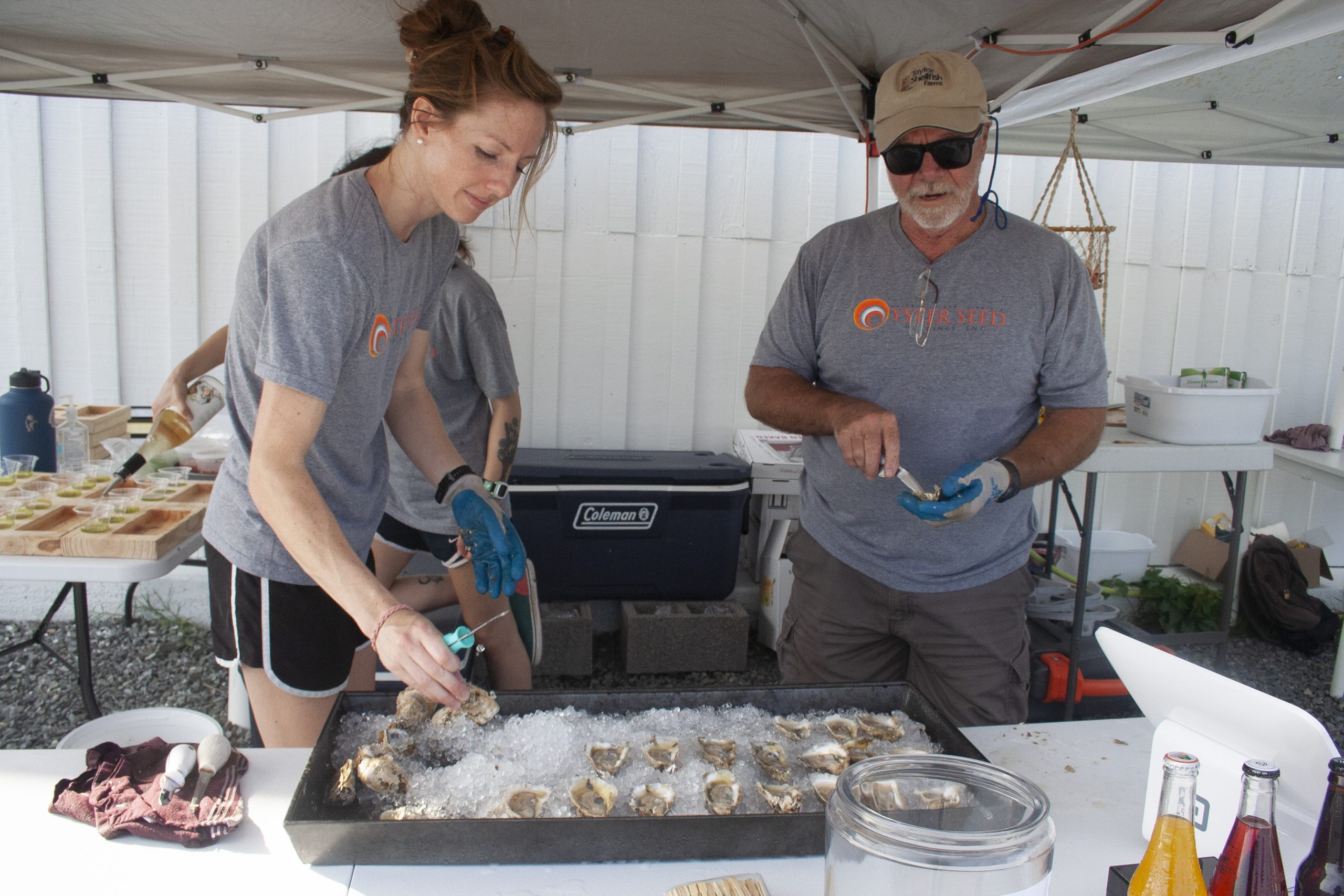
Oysters are definitely a local delicacy. But did you ever wonder about how they made it on your plate? Then you may be interested in taking a behind-the-scenes tour of a Gwynn’s Island facility—and also enjoy a tasty sample or two.
Oyster Seed Holdings, Inc., is a hatchery-specific company on the “growing edge” of shellfish culture, bent on driving forward hatchery technology and ensuring steady supply of premier quality oyster larvae and seed to farms.
Every other Friday evening, OSH opens its doors to the public for a hatchery tour and tasting, offering a chance to see what it takes to put oyster seed in the hands of aquaculture farmers.
They have a tour guide to take the guests through the facilities. On a recent Friday, the tour was led Samantha Glover, who is the Research and Development Manager at Oyster Seed Holdings. The first part of the tour is of the broodstock room, where they condition the adult oysters. These oysters within the facility were donated by the Virginia Institute of Marine Science and their oysters spawn every Thursday once the season has started.
“It takes about 18 months for us to grow oysters, where it would usually take about two years in the wild,” Glover explained.
After the tour of the broodstock room, guests are led to the algae lab, where the guide explains how this helps in the process of growing oysters at the hatchery. Glover said that in the algae lab they add seawater to their beaker and add nutrients to the water, making sure that there are no impurities before feeding the larvae. They take a look underneath a microscope to make sure that everything is OK.
After that, Glover showed visitors the Recirculating Aquaculture Systems (RAS). This is the area where the water quality is adjusted to support the larval culture in the tanks. Larval culture is also fed to the algae grown in the algae lab. The larvae’s water is changed every other day, and the tanks that they are kept in are cleaned as well. Their progress is watched under the lens of a microscope and once they have gone through this process, the larvae go through the setting system.
Glover then showed the group their outdoor nursery, where the tiny oysters are kept. While in the outdoor nursery, the guide showed the group some of the tiny oysters already in the outdoor nursery, scooping some up in her hand.
At the end of the tour, they allow you the opportunity to try their oysters and you will be able to have beer and wine with your oysters. There is also a chance of running into owner Michael Congrove, who enjoys speaking about all they do at OSH and the benefits of oysters to the environment.
“We give our oysters to farmers ranging to areas from Rhode Island all the way down to Florida,” he said. “With oysters, we are not only growing a great protein, but it is also great for the environment.
“Oyster Seed Holdings opened in 2009,” he said. “We decided to start building this place quietly. We did not do it intentionally. We have since then decided to try getting aquaculture out there and building more of a community by inviting people to come on tours.”
Oyster Seed Holdings holds tours every other Friday. They have up to six 30-minute tours for groups of six, starting at 5 p.m. The cost at $20 per person, the tickets are for oyster tasting and a tour through the hatchery. This also includes access to their pop-up oyster bar from 5-9 p.m., where guests can look out over the water as the sun goes down while sampling oysters, beer and wine; more may be purchased.
For more information on Oyster Seed Holdings, and to arrange a tour, visit www.oshoyster.com.

Scott Dinning puts charcoal on the grill to start roasting the oysters.

