
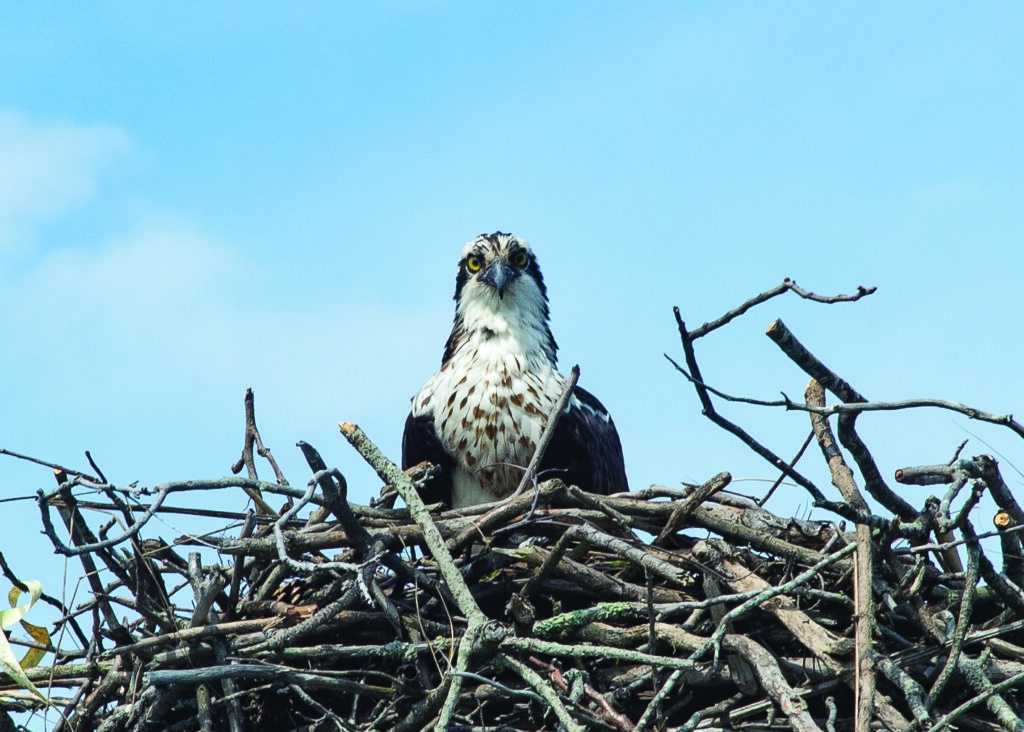
The Center for Conservation Biology at the College of William & Mary compiled its 2024 breeding performance results for osprey in the Chesapeake Bay last month after the end of the nesting season, which begins in March and lasts through August. Based upon direct observations during nest visits, the largest contributing factor to poor breeding performance was the loss of young due to starvation, the report said.
According to the report, low food availability leads to a sequential loss of young and results in smaller brood sizes or nest failure. One of the best indicators of food stress in Chesapeake Bay ospreys is the frequency of single-chick broods in the population.
The monitoring effort included 511 osprey pairs distributed among 12 study areas. Nine study areas were within the main stem of the bay where salinity exceeded 10 parts per thousand and two study areas (used as reference sites for comparison) were positioned on upper tributaries within tidal fresh reaches where salinity was less than 1 ppt.
Osprey pairs nesting within waters above 10 ppt salinity are believed to be highly dependent on Atlantic menhaden to raise broods. Osprey pairs nesting within tidal fresh waters feed primarily on catfish and gizzard shad, the report said.
Breeding pairs were monitored throughout the nesting season to determine nesting success and productivity. Cameras were mounted on a subsample of nests within all study areas to quantify diet and brood provisioning and to determine the cause of nest failure. Compilation of camera data has not been completed, the report said.
Mean breeding performance for osprey pairs nesting within the main stem of the bay did not meet levels believed to be required for population maintenance (1.15 young/pair). Collectively, the reproductive rate was 0.55 young/pair.
However, breeding performance did vary between study areas with two areas falling in the range of minor deficit (0.8-0.9 young/pair), two sites falling in the range of moderate deficit (0.6-0.8 young/pair) and five sites falling in the range of major deficit (less than 0.6 young/pair). By comparison, the reproductive rate within reference sites, defined here, was 1.36 young/pair which is above the maintenance target.
The osprey breeding performance in the main stem of the bay that was documented in 2024, and for the past several years, is not sustainable, the center said. In the absence of immigration from other parts of the bay, or outside of the bay population, the population would be predicted to decline. To date, the Center for Conservation Biology has not conducted surveys throughout the entire main stem to evaluate trends in the breeding population.
2024 objectives
In recent years, the Center for Conservation Biology has published papers on the historic decline of osprey breeding performance in the Mobjack Bay, a sub-estuary of the lower Chesapeake Bay, and the role of menhaden in driving the decline.
The center said the primary objective of fieldwork in 2024 was to expand the geographic scope of osprey monitoring to better understand their reproduction throughout the portion of the bay where the species is believed to be menhaden dependent.
Additional objectives include achieving a better understanding of the spatial variation in osprey reproductive performance, quantify osprey diet throughout the main stem of the bay and work to develop a field metric that is a reliable indicator of food stress.
Study areas
The main study area was delineated based on the 10 ppt contour throughout the Chesapeake Bay. Nine study areas were delineated throughout the main study area in early 2024 based on logistics and the known density of osprey to facilitate efficiency.
Specific study areas in Virginia include the Lynnhaven River, Elizabeth River, Poquoson River, York River, Mobjack Bay, Piankatank River, Fleets Bay and Eastern Shore bayside. In Maryland, study areas were Patuxent River and Harris Creek.
Reference study areas were selected within tidal fresh reaches of upper tributaries based on the same criteria. Reference study areas include the upper James River and upper Rappahannock River in Virginia.
Breeding performance
Poor breeding performance was widespread throughout the main stem of the bay and none of the study areas reached demographic targets. Although spatial variation in performance was evident throughout the season, most of the study areas were considered in the range of major reproductive deficit, the report said.
The overall reproductive rate for pairs in the main stem of the bay was approximately 50 percent of that believed to be required for population maintenance. By comparison, reproductive rate for pairs breeding within reference sites was well above maintenance levels. Both clutch sizes and hatching rates were generally consistent between the main stem and reference areas and throughout the main stem sites.
A large number of osprey pairs did not lay clutches during the 2024 nesting season. These pairs arrived from wintering grounds in a timely manner (late February to early March). Most of these non-breeding pairs remained resident throughout the nesting season and defended territories, but were never documented to lay eggs.
This is the first time this behavior has been documented on a large scale within the Chesapeake. The report said a likely explanation for the behavior is that females were not able to reach the adequate physiological body condition required to lay eggs.
Causes of nesting failures
Osprey pairs are subjected to a wide range of forces that may lead to nesting failure. These can include contaminants, weather events, nest competitors, predators and more. Based on other observations and published studies, disease, competition for prey, depredation and pollution do not currently appear to be significant causes of reproductive failure, the report said.
Poor breeding performance throughout the main stem of the bay in 2024 was driven by the loss of young after hatching. A clear indicator of food deficit, or stress, within an osprey nest is the development of asymmetric broods where the young differ in size and developmental stage, the report said, which added that the appearance of asymmetric broods is a precursor to brood reduction by the sequential loss of subordinate young to starvation.
One example of food stress and brood reduction leading to nest failure was captured on a nest camera within the Eastern Shore study area. The female laid and hatched three eggs. The signs of food stress appeared early in the brood dynamics, the report said. Over a period of three days, the two smallest young died.
The third nestling survived another four days but, after 38 hours without food, died during the night. The next morning, the male delivered a fish and the female attempted to feed the dead young. The female continued to shade the young for the rest of the day.
Implications
Overall, poor reproduction in ospreys is not restricted to the historic study area of Mobjack Bay, but is widespread throughout the main stem and likely involves thousands of nesting pairs, the report said.
Whether there will be a broad-scale decline in the osprey breeding population ultimately depends on the relationship between areas (such as the main stem) that are in reproductive deficit and areas (such as the reference sites) that are producing a reproductive surplus. A determination of whether the bay population as a whole is sustainable given the current prey situation is a topic of ongoing investigation, the report said.
The Center for Conservation Biology, Virginia Aquarium, Maryland-National Capital Park and Elizabeth River Project were all partners in this study.
Ospreys continue to experience poor breeding due to starvation

A clear indicator of food deficit within an osprey nest is the development of asymmetric broods where the young differ in size and developmental stage. An example of this is shown above.
More from Fall sectionMore posts in Fall section »
