
Press "Enter" to skip to content

NASA pioneer addresses Black Men Cooking

Dr. Christine Darden, aerospace engineer and the former director of the Program Management Office at NASA’s Aerospace Performing Center, shared her story as well as some of her wealth of knowledge with the crowd attending this year’s Black Men Cooking event in Gloucester.

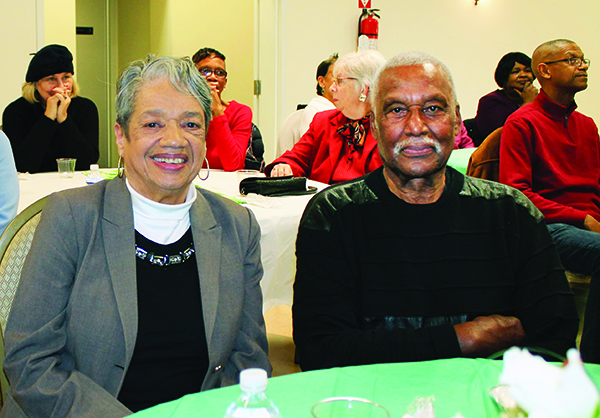
Held on Saturday at Moody’s Event Center, the gala event annually raises funds for educational scholarships. It is sponsored by the Epsilon Eta Chapter of the Iota Phi Lambda Sorority, Inc.

Darden was a natural choice to be the keynote speaker for an education-focused organization. She spoke of her determination to broaden and forward her own education and of her successful efforts to move her career forward in a field of research that was dominated by males. She was given a rousing introduction by sorority member Paula Washington.

Although she was one of the pioneering female “computers” featured in Margot Lee Shetterly’s book “Hidden Figures: The American Dream and the Untold Story of the Black Women Mathematicians Who Helped Win the Space Race,” Darden said she was not portrayed in the film “Hidden Figures.” Her career began later than the period covered by the film, and she said that the majority of the history Shetterly covered in the book didn’t make it into the film, which was being developed as the book was being written.

Darden humorously told of how women came to be employed at NASA in the first place. She said that the U.S. had fallen behind the Germans in airplane technology, and the National Advisory Committee for Aeronautics (NACA) established the first laboratory for aeronautical research in Hampton in the early 1900s. They built wind tunnels to study how the wind affected airplanes, and those tunnels generated a great deal of data that had to be reduced and put into reports.

“The men they hired complained about the work,” said Darden, to laughter, “so NACA decided to hire female math teachers to reduce the data.”

All the women initially were white, she said, but shortly before World War II, President Franklin Roosevelt was convinced to issue an executive order prohibiting discrimination in federal facilities. Thus, the first black female computers—those portrayed in the film—began working at NACA (later to become NASA).

A precocious student who started second grade at the age of 4, Darden said she was always attracted to mathematics and the physical sciences, but the schools she attended didn’t have the kind of advanced courses she needed. When she was accepted as a student at Hampton Institute (now Hampton University), she said her dream career was to be a mathematician, but the only path forward was by becoming a teacher. So, while studying to be a teacher, she filled all of her electives with advanced math classes, during one semester even taking modern geometry and advanced calculus during the same time slot.

“When I graduated, I had 28 hours in higher level math classes I did not have to have to graduate,” she said.

Once she began teaching, she continued her education by taking classes at Virginia State University, driving 80 miles from Portsmouth to Petersburg every Friday after work until she was able to get a job as a research assistant in the physics department at Virginia State, where her husband had accepted a fellowship. This led to her earning a master’s degree in Applied Physics from Virginia State and a job at NASA as a human computer. She eventually received her doctorate from George Washington University.

“I was hired as a computer two years before we walked on the moon,” she said.

For five years, Darden worked on the space program’s re-entry team. Her job was to determine the speed and angle at which a spaceship enters the Earth’s atmosphere. Having learned computer programming in graduate school, she would write a computer program when given an equation to solve and provide the answer that way.

But Darden noticed that men with the same degree she had were being placed in the engineering pool rather than the computer pool. As engineers, they were able to do research, give talks, write papers, and receive promotions—all opportunities not afforded to the people in the computer pool. So she asked to be transferred to the engineering pool, and three weeks later, she was promoted and transferred.

That was the beginning of Darden’s long, illustrious career working on sonic boom minimization. While other nations were developing supersonic airplanes that could fly faster than the speed of sound, she said, the U.S. prohibited their development because of the damaging effects sonic booms had on infrastructure and the resulting negative response of citizens.

Darden shared a slide show with the audience, demonstrating the way in which an aircraft going faster than the speed of sound creates a cone of pressure that causes a shock wave that’s felt as sonic booms as the cone comes into contact with the earth. She showed the geometric wave form that represents the minimization of the sonic boom, and she talked about the work that she and a partner did to create models of a supersonic aircraft whose cone of pressure would mathematically adhere to that wave form. She said it all had to do with the sharpness of the nose of the aircraft as well as the pressure of the air flowing across the top and bottom of the aircraft, creating lift along the wings that enables flight. She wrote the computer code that provides a minimized sonic boom, and the result of her work will finally be realized next year when Lockheed-Martin finishes work on an aircraft that can hopefully fly at supersonic speeds over land without negatively impacting people.

“They will fly over people and get comments on whether people can stand it,” said Darden. “NASA will evaluate it, and determine whether we can have a supersonic plane over the continental U.S.”

Darden said this would make it possible for passengers in the future to fly across the U.S., from coast to coast, in little more than two hours.