
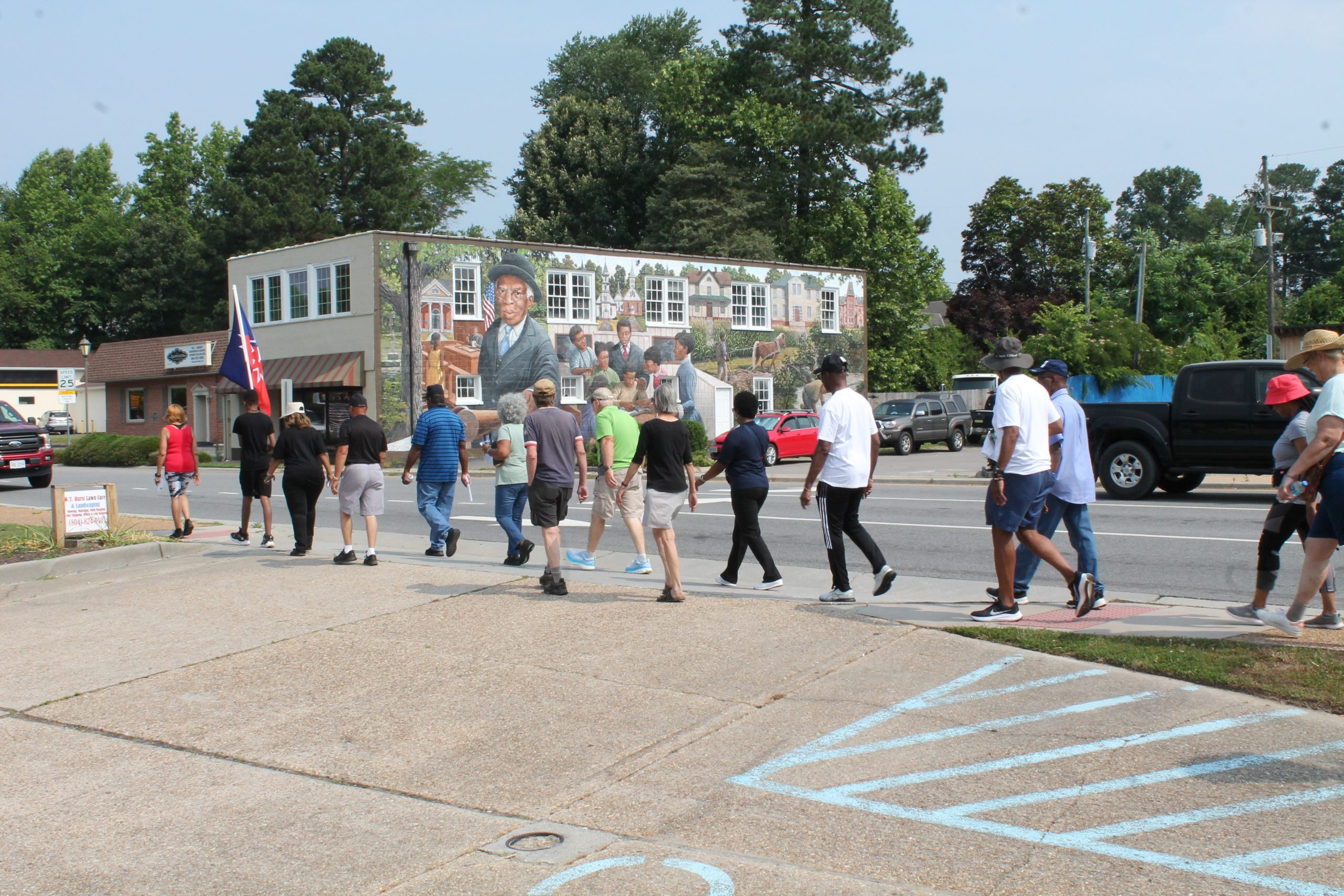
Juneteenth was celebrated all day Monday in Gloucester, beginning with a morning march along Main Street and ending with an afternoon spent at the First United Baptist Church in Gloucester.
Around 40 hearty individuals, under the Juneteenth banner, took part in the sweltering 2.6-mile walk along Main Street, which began and ended at the Gloucester Library at Main Street Center, with walkers treading the 1.3-mile trip to the Pocahontas statue at Belroi Road and back.
At the statue, Dr. Wesley Wilson, organizer of the march, gave an impromptu talk about the origins of Juneteenth and handed out bottles of water before the group headed back.
In the afternoon, a crowd gathered under the shade trees on the wide church lawn to hear speeches, poetry, and music; socialize; watch a dance demonstration; and visit vendor and information booths.
Brenda Dixon, president of the Gloucester NAACP, welcomed those present; the Rev. E. Randolph Graham gave the invocation, musician Andre Billups played several selections on the keyboard, Nasir Elazier read a poem, and Amaya Slusser entertained the crowd with her talents as a dancer.
Mistress of ceremonies for the day was the Rev. Dr. Katrina W. Brown, who gave a powerful rendition of the song “Oh Freedom” and exhorted everyone there to “celebrate, cherish, and protect your freedom.”
Franklin Lemon spoke of his experiences as the child of a mixed-race couple who inherited his mother’s light skin. He recalled having to walk past the Boy Scouts’ log cabin to get to the place where his all-black Boy Scout troop gathered and of riding in the front on the Greyhound bus when he was with his mother, but being relegated to the back if he rode with his darker-complexioned father. Traveling with his mother meant they could go inside a snack bar or restaurant when the bus stopped, he said, but when he was with his dad, they had to go to a window around back to buy their snacks.
“What freedom means to me,” said Lemon, “is saving a few steps … What freedom means to me is that when we travel, we can sit wherever we buy our tickets for, eat inside, share our lives with our friends and family, and be free.”
Lourdes Travieso Parker said that freedom is about knowing how to speak the language. A native of Puerto Rico, she said that as a child new to the mainland U.S., she and her classmates were walking one day with their teacher. When the teacher told them to stop, she said, she didn’t understand and kept going. She was then punished by the teacher for not obeying the order that she hadn’t understood.
“We need to have the right education for everybody,” she said.
Keynote speaker for the day was Christy S. Coleman, executive director of the Jamestown-Yorktown Foundation. She provided a fast drive-through the history of slavery and the movement for civil rights in the U.S.
Coleman spoke of the arrival of the first Africans to British America in 1619, when English privateers brought people they had captured from a Spanish slave ship to Point Comfort to trade them for supplies. She said the British hadn’t yet established servitude for life, so each captured person’s status was left up to the person who made the exchange. Some were given the opportunity to earn their freedom, she said, while others were indentured and some were kept for life.
Later, said Coleman, three indentured servants ran away from their master—a Scotsman, a Dutchman, and an African man named John Punch. The two white men were beaten and forced to serve extra time as indentured servants, while Punch was sentenced to spend the rest of his life in servitude.
Coleman told the story of one strong woman who challenged her status. She said that mixed marriages began to occur, and one mixed-race woman, Elizabeth Key, sued for her freedom from a man who tried to force her to hire out. Key argued that she should be free because her father was white and she had been baptized in a Christian church. She won the case, said Coleman, but the Virginia House of Burgesses then changed the law to say that any children born in the colony would take the status of the mother. A child of an enslaved mother would therefore be born into slavery, regardless of who the father was.
Other laws were gradually put into place, she said, until by the time of the American Revolution, all 13 colonies had slavery on their books. Over time, some colonies, especially those with economies that didn’t depend on slave labor, determined that slavery was not consistent with “life, liberty, and the pursuit of happiness,” said Coleman, and those colonies began to emancipate those being held in bondage.
The idea of freedom “has been with Africans and their descendants since day one,” said Coleman. During the Revolutionary War, she said, the British promised Black people their freedom and a land settlement if they would fight for the crown, and 100,000 ran off to serve with the British, with another 200,000 using the chaos of war to escape. Just 5,000 committed to fighting with the Americans, she said.
Over time, in spite of laws codifying slavery, some people such as John Brown decided they wouldn’t participate in the recapture of Blacks, while others such as Harriet Tubman worked to actively free them, said Coleman. She told of one act of rebellion that took place in Gloucester in May 1862 during the Civil War, when three Black men who were just a small part of the larger number who had been impressed by the Confederate Army stole a rowboat and rowed to Fort Monroe, which was under Union control. Once there, they told Gen. Benjamin Butler they wanted to be free, and he decided he could confiscate them as property and thus set them free.
“Lincoln wasn’t happy,” said Coleman, “but within a few short months, pressure builds and Lincoln issues the Emancipation Proclamation.”
By September 1862, she said, “there were already 3,000 self-emancipating Black folks in Fort Monroe.”
While some people argue that the Emancipation Proclamation didn’t free Black people enslaved in states not at war with the Union, Coleman said it did three important things—it ended slavery in the District of Columbia; allowed for the establishment of the U.S. Colored Troops, with over 200,000 serving in the Army and 25,000 in the Navy; and allowed 1 million of the 4.25 million enslaved people to leave slavery.
While some former slaves were celebrating freedom in 1863, she said, there were people who were still enslaved, including in Galveston, Texas, where U.S. Troops landed on June 19, 1865 and issued Order Number 3, finally telling the Black people of Texas that they were free people. That event was the origin of the Juneteenth holiday.
Finally, Coleman spoke of Martin Luther King Jr.’s “I Have a Dream” speech, saying that the first half of the speech talked about the Emancipation Proclamation and the fact that “100 years later the negro is still not free … [but] is crippled by the manacles of segregation and the chains of discrimination,” with people living “on a lonely island of poverty in the midst of a vast ocean of material prosperity.”
“That speech was 60 years ago this coming August,” said Coleman, and she urged all those present to understand that “none are free until all are free.”
“As you celebrate our joy and happiness and progress,” she said, “remember Juneteenth and its promise and the sacrifices along the way.”
The event was co-sponsored by the First United Baptist Church, the Gloucester and Mathews branches of the NAACP, the Gloucester Union Relief of Missionary Baptist, the Woodville Rosenwald School Foundation, and CircleUp Middle Peninsula.


Participants in Monday’s Juneteenth celebration were, front from left, Brenda Dixon, president of the Gloucester NAACP; the Rev. Dr. Katrina Brown, pastor at Bethel Baptist Church of Gloucester; Christy S. Coleman, executive director of the Jamestown-Yorktown Foundation; Dr. Wesley Wilson, president and executive director of the Woodville Rosenwald School Foundation; back row, Nasir Elazier, who gave the Juneteenth Call and Response; and the Rev. E. Randolph Graham, pastor of First United Baptist Church.

Dr. Wesley Wilson, at center in striped shirt, talks to participants in the Juneteenth walk down Gloucester Main Street held on Monday about the Emancipation Proclamation, which was rendered on Jan. 1, 1863, and the fact that the enslaved people of Galveston, Texas, weren’t told that they were free until June 19, 1865.

Amaya Slusser performed “A Celebration in Dance” during the Juneteenth celebration at the First United Baptist Church in Gloucester.

Participants in Monday’s Juneteenth celebration in Gloucester march down Main Street.

