
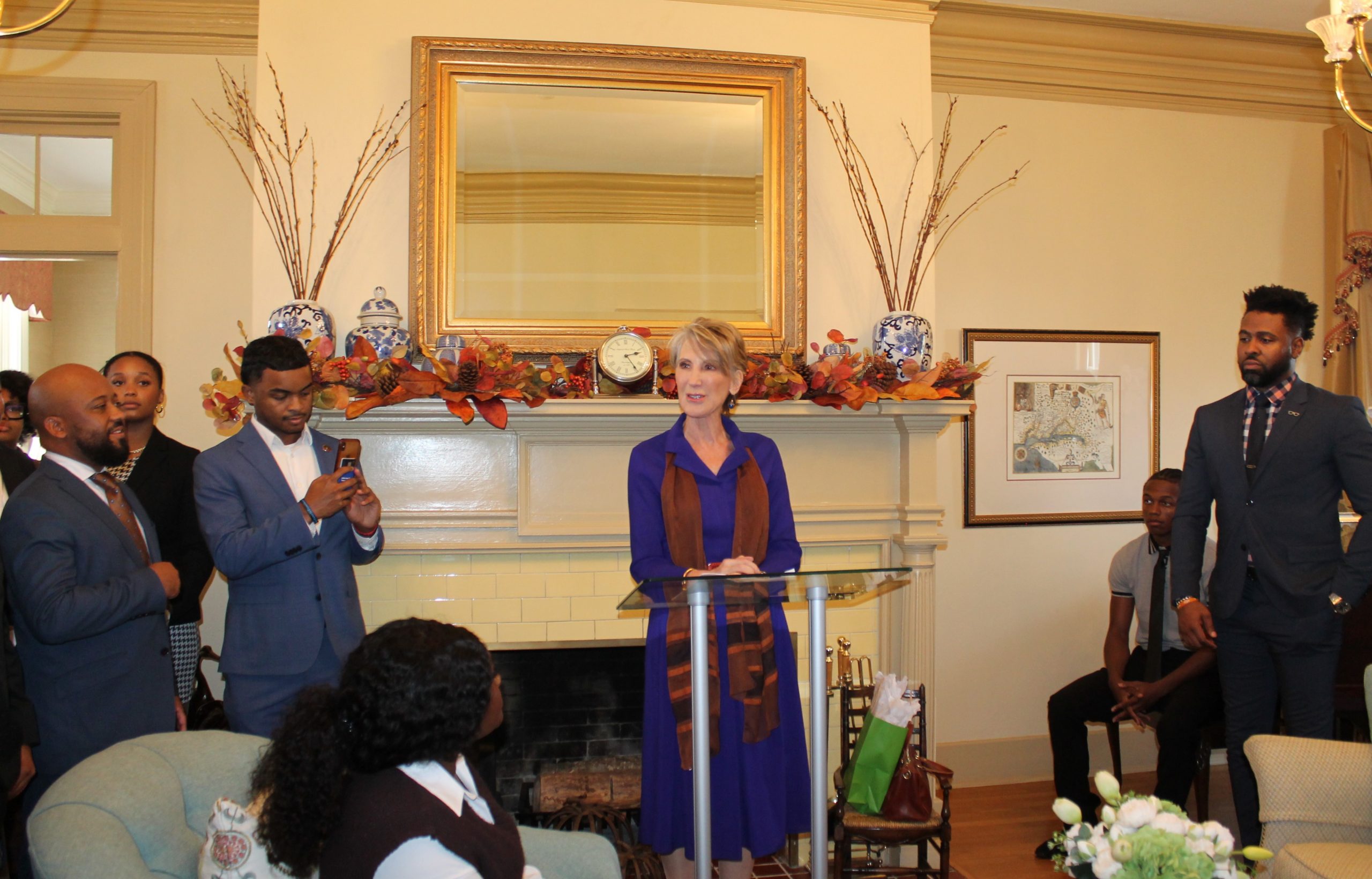
Colonial Williamsburg Foundation Chair Carly Fiorina was the guest speaker at The Return of Sunday Dinner held on Sunday, Oct. 1, at Holly Knoll on the historic Moton Conference Center campus in Cappahosic.
Fiorina, an American businesswoman and politician, is perhaps best known for her tenure as CEO of Hewlett-Packard, the first woman to lead a Fortune Top-20 company. She ran unsuccessfully for the Republican presidential nomination in 2016.
Guests at the event, which was sponsored by The Gloucester Institute, gathered on the wide, shady lawn overlooking the York River before being ushered inside to hear Fiorina speak and enjoy a sumptuous dinner.
Twenty-five current members and a number of past members of the institute’s Emerging Leaders program were welcomed. These college students receive training that prepares them to compete for leadership roles in today’s business environment.
Fiorina spoke eloquently about Sunday dinners, a time when families gather to talk about issues, problems, events, and “the gossip of the day.” She said such talk inevitably leads to people and stories of the past.
“Why?” she said. “Because we know we cannot be fully complete in our present without a connection to our past … All of us understand that our history matters.”
Fiorina said that many Americans are unaware of the nation’s history, just as she was unaware of the significance of Holly Knoll and of Dr. Robert Russa Moton, who lived there. She said she was also unaware that other leaders such as Dr. Martin Luther King Jr. had gathered there to solve problems.
“Just as a family cannot fully heal without coming to terms with its past, so too a nation,” said Fiorina. “We must know all our heroes and fully reckon with all the horrors of our past.”
Fiorina quoted Virginia historian Edward Ayers, who said, “Nostalgia dims and diminishes the past by softening its contours. History honors the past by taking its struggles seriously.”
A quick run-down of Virginia history followed. Fiorina spoke of the Virginia Company’s unsuccessful initial efforts to colonize Jamestown in 1607 and of subsequent reforms that gave local colonists more autonomy to make decisions. She talked of the introduction of tobacco as a crop and of the first encounters with indigenous peoples. And she spoke of 1619 as “a momentous year” when the General Assembly held its first meeting, Burgesses were elected by the people, property ownership first became possible for many, and the first women settlers arrived.
“So began representative democracy and entrepreneurship,” she said, “foundations upon which, along with immigration, the strength and wealth of our nation has been built.”
But the first enslaved Africans also arrived in 1619, said Fiorina, “bound in chains for the entirety of their journey across an ocean in the literal hellhole of the slave ship.” She said many residents of Jamestown were horrified by their condition, “but we also know investors recognized that this new source of cheap labor could ensure manpower for the increasingly lucrative tobacco crops.
“So began the normalization of the idea that some are more human than others and the institutionalization of human slavery,” said Fiorina. “And this shame of our nation also built a great deal of the wealth of our nation and entwined itself in our social fabric.”
Fiorina spoke of Virginia as “the crucible of our nation,” where the movement towards independence began. She mentioned people and events in Virginia history—Patrick Henry and his “Give me liberty or give me death” speech and James Lafayette, who spied on the British for his American enslavers to help win the revolution. She said every founding document on which the nation was built was written by a Virginian—the Bill of Rights, the Declaration of Independence, and “the Constitution itself.”
“From slave rebellions to abolition movements, right through from the Civil War to Civil Rights, from Jim Crow to Monument Avenue,” said Fiorina, “Virginia has always been the crucible of our nation.”
Fiorina said it’s “indisputably true” that the founding fathers believed the rights they sought only applied to white, male property owners and that they did not consider ownership of other humans “a vile abuse of power.” Nevertheless, she said, “their words took both deep thought and great courage to write.” Those words and the system of government that the founders designed “have inspired every movement for human dignity, sovereignty, equality, and liberty everywhere, ever since,” she said.
The nation will celebrate the 250th anniversary of the Declaration of Independence in 2026, said Fiorina, honorary chair for the event, and she said the nation will face a fork in the road.
“Either people’s false and incomplete perceptions of our history, or depictions by others, will make us even more divided and suspicious of one another,” she said, “or we will find a new sense of empathy and understanding by discovering the fullness of our complete, difficult but nevertheless inspiring history. And in so doing, we renew our sense of purpose and unity as a nation.”
Kay Coles James, founder and president of The Gloucester Institute, then addressed those present, thanking Fiorina for being there and saying, “We only put the best before our students.” She introduced other distinguished guests, as well, telling the students, “All of these people can be life-changers for you.”

Kay Coles James, founder and president of The Gloucester Institute, at left, addressed those in attendance, thanking Carly Fiorina for her participation in the program at Holly Knoll, as well as introducing distinguished guests.

