
The fate of the Confederate monument in Mathews will be placed in the hands of county voters.
By a 5-0 vote Wednesday night at Mathews High School, the Mathews County Board of Supervisors decided it will petition the circuit court to have the matter placed on the November 2021 ballot.
Details of exactly what voters will be asked to consider—such as where the monument would be moved to (if it is moved), the associated costs, whether there should be a plaque or marker to contextualize the current monument—have yet to be worked out.
During board discussion, Mathews County Attorney Andrea Erard said that supervisors have plenty of time to prepare the language for next year’s ballot and suggested holding a work session at some point to come up with the details.
The decision followed an at-times contentious public hearing with impassioned pleas by residents, both for and against removing the monument.
Supporters of keeping the monument in place view it as a war memorial and tribute to the county’s dead soldiers and sailors, often the only such marker for men whose unmarked graves can be found in Gettysburg, Petersburg and other battlefields. Those in favor of its removal see it as a painful reminder of slavery and Jim Crow discrimination and its placement in front of the historic courthouse a message that the county’s Black residents are considered second-class citizens.
For over an hour and a half, the two sides wrangled over the issue, as the board alternated between in-person speakers and Erard reading from written comments submitted prior to the meeting. Speakers received boos, cheers and catcalls from the audience, in spite of efforts by chairman Amy Dubois to keep order.
During the 90 minutes the board had set aside for public comment, Erard read from 21 submitted comments, while 24 individuals addressed the board in person, speaking from the two microphones set up at the end of the aisles in the school’s Harry M. Ward Auditorium.
While in-person comments skewed more toward keeping the monument where it is, a larger percentage of written comments favored removing the Confederate statue from its current place in front of the historic courthouse.
Several of the comments, both from in-person speakers and from those sent in, made mention of an Oct. 29, 2019 candidate forum at the Gwynn’s Island Civic League, where all of the candidates running for office (including current supervisors Paul Hudgins, Jackie Ingram, Mike Rowe and Melissa Mason) indicated they were not in favor of removing historic monuments at that time.

Linda Hodges offered up a possible compromise to the issue of the Confederate monument in Mathews Court House during last week’s meeting of the Mathews Board of Supervisors.
David Anthony of Gwynn, in his written comments, said that “every candidate pledged not to take the monument down [at the forum]. That includes those who won the election and who sit on the current Board of Supervisors. I recall Mr. Hudgins, Mrs. Ingram, Ms. Mason and Mr. Rowe made that pledge. Will those board members mentioned stand by their pledge made that night?”
“I believe that my response [that night] was ‘no, I would not initiate the removal of the statue,’” Mason said following the conclusion of public comment. However, “if the statue is there, that also is a time of healing to erect other statues that show the inclusiveness and diversity of the county.”
Paraphrasing from the musical “Hamilton,” Mason said that “history has its eyes on us” at this pivotal moment. Mathews will face other moments that will try this county “that may be far worse than this,” she said, and the community must be able to come together to make decisions not good for one side or the other side, “but what is best for this county.”
During the public comment period, Linda Hodges, a member of the Mathews County School Board, suggested a compromise along the same lines that Mason alluded to. “What I see is we’re going down a path of win/lose,” she said. She suggested instead that “each side needs to give up something.” She said the issue with the monument differs from that of the name of Lee-Jackson Elementary; the monument is a war memorial to Mathews County dead, while the school’s name was to glorify Confederate generals.
A part of the compromise, Hodges said, would be “no more Confederate flags at the base. That’s got to be the first thing.” Secondly, she said, would be the erection of “a plaque and a response to the war … to give perspective and response to the memorial.”
Later in public comment, fellow school board member Jeanice Sadler voiced her support for Hodges’s proposal. Sadler then discussed the roots of the Civil War, which she views as primarily economic. “The Civil War was basically over tariffs,” she said. “Slavery was a byproduct.
“I think it’s only fair that a monument of some type, a plaque, be put up having to do with the end of slavery,” Sadler concluded.
A number of speakers and letter writers opposing the removal of the monument questioned the timing of this proposal.
“Neighbors have lived, worked and played side by side for decades in Mathews County, both black and white. Don’t start this ‘woke’ movement; not here, not now,” Candy Sanford of Cobbs Creek wrote. “This monument has been in place since early 1900s. If it wasn’t offensive 50 years ago, 30 years ago, 10 years ago or even five years ago, then why now? Political reasons perhaps?”
Michael Carter of Hudgins, a Black man and lifelong resident of Mathews, replied to the argument put forth by Sanford and others that the monument only became offensive in the present political climate. “That statue has been offensive to me my entire life,” he said. The statue in front of the courthouse, he said, is a reminder to him, his friends and family that “they aren’t truly free.”
Carter attempted to debunk the theory that the Civil War had been fought over something other than the continuation of slavery. If it was states’ rights, what was the right other than the right to hold men and women in the bonds of slavery? If it was economic reasons, what economic reason other than the preservation of an economy based on slave labor?
“We can’t heal until we tell the whole truth,” he said.
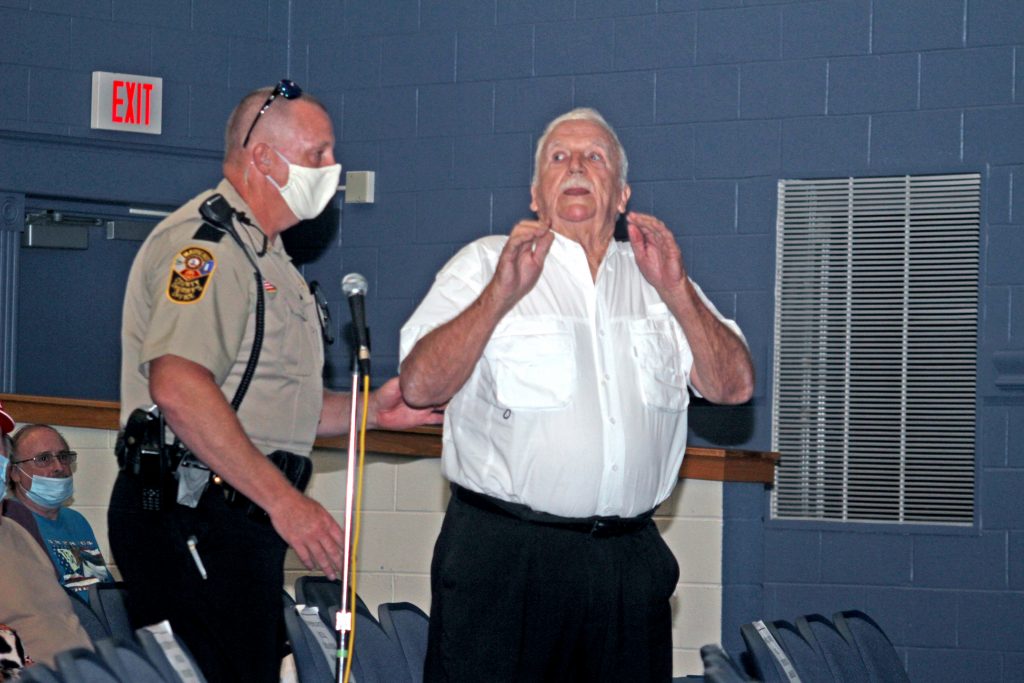
In probably the most dramatic moment of the night, Andrew Maggard of Port Haywood attempted to speak and was temporarily escorted from the meeting by Mathews County Sheriff’s Office deputies. Maggard did not provide his name and address as Dubois requested, and spoke in a loud voice facing the crowd. When Maggard did not respond to several requests from the chairman, she eventually instructed deputies to remove him.
Later, when Dubois was made aware that Maggard had been unable to hear her requests, she apologized for the misunderstanding and instructed deputies to seek him out to return to the microphone.
They did so and Maggard was allowed to finish his comments. “I would be devastated to see a continuation of what I am witnessing in this country. Destruction of history. Destruction of past presidents’ statues … What else is there going to be?”
He concluded by making a light-hearted reference to his ejection earlier in the meeting. “Ladies and gentlemen, I thank you for your time and I apologize for creating any little bit of excitement that you may have beheld.”
Early in the public comment period, Chuck Smith of Virginia Beach attempted to speak, but was shouted down and Dubois pointed out that the hearing was primarily for county residents and landowners. She asked if he could wait if there was time at the end, and he stepped down.
As the hearing was coming to an end, he approached the microphone a second time and several members of the crowd continued to boo and there was a shout that if he were allowed to speak, Joey Taylor should have also been given the right.
Taylor, a Gloucester resident and commander of the Lane-Armistead SCV, had not been permitted to speak at the Aug. 18 school board meeting concerning the fate of the Lee-Jackson Elementary School name; the school board had restricted comments at that meeting only to county residents and school employees.
Smith, a Black man and Republican candidate for Virginia Attorney General, was finally given a chance to speak and as it became clear he was speaking in favor of keeping the monument where it is, the catcalls and boos turned into cheers and applause.
Other in-person speakers at the hearing included Tom Robinson, Sharon Frye, Bobby Dobson, Wendy Harris, David Jones, Melanie Procopio, Brent Payne, Mark Truscott, Ronald Fitchett, Brianna Carter, Randall Dobson, Cindy Fitchett, Charles Gerald “Jerry” Sadler, Valerie Bass, Keith Ellenberger, Albert Clark, Ray Mulvaney and Robert Farmer.
Comments were read from Mary Broderson, Kurt and Linda Kurzmiller, Ray Stubbeline, Ula Ilnytzky, Sheila Crowley, Charles Crook, Mary Sampson, Dia Lawless, Charles Haywood, Peggy Newsome, Yvette Gaither, Nancy Pitts, Christine Johnson, Dorothy Long, Paul Gibson, A. Conrad Bareford III, David W. Callis, Mary Perdue and the Mathews Branch NAACP/Raymond Willis Sr.
All of the written comments, along with a video of the night’s proceeding can be found on the Meeting Portal of the Mathews County website (www.mathewscountyva.gov).

