
Press "Enter" to skip to content

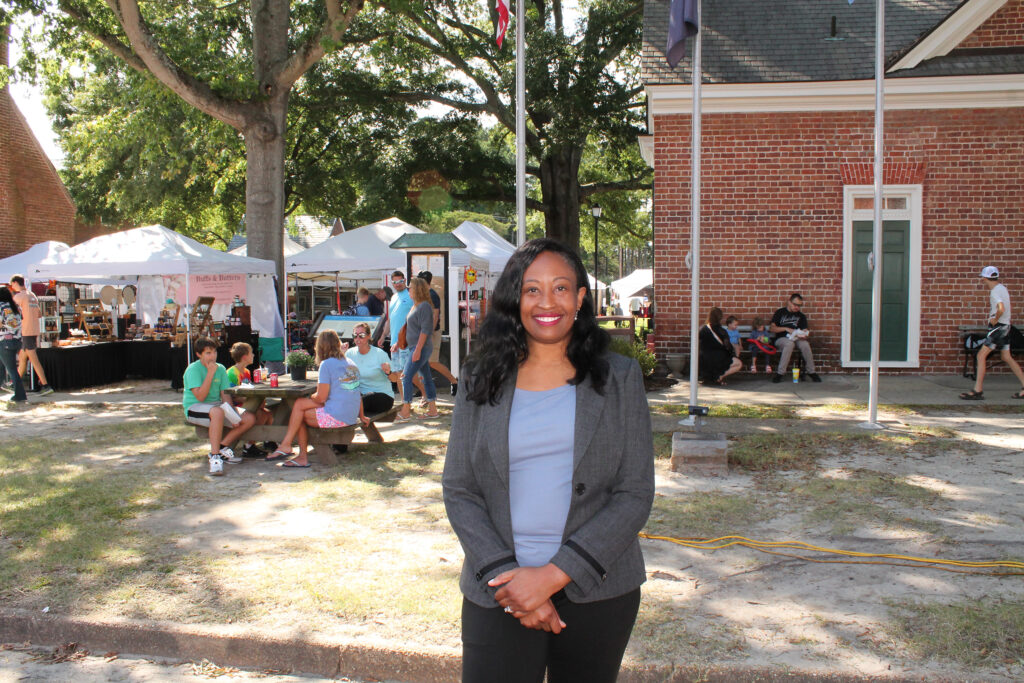
Democratic nominee Leslie Mehta

Leslie Mehta is the Democratic Party candidate for the U.S. House of Representatives’ 1st Congressional District. She is challenging longtime Republican incumbent Rob Wittman.

Speaking with the Gazette-Journal in Mathews during the annual Mathews Market Days festival, Mehta shared insights into her background, her political beliefs, and her decision to run for office.

A Woodland, North Carolina native, Mehta attended the North Carolina School of Science and Mathematics as a youth and was subsequently accepted at the University of North Carolina at Chapel Hill. She received her undergraduate degree in 1999, then went on to earn a law degree from the Howard University School of Law in 2002.

After graduation from law school, Mehta spent a few years as a litigator and civil rights attorney in Missouri. Then she and her husband, Tarun, who had attended law school with her, relocated to San Francisco for his law firm, and Mehta joined a civil rights firm there. When the couple’s first child, Brooke, was born in 2016, they moved to Chesterfield, Virginia, to be near family, and Mehta accepted a position as director of the American Civil Liberties Union of Virginia.

But Mehta had to cut her career short when Brooke was diagnosed in 2017 with Rett Syndrome, a disease that renders a person unable to walk, talk, or have purposeful use of their hands. Mehta turned her attention to advocacy for rare disease research, connecting with both Democrats and Republicans to try to obtain funding. She said she gained bipartisan support, but when she reached out to Congressman Rob Wittman, he didn’t respond.

“I was frustrated that Wittman didn’t sign on,” she said.

Eventually, Mehta was able to obtain $600,000 in federal funds for Rett research with a bill supported by both Democrats and Republicans. Her advocacy grew from there, and she was appointed to the board of directors of the International Rett Syndrome Foundation. She also served on Gov. Ralph Northam’s Commission to Examine Racial and Economic Inequity and on Governor Glenn Youngkin’s Rare Disease Council.

“When Brooke passed away in 2021, I began thinking what could be the next step,” said Mehta. “I decided it was running for office.”

Issues

Mehta said she supports abortion access; affordable, accessible health care; and investment in public education. While she’s a lifelong Democrat, she said she believes in working across the aisle.

Mehta said that Congress needs to codify Roe v. Wade so that women have reproductive freedom in all states, not just some.

“Virginia is sort of the last bastion of abortion access in the South, and we need to expand that,” she said.

Mehta’s experience with Brooke led her to make health care a priority in her race for Congress. She said that Brooke was denied Medicaid twice in spite of her diagnosis, and she had to go all the way to Atlanta to receive the treatment her child needed. A lot of people have to pay such high premiums for insurance and have such high copays that they’re not having their needs met, she said, adding that, while prices have lowered some, “more needs to be done.” There are also issues with people not having providers close enough to their locality, with some women living 45 minutes or more away from a maternity ward. Not all providers accept Medicaid because reimbursement is so low that “it’s hard to keep the lights on,” said Mehta, so reimbursement levels need to be raised. She said that healthcare workers needed to be incentivized in the way that Teach for America incentivizes teachers to go into areas of need—by paying off or reducing student loans.

A product of public schools herself, Mehta said that Congress needs to invest more in public school education. She said the small town that she grew up in had few resources, and when she went to the N.C. School of Science and Mathematics, she discovered that children from larger cities had a lot more resources in their public schools.

“It matters a lot what your zip code is,” she said. “It’s important that rural areas be properly funded by chipping in federal funds … We need to make sure the areas that need it most are getting the funds.”

In terms of the environment, Mehta said that people are increasingly concerned about the more severe weather events that are occurring, such as hurricanes and flooding.

“We need to anticipate the problems that might happen due to climate change,” she said.

On business, Mehta said she’s encouraged by the fact that the infrastructure bill and inflation reduction act provided resources for clean energy jobs, programs that help revitalize communities, and resources for small businesses. A lot of the money provided by the legislation hasn’t been tapped into yet, she said, but “things are headed in the right direction.”