
Press "Enter" to skip to content

Cobbs Creek resident sees first-hand the result of ICE arrests

A little over a mile from the U.S./Mexico border checkpoint at the Paso del Norte International Bridge in El Paso, Texas, is Annunciation House, a center that provides hospitality, advocacy and education to migrants, refugees and economically vulnerable people in the border region.

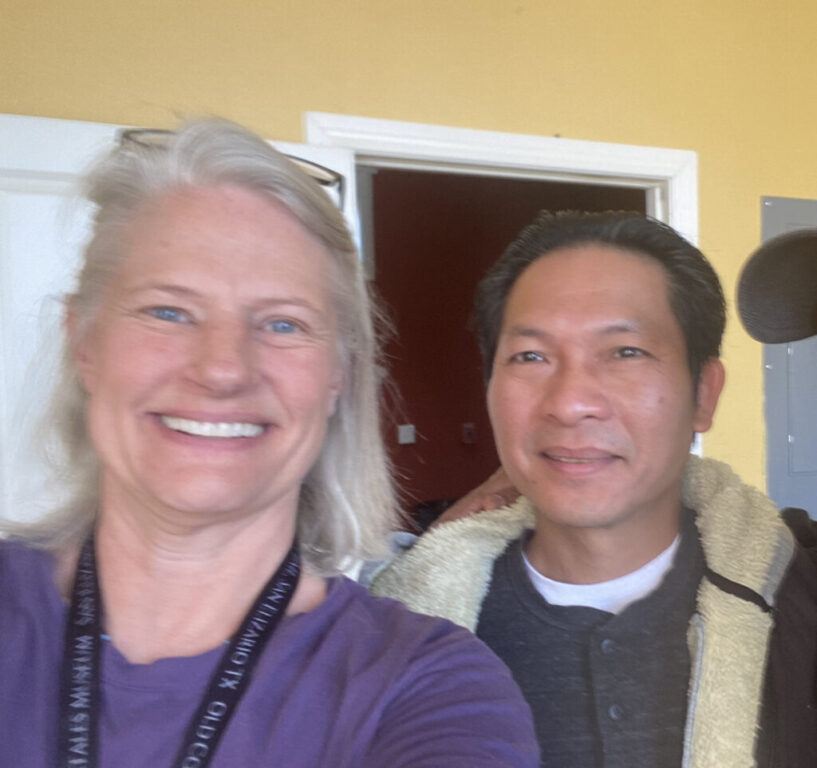
Cobbs Creek resident Terri Mock was a long-term volunteer for Annunciation House three decades ago and was well aware of the work that’s done there and the value the facility has for the people it helps. Now retired from a career with the U.S. Department of Defense, Mock said when she started seeing news reports about the number of people being detained by U.S. Immigration and Customs Enforcement and sent to the East Montana detention facility on Fort Bliss, a 25-minute drive from Annunciation House, she decided to volunteer again.

“I had heard about the conditions there,” she said. “The news has been so confusing, so I wanted to see for myself.”
She spent two weeks at Annunciation House, from March 12-28.

Mock said Camp East Montana (located off Montana Avenue) is the largest detention center in the United States. Placed in the Chihuahuan Desert, the center will eventually house up to 5,000 people. Detainees are kept at the facility until they’re able to see a judge, who either orders their deportation or sets a future court date to give them time to work out any issues with their visas or green cards or asylum cases, said Mock. If the judge has determined they pose no threat, ICE drops them off at Annunciation House, texting the center to let them know they’ll be coming. Men from 31 different countries were dropped off during March.

At Annunciation House, volunteers are assigned to help the recently-released detainees get back to whatever part of the country they came from. While arrangements are being made for airline or bus tickets or for family members to pick the detainees up, volunteers offer them food and clothing, a bed in the dorm if it’s going to be a while, and assurances that they’re now in safe hands.

Mock said she was assigned to work in the building where men are housed, and while she was there, she helped at least 30 men return to their homes and families.

“I saw the toll it had taken on them, being in detention three to six months,” said Mock. “They were frightened. Some asked if they were at ICE, so I’m not sure anybody had explained what was happening to them.”

When the men were dropped off, their handcuffs were removed and Mock would greet them and let them know they were safe and that she would coordinate their travel home.

“They just needed a place to get their heads together,” she said. “The first thing they all wanted was to charge their phones and FaceTime their families.”

Mock said she saw a lot of joy when the men were finally able to get in touch with their families.

“One man got to see his week-old baby for the first time,” she said.

When it was time for a man to leave the center, said Mock, she would make sure he got safely to the airport or bus station.

Mock said that each former detainee was asked if he would be willing to answer some questions for an anonymous survey. Some of them refused, afraid they would get in trouble if they told their stories, but others were willing to share information about what had happened to them while in detention. They were asked how they were picked up, how long they had been in detention, and what the conditions were like—whether they had adequate food or treatment for any medical conditions. They were also asked how and when they entered the country and what kind of visa they had.

“The stories were heartbreaking because they were treated so poorly,” said Mock.

She said the men told stories of being arrested at gunpoint for no reason; of trying to show their captors paperwork that would prove they were in the country lawfully, only to be ignored; of spending hours and hours waiting in holding cells for processing, often not allowed to go to the bathroom; of spending the night before a court date on a metal bench in a holding cell, then being too tired to be entirely coherent when brought before the judge; of waiting months for a court date only for the judge not to show up in court.

Because the camp is in the desert, dust is always blowing into the tents, said Mock, and the men were unable to keep themselves clean. The people in the camp were always sick because the canvas walls dividing the tents into pods didn’t go all the way to the ceiling, so those placed in the pod with Covid and other respiratory diseases weren’t truly quarantined. One man Mock interviewed said a roommate at the camp arrived too sick to stand up. He tried to get the man help, he told her, but he died the next day. Detainees shared rumors that one man committed suicide, while another was choked to death by a security guard. People told of assaults that had occurred.

“Listening to their stories would totally exhaust me,” said Mock. “Now I understand why people don’t want to talk about these things. You just didn’t want to think about it. I don’t think any good stories come out of that place.”

Mock shared the stories of several of the men. One man from Ecuador who had been granted political asylum by the U.S. and lived in New York was in Fort Myers, Florida, working on houses that had been damaged in a hurricane. He was driving away from a job site while it was still daylight outside, he said, but police stopped him for not having his lights on, then turned him over to ICE. He lost over 50 pounds while in detention, said Mock, adding, “All the men said the servings of food weren’t enough. They were always hungry.”

When the judge at Camp Montana who handled the Ecuadorian man’s case saw that he owned his own flooring business, paid his taxes, and had customers lined up when he returned home, he released him, said Mock.

“His life was stalled for six months in bad conditions,” she said. “He had already left bad conditions in Ecuador.”
A man from Guatemala who was living in Florida had left the restaurant where he was working and was pulled over for not making a complete stop, although he said he had. The police turned him over to ICE, and he was in detention for six months.

A man originally from Kyrgyzstan had lived in Minneapolis since 2011, said Mock. He had all of his travel documents and, after marrying a U.S. citizen, had applied for a green card. A long-distance truck driver, he said he was putting fuel in his tank in Wisconsin when ICE agents pointed a gun at him, dragged him to their car, and handcuffed him. He said he showed them his documentation, “but they didn’t care.”

When first picked up, the man spent 30 hours confined in a small room with 55 detainees, said Mock. There was no place to sit and the toilets didn’t work, and ICE agents stood outside the room laughing at the men because they had to urinate in the cell and stand in the urine. One man defecated, and ICE agents cursed at him and called all of the men animals. Once at Camp Montana, the detainee was sick with a fever for five days, she said, but he was told he couldn’t have medical care unless he was dying.

Another long-distance truck driver, who lived in Chicago and was from Central America, had all of his paperwork in order, including a valid work visa and a CDL license, said Mock. Yet, when he pulled into a weigh station, “he was yanked out of his truck by a dozen or more agents” and sent to a local detention center before being transferred to El Paso. The keys to the truck were still in the ignition, she said.

A former detainee, originally from Mexico, was afraid to leave Annunciation House or try to fly home after he was released because of the possibility of being detained again. He stayed at the house waiting for his family to drive from Florida to pick him up.

Finally, a Cuban refugee told Mock that he spent three straight days in handcuffs at Florida’s Alligator Alcatraz before being transferred to El Paso.

“I want people to know these details,” said Mock. “These are human beings and we’re not treating them as such. They were in jail for six months and never should have been.”

Mock said it seemed to her that the “mass deportation” that had been implemented by the U.S. meant “just picking up everybody and figuring it out once they get in there.”

“There seems to be no end in sight,” she said. “The U.S. has bought a lot more warehouses (to turn into detention centers).”

Mock said volunteers at Annunciation House stay at the house and eat their meals there, alternating between a 6 a.m. to 2 p.m. shift and a 2 p.m. to 6 a.m. shift. They’re given one day a week off.

“It’s exhausting but rewarding,” she said. “You feel like you’ve helped people. And they’re so appreciative. And it’s good to see what’s going on the world without solely relying on the news.”

Everyone at Annunciation House is “running around haggard,” said Mock, and the organization could use more volunteers.

To volunteer, visit annunciationhouse.org/get-involved.