

Conrad Hall, author of “A Select History of Mathews County, Virginia: 17th, 18th & 19th Centuries and The Family of Ann and Robert Hall,” knew that he could trace his family to Mathews County.
However, the Norfolk resident wasn’t sure where in Mathews his ancestors lived, so he reached out to the Fairfield Foundation three years ago to see if they could help locate his forebears’ home.
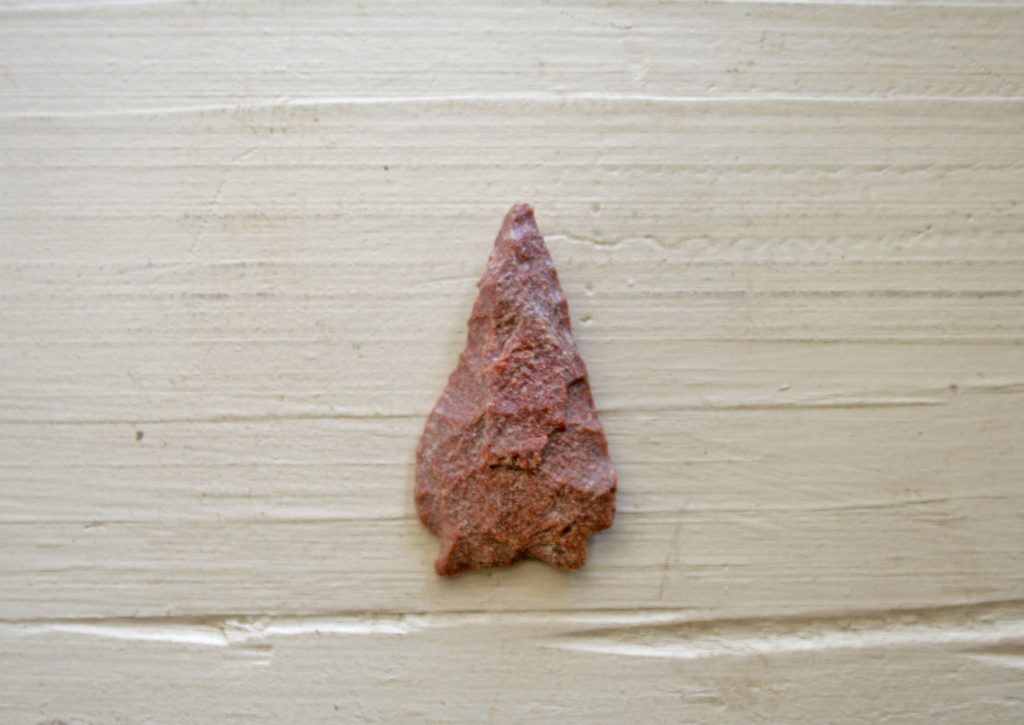
This arrowhead was found at the Hall dig site. The Fairfield Foundation dated the projectile point to have been made between 8000 and 6000 B.C.E.
Together, they found land in Port Haywood, and that discovery in turn led to an excavation of 17th and 18th century artifacts. Dr. David Brown, co-director of the Fairfield Foundation, said that Hall is an amateur map expert and had immersed himself in old county records to try to locate his family’s former land.
Hall himself found that land in Port Haywood, and the Fairfield Foundation was able to narrow where they believe the home was located. The land now belongs to the Shields family, who allowed the Fairfield Foundation to dig holes in their front yard for three years.
Brown said that LeAnne Shields was very encouraging and enthusiastic during the dig. A former history teacher at Mathews High School, Shields felt it serendipitous that the dig would take place in her front yard. She was glad that she had a part in the historical dig and in the history of Mathews, and that the three years felt like a matter of weeks.
“I wanted to be an archaeologist when I was little, and to have that in my front yard was surreal,” said Shields. Though she didn’t get to do any digging, Shields said that she was often beside the holes looking at what was being discovered.
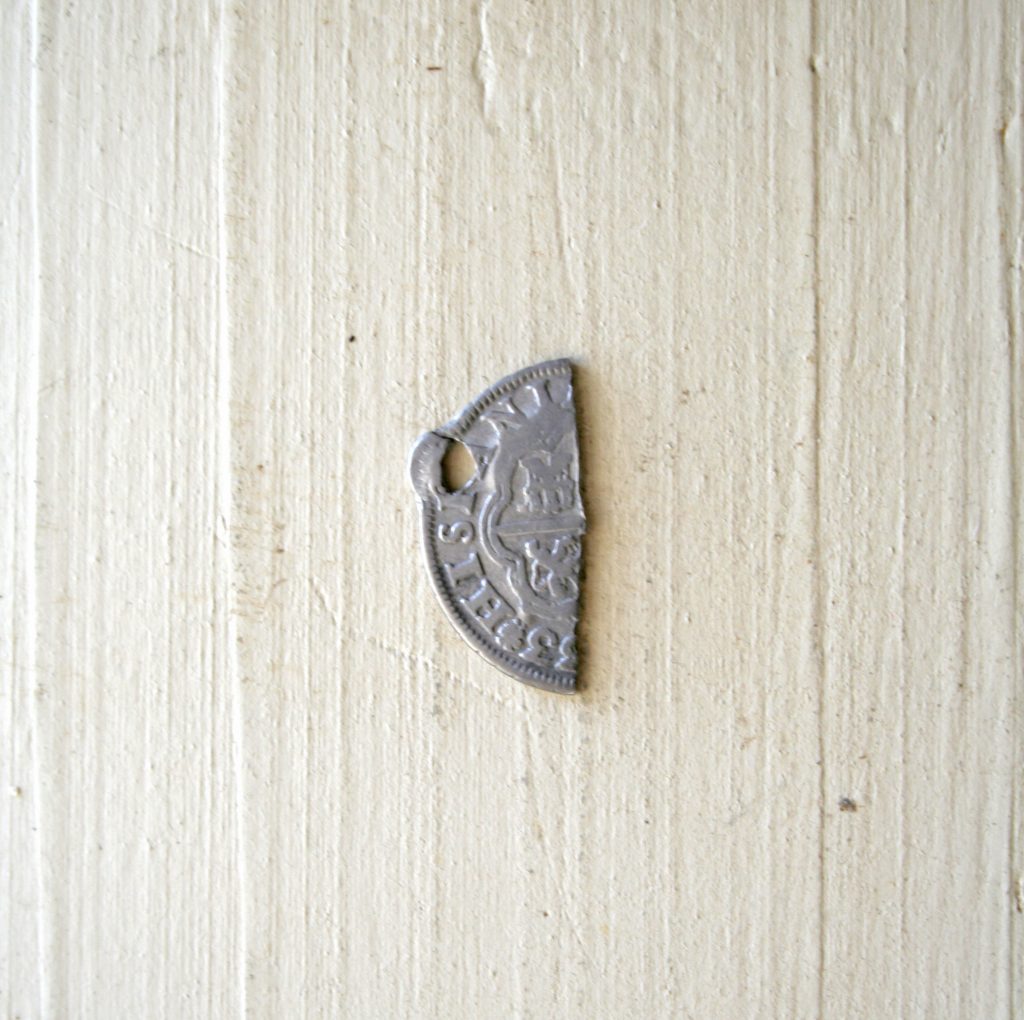
This cut Spanish coin from 1733 was fashioned into a pendant by its former owner. Dr. David Brown said that these types of pendants were made to signify a date that likely happened in the same year the coin was made. Brown said that coins were cut to make change for transactions.
“Archaeology is like a big game of battleship,” said Brown. He explained that when looking for artifacts, they just dig a hole and hope. At this site, they hit the “battleship” on the first try.
Brown said that part of archaeology is knowing what to look for. Hall knew that his family owned the land from the 1700s to the early 1800s, so the foundation knew to look for artifacts from that time frame.
They immediately found pieces of tobacco pipes and delftware that fit the bill. Brown said that they knew without a shadow of a doubt that they were in the right spot.
The goal was to find the location of the house. They searched for structural remains, or evidence of a foundation. If one test hole comes up with any of this evidence, said Brown, they then look for the home in a rectangular grid.
Two challenges were presented to the archaeologists in their hunt for the house. The first, Brown said, was that the artifacts were leading them to the Shields drain field. The second was that almost no one has done digging in Mathews.
“Our excavation is probably the biggest excavation in the county,” said Brown. He said the lack of digging in the county meant that they didn’t know if the architecture was “exceptional.” They could have been looking for a different kind of structure all together.
Though they did find evidence of a small cellar, Brown said that they were unable to locate the house. What the archaeologists did find were artifacts of everyday life that gave them and Hall an idea of how his ancestors lived.
Brown said that one of the more interesting finds was a collection of Dutch pipes, tobacco pipes. On one of the pipes is the word “Gouda,” which is a port city in Holland.
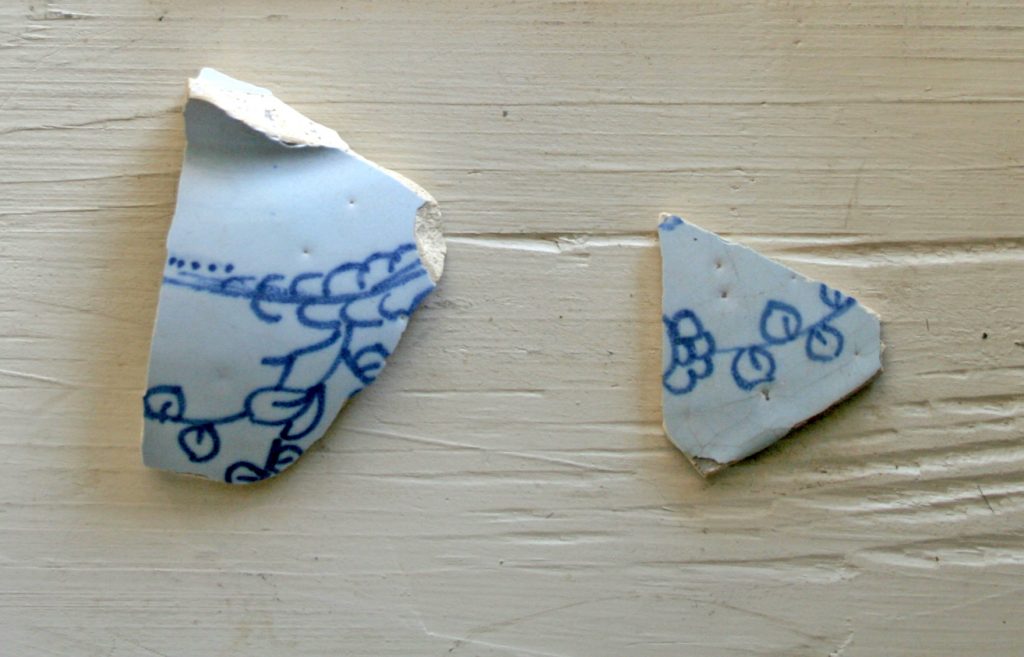
These delftware fragments were likely made and hand-painted between the late 17th and 18th century.
He said that Mathews was an outward-looking community that had commerce through trade with other locales, and that not everyone made their living on the water. Since the dig site was far from any waterways, the foundation concluded that the Hall family likely made their living as merchants and had connections with Dutch traders, which would explain the pipes.
Other artifacts of everyday life found over the three years of digging, as well, included buttons and belt buckles. Brown said that sometimes the smallest of finds can be the most significant to the history of the location. One small find was a coin cut in half that was fashioned to be worn as a necklace. Brown said the coin likely shared a date with an important moment for the Hall family, such as a wedding or birth.
Shields said that her favorite artifact was a small brass thimble that likely was owned by a young girl. She said that she would put it on her pinky and think about the girl and how she lived.
She said that she taught her kids that history is the legacy of those before us, and the legacy most people leave is of their normal, everyday life. The thimble is a part of the girl’s and Mathews County’s legacy.
The excavation ended in 2019. The artifacts found at the site are being given to Colonial Williamsburg to be part of an exhibit in the coming years. The items may find their way back to Mathews one day, though, said Brown, thanks to an agreement that Mathews has the right to display the artifacts.