
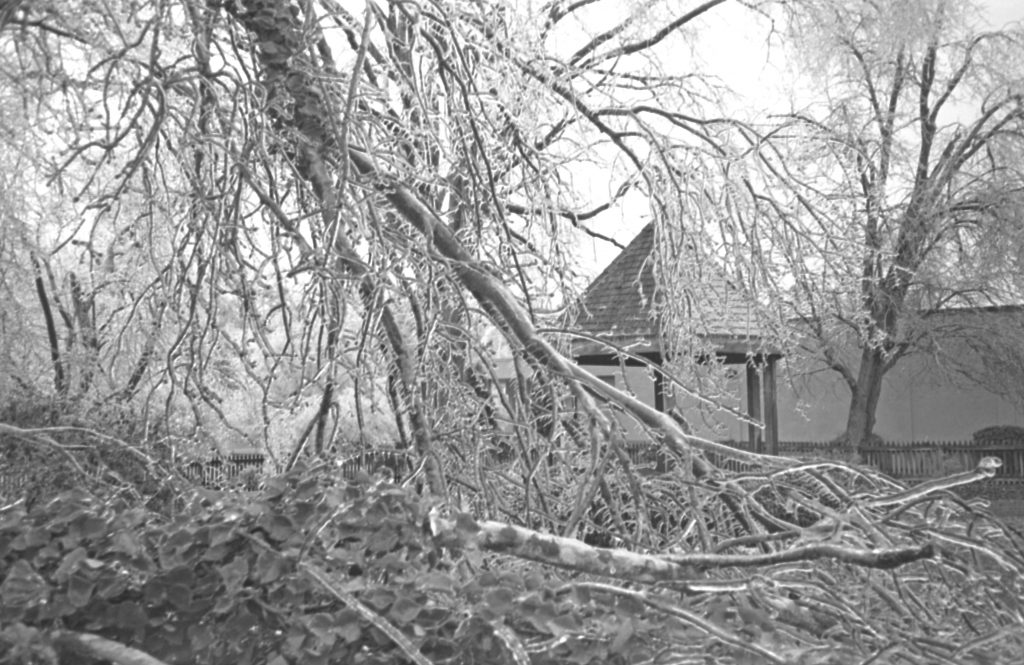
No warm mellow glow from Christmas shone over Gloucester and Mathews counties in the last week of December, 1998.
Instead, residents shivered in the aftermath of an epic ice storm that turned the holiday to misery in every corner of this part of the world. Anyone over 30 who was here then probably has memories of those cold, dark days, waiting for electrical power to be restored.
The Gazette-Journal of Dec. 24 included a National Weather Service forecast that gave scant indication of what lay ahead. “A white Christmas is not in the forecast” however “Sleet, rain and freezing rain are likely today.” The freezing rain forecast was accurate, but there was no prediction of how long it would last or the havoc it would cause.
We recall those days now from the columns of our newspapers that came out one week later, on Thursday, Dec. 31, 1998, and in a final report made on Thursday, Jan. 7, 1999. The power had been restored in many sections by December 31, including in Gloucester Court House, so the paper could get out. But many homes remained dark: almost 10,000 accounts were still not fixed, out of 33,000 that had initially lost power.
The paper related: “Rain and sleet began falling on Dec. 23 in temperatures that hovered around freezing. By nightfall the George P. Coleman Memorial Bridge was closed for several hours … a thin glaze of ice was forming on leaves, steps, roads—and electrical wires.
“By the early hours of Christmas Eve, the freezing rain continued and power connections began to break everywhere. Only an area in Gloucester Point directly connected to the Coleman Bridge escaped without any outages.”
In other words, homes in almost every corner of our coverage area suddenly had no electric power and, in most cases, no heat.
Here, again, from the Gazette-Journal: “The storm forced a change in priorities from the traditional Christmas celebrations. Keeping warm without power was the first priority. Finding fresh water over a long stretch of days was close behind. Fixing a Christmas feast fell to the end of the list, as people made do with hot dogs and other simple foods, sometimes cooked over an open fireplace or kerosene heater.”
A line of people waited at Village Star Texaco to refill kerosene containers. One man said that at another station, he was No. 20 in line and at No. 18, the supply ran out. “It’s like being in Russia,” he said.
Temporary shelters opened at Gloucester Moose Lodge, Newington Baptist Church, Lighthouse Worship Center, and at the newly-constructed, as yet unoccupied, Middle Peninsula Regional Security Center; wherever it was warm for a while. The Red Cross provided hot meals.
Robbie Kerns, chief at Abingdon Fire and Rescue, said, “The biggest problem has been with persons using other sources of heat and light, such as kerosene heaters and lamps. In some cases that caused carbon monoxide-related health problems.” Calls for chimney fires came in through all service areas.
After an initial spate of accidents from vehicles slipping on the icy roads, people stayed home and looked out for themselves and their neighbors. The biggest question became: when will power be restored?
Electric company workers faced a daunting task: Trees were brought down over power lines, lines were down and broken, power poles broke under the strain … and parts of trees were in every roadway to impede the progress of trucks.
Virginia Power vice president of distribution operations Tom Hyman summed up the problem: “In most areas, a system that took years to build was destroyed overnight and is now being replaced pole by pole and line by line.” The utility brought in crews from many areas to deal with the work. Their spirits were brightened by offers of help from individuals and businesses, said Gloucester district projects manager Ron Saunders. He said some people used chain saws to help clear the trees from the roads. The Gloucester High School Booster Club took baskets of fruit to the office for tired crews.
Many residents appreciated the strain placed on the utility by this historic storm. In a letter to the Gazette-Journal, Marie Billups of Moon said, “The Virginia Power linemen are working sixteen-hour shifts to bring power to all of us. There are no words to express the appreciation I feel … Thumbs up, fellas, keep up.”
In the end, Virginia Power assessed that the problem came from freezing rain that fell much longer than predicted. “Our system is designed to withstand a half inch ice buildup,” said corporate spokesman Dan Genest. Much of the ice buildup from the storm was an inch or more.
One week later, at 8:45 p.m. Saturday, Jan. 2, the final customer of 400,000 across Virginia who lost power was reconnected. That case was in Gloucester, and the outage was declared over. Three days later, a lineman eating lunch was approached by a resident who asked a surprising question: “When are you going to get my power back on?” In this case, the utility had never been notified that her lines were broken.
In the end, an army of electrical company employees and contractors labored in the cold on Christmas Eve, Christmas Day, Dec. 26, Dec. 27, Dec. 28, Dec. 29, Dec. 30, Dec. 31, Jan. 1 and Jan. 2 to reconnect power that was lost for periods of a few hours to more than one week.
Most filed away the episode in their memory banks to retell on future Christmas Eves … and sales of generators boomed.

While it was an annoyance for some, and a danger for those on the road as well as those who lost their heat and electricity for days, there’s no denying the Christmas Eve ice storm of 1998 also created some beautiful patterns as ice encapsulated the branches of trees.

A most welcome sight for residents who lost power during the storm. About 400,000 Virginians had to do without electricity for days, with the final customer getting power restored on the evening of Saturday, Jan. 2, 1999.

A truck passes dangling branches that became weighed down by the thick layer of ice that blanketed everything.

