
Press "Enter" to skip to content

$10+ million makeover of Gwynn’s Island bridge completed quietly

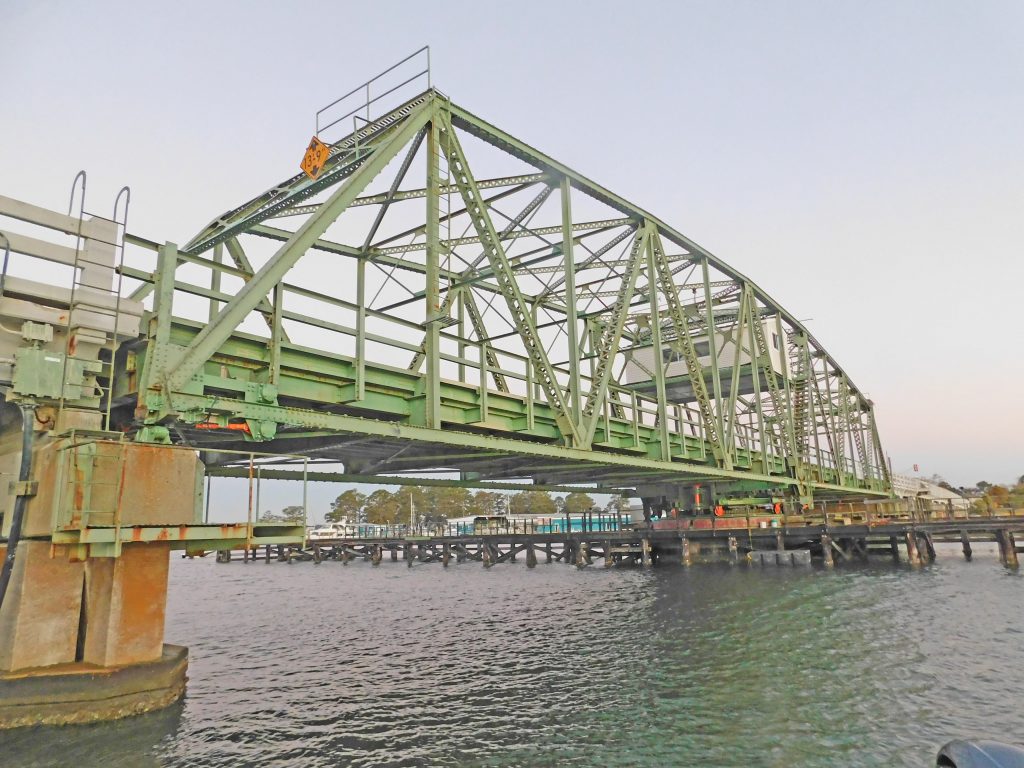
With no public fanfare, a $10.7 million makeover of the Milford Haven Bridge, which carries Route 223 traffic over Milford Haven from the Mathews County mainland on Cricket Hill to Gwynn’s Island, wrapped up in early October.

Thus, the oldest and busiest swing span maintained by the Virginia Department of Transportation, which was dedicated in November 1939, received a thorough renovation that will prolong its working life.

Kelly Hannon, a public information officer for VDOT, said limited openings started more than two years ago, and a long period with no openings (Aug. 15, 2022-March 15, 2023) was followed by additional limited openings.

Back to normal, the bridge began to open on demand for marine traffic on Oct. 15.

The rehab got underway in early 2022 and completion was delayed for several months awaiting fabrication, installation, fitting, and testing the bridge’s center bearing and rack gear, Hannon said.

These devices are critical to swinging open the central part of the bridge to allow marine traffic to pass from Milford Haven to the Narrows, the bodies of water separating the island from the mainland. Continuing problems with the openings led to the bridge’s overhaul.

During periods of extreme heat, motorists endured long unexpected waits at the bridge “when expanded steel prevented the bridge’s swing span from closing,” Hannon said. Personnel from the Mathews Volunteer Fire Department pumped water on the bridge; this “assisted in cooling the steel allowing VDOT crews to get the swing span in the closed position as soon as possible,” Hannon said.

Also, due to the condition of the bridge’s mechanical and electrical systems that operate the swing span, openings for marine traffic were limited to six scheduled times a day starting in June 2021, she said. Rehab work got underway six months later.

The overhaul by Archer Western Construction, LLC, of Norfolk, also included spot structural steel repairs and renovation of the bridge tender’s house.

Engineering for the rehab started in 2019; construction began in January 2022, “but the earliest months of the project required Archer Western to procure the specific replacement parts for the bridge’s mechanical and electrical systems, many of which had to be fabricated for the specific dimensions of the Milford Haven bridge,” Hannon said.

The bridge has a navigational vertical clearance of 11 feet when closed, and must open for vessels with higher superstructure or masts. In normal times before the construction work, the bridge opened for marine traffic around 3,000 times a year, “which is more than any other state-maintained moveable bridge in Virginia,” Hannon said.

History

Construction of the Milford Haven Bridge got underway in February 1939 after the Bowers Construction Company of Whiteville, North Carolina, submitted a low bid of $128,326 to build it. This was the second round of bids after a first low bid of $162,452 had been rejected as too high, according to issues of the Gazette-Journal that reported on the project.

The rather speedy construction, which began in March 1939, included a serious injury that May to foreman Earl Miller by a pile driver, and the death by drowning of worker George Miller in August, the newspaper reported.

By late fall the bridge construction was completed, and Mathews County celebrated the connection of the island to the mainland with elaborate ceremonies. On a cold and overcast day, a parade of school, fraternal, civic and commercial floats left Mathews Court House at 11 a.m. on Nov. 24, 1939, and proceeded to the island bridge.

There in front of 1,000 people the procession paused, while Henry G. Shirley, chairman of the State Highway Commission, cut the ribbon to open the span officially.

The parade continued to Gwynn’s Island School for speeches and a pageant depicting the island’s history. This was written by island school principal Stanley Armistead and because the crowds were so large, it had to be shown twice.

An editorial in the Gazette-Journal of Nov. 30, 1939, said, “From the time of its settlement until this day the citizens of the Island have faced the handicap of being compelled to cross the waters of Milford Haven in order to get in contact with the outside world or even the Mother County. It is said upon good authority that for a long time, the only means of getting from the Island to the mainland was by swimming across the Narrows on horses; that, even after the institution of a ferry by franchise granted to the late Dr. L. B. Hunley many years ago and up to a comparatively recent period, the only means of crossing the Haven by the public was the crudest sort of a ferry pulled across the stream with hand levers working on a cable to which the ferry was attached and later propelled by a motor boat, the lighter remaining attached to the cable.”

The ferry progressively improved and was taken over by the state in 1931. At this time the crossing became free, and agitation began for a bridge which became reality eight years later.

Although the opening 84 years ago was accomplished with considerable ceremony, no rededication ceremony is planned following the major rehabilitation just finished. “The project has been completed,” Kelly Hannon said.

MW035 Gwynn's Island cable ferry
MW036 Gwynn's Island ferry 1930s
FILE PHOTO

This photograph of the Milford Haven Ferry carrying cars and passengers to Gwynn’s Island from the Mathews County mainland dates from the 1930s. Several passengers have been identified. Standing from left are Lucille Hailey, Hal Hudgins, unknown, Leonard Buchanan, Oscar Minter and John Bassett. The final two people in this row and the two in the pilothouse are unknown.