
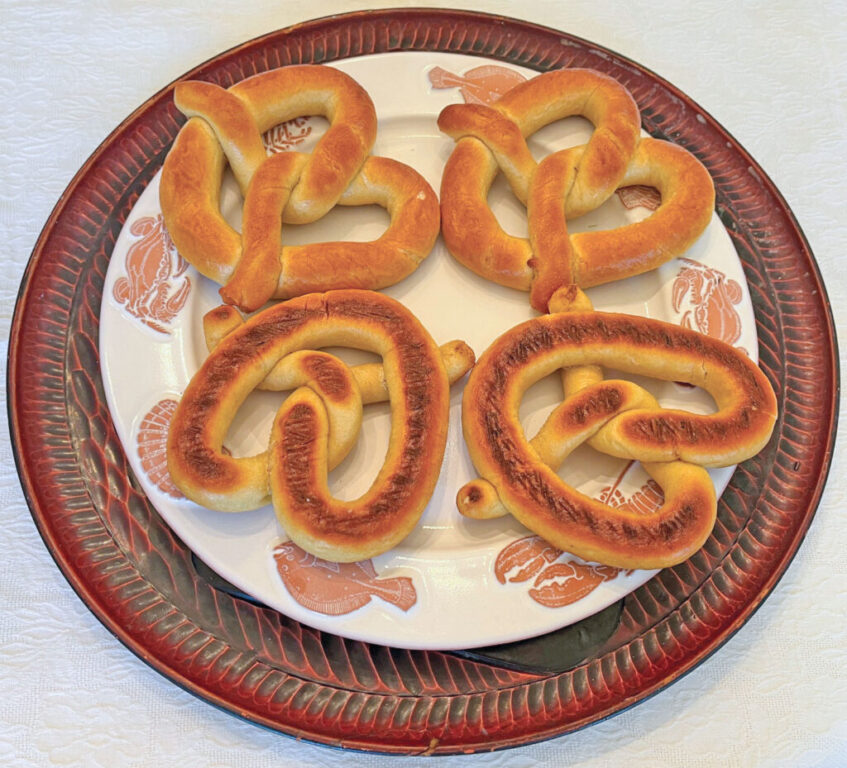
April is National Pretzel Month. No one really knows who the first baker was, deciding to mix salt water and flour together, give it a twist and then call it a pretzel. A fifth century manuscript found in the Vatican reportedly relates what could have been that first salty treat. Another legend tells that a monk in Italy who had been working with dough, after making bread, twisted the leftovers to resemble the crossed arms over the breast of a person in prayer.
It is true history that the southern German and Swiss German immigrants who were later to be known as the Pennsylvania Dutch introduced the soft pretzel to America in the 1700s. The hard pretzel is distinctly an American product.
As more immigrants settled in Pennsylvania, pretzels took on a strictly American flavor. In 1861 the first pretzel bakery was established in the Keystone state and the first hard pretzel was created there. That was a good business decision as now the crispy treat packed in airtight containers could stay on the shelves for a much longer time than the soft pretzel. Today an estimated 80% of all pretzels made and sold in the U.S. are from Pennsylvania.
In its travel through time, the pretzel has taken on more than culinary use. It became to be seen as a symbol of good luck, prosperity and spiritual fulfillment. In the 16th century, children hung pretzels around their necks for special occasions. Christmas trees were decorated with these treats. Even tiny pretzels were hidden on Easter, an early version of modern Easter egg hunts. In the 17th century the pretzel became a symbol of love. Couples being married grasped the ends of the pretzel and unraveled it during the ceremony.
Today in America, the industry worth of the pretzel is valued at $3 billion a year. The average American consumes an estimated two pounds annually.
Soft pretzels are warm and chewy with a golden baked exterior, while the hard pretzels are drier and more brittle, offering a satisfying crunch. Hard pretzels also have a longer shelf life and are more versatile.
Today’s market offers this ancient treat in many flavors and shapes. I don’t think the monks would recognize them.
Information: “The Twisted History of Pretzels,” “The History of Pretzels,” and “The History of Pretzels in America.”
HOW TO MAKE SOFT PRETZELS
3 c. unbleached flour
2¼ tsp. instant yeast
1½ tsp. sugar
1 tsp. kosher salt
1 Tbs. melted butter
1 c. water
For the boiling liquid
6 c. water
1/3 c. baking soda
For the topping
1 egg yolk
1 tsp. water
Coarse sea salt, for sprinkling
Stir flour, yeast, sugar, salt, and melted butter in the bowl of a stand mixer. Add water, using the dough hook to mix. Once dough starts to form, knead with the dough hook on medium-low for five minutes. Remove dough to an oiled bowl and cover with oiled plastic wrap. Let rise for 40 minutes.
Heat oven to 450℉. Bring water and baking soda to a low boil. Oil a rimmed cookie sheet. Divide dough into six equal pieces. Using hands, roll each piece into a rope about 24 inches long. Form a “U” with the dough, bottom closest to you, twist the ends and bring the tails down to the bottom of the U forming the classic pretzel shape.
Place on the oiled sheet. One at a time, boil pretzels in the water mix for 15 seconds. Spoon water over the tops as they boil. Using a strainer or slotted spatula to remove. Blot the strainer on a paper towel, place pretzel on the oiled sheet.
Once they are all shaped, mix egg yolk and water with a fork. Brush the pretzels with this, and sprinkle with the salt.
Bake for 8-10 minutes until deep golden brown.
To keep them soft
Room temp: Store cooled pretzels in an airtight container or zipper bag up to two days, adding a paper towel to combat the humidity.
Cooled: Can be stored in the refrigerator up to 4 days. Reheat to revive them.
In the freezer: Store in a freezer bag up to two months. Thaw and reheat.
Reheating methods
In a 350℉. oven for 6-10 minutes works best, lightly sprinkle with water for extra softness. Can be heated in an air fryer at 325℉. for 3-5 minutes. Microwave, 10-20 seconds, but the crust will soften.
Are hard pretzels the same as soft pretzels? Soft pretzels are warm and chewy with a golden baked exterior, while hard pretzels are drier and more brittle, giving a crunchy bite. Hard pretzels also have a longer shelf-life and are more versatile than their softer counterpart.
Methods to soften hard pretzels
Microwave Method (fastest): Wrap the pretzels in a slightly damp paper towel and microwave on high for 20-30 seconds. Oven: preheat oven to 375℉. Lightly brush the pretzels with water or melted butter. Place on baking sheet and bake 4-5 minutes until warm and soft.
Air fryer: Preheat to 350℉., lightly spray the pretzels with water, air fry for 3-5 minutes.
Other uses for pretzels
Grinding them and utilizing in pie crust, for breading (chicken, poultry, crab cakes), in meatloaf and stuffings. In Germany a popular mid-morning snack consists of a soft pretzel accompanied by white pork and veal sausage, sweet mustard, and a cold glass of wheat beer. Bavarians also use the thick belly of a pretzel as a sandwich pocket, filling it with smoked salmon, ham, or cheese and topping it with butter. In Germany, a popular mid-morning snack consists of a soft pretzel accompanied by a white pork and veal.
Converting a soft pretzel recipe into a hard pretzel recipe
Roll thinner dough. Make desired shape. Bake at a much lower temperature and longer time. Turn the oven down to a low setting (approx. 200°F. to 250°F.) and bake for an additional 1–2 hours, or until they are completely crisp. This dehydrates them.

