
Press "Enter" to skip to content

Training firefighters is serious business

Training firefighters is serious business, whether teaching them how to drive a fire truck, put out a fire, force open a door, search for victims, or attend to any of the myriad other tasks required when responding to a fire, not to mention keeping themselves and others safe while doing it all.

Captain Andy Nazak, Officer in Charge of Fire Training for the Gloucester Volunteer Fire and Rescue Squad, heads a team of a dozen instructors who oversee training for the department. Every year, they organize a four-month-long session of classes to teach around 15 firefighters the skills and knowledge base required to obtain Firefighter 1, Firefighter 2, and Hazardous Materials certification.

It takes a significant amount of time to achieve certification in all three areas—160 hours for Firefighter 1, 57 hours for Firefighter 2, and 32 hours for Hazardous Materials, for a total of 249 hours. Classes are held Tuesday and Thursday nights, with hands-on training every Saturday and Sunday, from early January to mid-May.

But Nazak said in addition to the classroom and hands-on time they spend with students, instructors spend many more hours in preparation for the classes, including building props to simulate real-fire conditions. He said it’s not unusual for the training team to put in 300 to 400 hours during the spring training program.

The team also offers a range of additional classes throughout the year in skill areas such as emergency vehicle operations, driver/pump operations, driver/aerial operations, and others. Each one of these classes requires the instructor to achieve separate certification. For instance, one such class, “Mayday Firefighter Down,” centers around a firefighter rescuing him/herself or another person. It’s a 16-hour course, but it requires the instructor to spend an additional 16 hours learning to teach it. And everything has to be taught to National Fire Prevention Association (NFPA) standards.

Fire training center

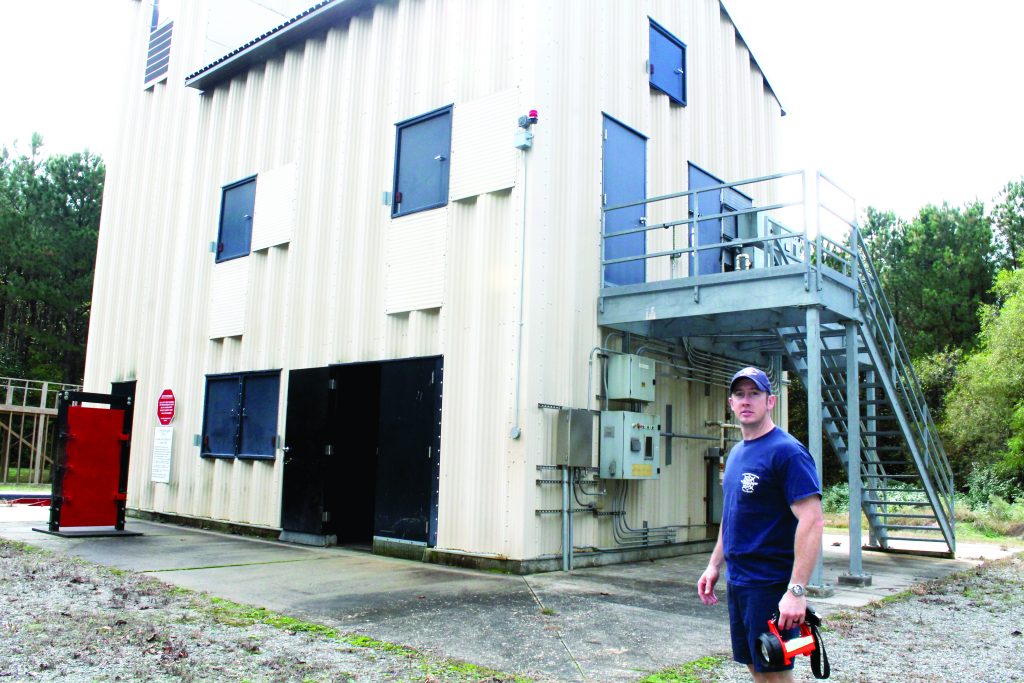
The department’s training is enhanced by a fire training facility, a Class B burn building, located at Harcum. The Middle Peninsula Regional Fire Training Center is a two-story structure, with additional attic space, that gives firefighters-in-training the opportunity to develop skills in such areas as handling a hose line, working a nozzle and practicing streaming the water, and rescuing victims under smoke and fire conditions.

Initially a Class A burn building that only allowed for the burning of materials such as pallets and hay, the building is now equipped with propane for burning so that, rather than a short training session in which the firefighters extinguish the fire and are left with nothing else to do, there is a continuous gas-fed fire. The propane equipment, including exhaust fans and temperature regulators, along with steps for outdoor access, materials to finish the roof, and other materials, were all purchased four or five years ago with a $250,000 grant from the state.

The burn building is made entirely of concrete and metal, but the burn rooms—one downstairs and the other upstairs—are equipped with special tiles lining the walls and ceiling that contain the heat and prevent damage to the surrounding metal and concrete. The downstairs burn room is a simulated kitchen, with a $12,000 prop that looks like a large commercial oven. During training, furnishings are brought in to simulate a real home environment, then propane is piped in to create a fire. Upstairs, the propane prop is a “twin bed” made entirely of metal. Nazak said he’s constantly searching for used/discarded metal furniture that can be used for training.

The propane props have sensors and controls that will automatically turn up the exhaust if the temperature in one of the rooms reaches 650 degrees and will shut down the system altogether at 750 degrees. The building is inspected every two years, alternating between a company the fire department hires and a state inspector.

Learning to force open a door is accomplished with the help of two props the department purchased—steel doors set in frames that allow firefighters to practice using different tools and techniques for forcible entry. But the doors came at a cost—$4,000 for the smaller one and $8,000 for the larger one. A couple of “cutting trees,” at $2,000 each, allow trainees to practice using saws.

“We want to give students as much hands-on as possible,” said Nazak. “My thing is to provide quality training. I want firefighters that know what to look for, how to throw a ground ladder, how to force open a door.”

Background

A native of Vestal, New York, and a third-generation volunteer firefighter, Nazak has been with Gloucester Volunteer Fire and Rescue since 2006, but he has 20 years of experience in the fire service, beginning as a teenager. He joined the U.S. Air Force in 2002, right out of high school, and worked as a firefighter for four years while stationed at Langley Air Force Base in Hampton. While there, he asked around about joining a volunteer fire department and was told about Gloucester.

As life so often goes, Nazak met a young woman, Lindsay Fary, then-Fire Chief Joe Fary’s daughter, and decided that Gloucester was where he wanted to be. The two married and now have two sons, three years old and five months old.
After leaving the Air Force, Nazak got a job as a firefighter/paramedic with Fort Eustis Fire and Emergency Services, and he’s been there ever since. He works 24 hours a day, 13 days a month, and volunteers for Gloucester on his days off.

For information about volunteering with GVFRS, visit gvfrs.org, email training1@gvfrs.org, or call 804-693-2148.