
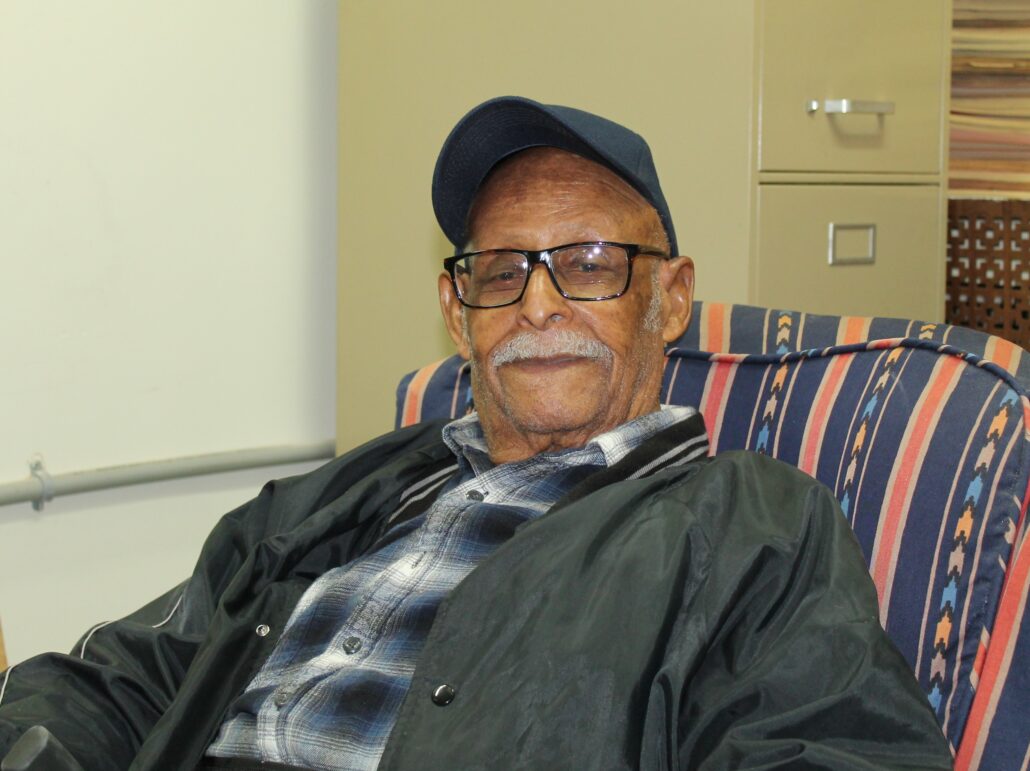
William Cooke, a 100-year-old honoree recognized during the Thomas Hunter Middle School Founders Day program on Friday, was unable to attend the ceremonies, but spoke with the Gazette-Journal before the event.
Cooke was born in Mathews in 1924 to parents William Eddie Cooke, a Mathews native, and Lossie Bannie Cooke, a North Carolina girl. His father was a waterman who caught oysters, fish and crabs for Arthur Gay, a Gwynn’s Island resident. Cooke had his own boat and worked for himself, as well.
The family lived at Blakes, where they raised a garden and had two hogs, a cow and a horse. They were self-sustaining, just as “most everybody was then,” said Cooke.
One of four siblings, Cooke had an older brother, James Edward, and two younger sisters, Ruth Cooke Jarvis and Addie Cooke Cook.
“It was good growing up then,” said Cooke. “You could go most anywhere you wanted, and nobody said anything to you …We could get anything we wanted to eat—just go and pick up oysters in the creek.”
The elementary school the children attended was in front of Tom Brooks’s store in Blakes, said Cooke. When they finished there, the students moved up to Thomas Hunter High School, then a one-story wooden school with just two rooms. There were only nine boys and two girls when he went to school there, said Cooke, because “not many people went to high school them; they dropped out to go to work.”
Cooke graduated from Thomas Hunter in 1943 and two weeks later went off to war. He had been drafted while still in school, but received a deferment to finish. While he was in basic training, Cooke said he injured his back and shoulder jumping over a fence. He was sent to Newport News to be discharged, he said, but instead the Army changed his orders and loaded him on a ship that set sail for Casablanca, Morocco.
Eleven days and nights on the ship was too much for some of the soldiers and they got sick, said Cooke, but his days on the water with his father stood him in good stead and he was fine. While in the water off Casablanca, the English ship Cooke was on got torpedoed, he said, and “a bunch of tugboats came to hold us up out of the water.” He said 300 people died.
From Casablanca, Cooke’s regiment was sent to Italy, where he worked as a heavy equipment operator, repairing bombed-out highways and bridges in support of the forward movement of troops. He said he was never issued any arms, only a Caterpillar or a bulldozer. Fighting was always going on around his unit, he said, because it was always within five or 10 miles of the front line.
“At night, they would drop a flare, and then a bomb, and pieces of metal would be flying through your tent,” he said. “You had an awareness of the enemy all the time. You stayed on guard, listening and looking. You didn’t light up cigarettes in case you were seen.”
From Italy, Cooke’s regiment moved to Germany and then France, always going where the fighting was happening. At one point, Cooke and several of his fellow soldiers stayed in a house, only to find out later that three or four Germans had been hiding in the attic.
Cooke said the war in Europe ended and he was headed to Japan when the news came of the Japanese surrender.
“They turned the ship around and headed to New York,” he said. He was sent to Fort Dix, New Jersey, then to Fort Meade, Maryland, and it was there that he was discharged on Dec. 26, 1945.
“It was a happy day,” he said.
A bus took him and fellow Mathews native Dallas Fields to Richmond, and they paid a cab driver $150 to drive them straight to Mathews. They got home that night.
Cooke’s honorable discharge papers list him as a sergeant with the Headquarters and Service Company, 94th Engineer General Service Regiment. He received the Good Conduct Metal, the European African Middle Eastern Theater Ribbon, the World War II Victory Ribbon and a Lapel Button for No Days Lost. His mustering-out pay was $300.
Once home, Cooke couldn’t get a job working with heavy equipment because of the injury he had sustained in basic training, but he was offered a job as custodian in county schools, and the $120 a month “sounded right good.” He was a fixture at Mathews High School for decades and worked in the school system for 29 and a half years, until the doctor told him he could no longer do the work because of his back. He said he’s been on disability since 1980. Later he was diagnosed with PTSD and received a military disability pension, as well.

