
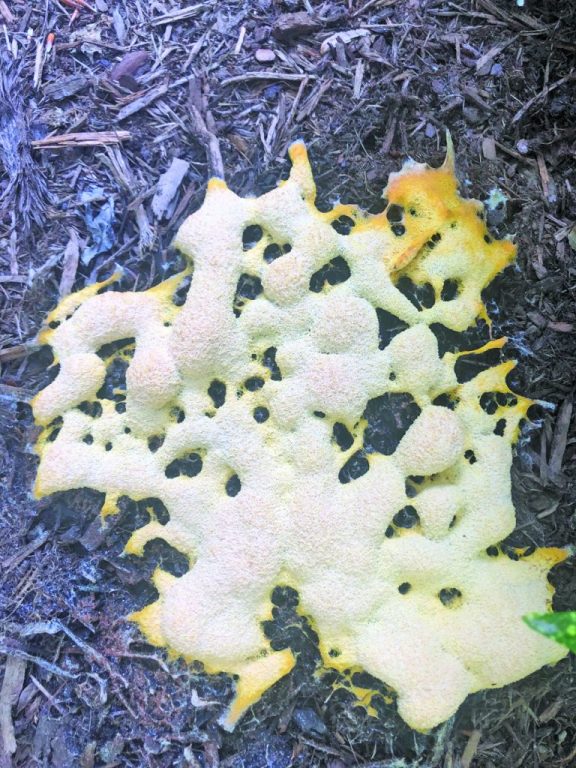
Not everything that grows in the garden is pretty or even desirable. Fellow Master Gardener Ann Gentry texted me last week to say that slime mold has been a problem in her flowerbeds this summer. She sent several pictures of an ugly yellow and white mass adorning the mulch.
Slime mold is an unwelcome late-summer visitor to the garden and playground, often appearing after a rain. Sometimes known by the unpleasant common name “dog vomit fungus,” slime mold isn’t a mold, and it isn’t even a member of the Fungi Kingdom.
Although slime molds once were grouped with fungi, they have been reclassified as members of the Kingdom Protista in the Division Myxomycetes, although older texts still refer to slime molds as fungi. I mention this fact in case you decide to do some further research on slime molds in one of your older gardening books.
Over 1,000 species of slime molds are found worldwide, although only a few affect us locally. The slime mold found most frequently in Middle Peninsula gardens is Physarum polycephalum with its telltale yellow color that dries to a hard brown crust.
Slime molds do not contain chlorophyll, so they can be any color except true green. They spend most of their existence as single-celled organisms that, like amoebas, lack cell walls. Slime molds flow or ooze over the ground, surrounding and consuming fungal spores, bacteria, and decaying material. In this stage, slime molds can grow from ½ to 1 inch in diameter to 1 to 2 feet with a thickness of 3 to 5 inches.
When food becomes scarce, two or more of the same species of slime mold join into one cell, becoming as large as 1 square yard in diameter. And the cell moves. In this phase, a slime mold extends finger-like projections called plasmodia, which propel the organism along at a speed of about 1 millimeter per hour. The slime mold is sensitive to light and certain chemicals and can develop a cell wall for protection, lying dormant for several months until environmental conditions improve.
When mulch and turf dry out, the plasmodia grow together and form spore-producing structures that look like tiny puffballs. The puffballs may be brown, grayish-blue, yellow, or white. The spores are blown by the wind to new locations.
Slime molds are ugly, and gardeners want to eliminate them from their flowerbeds. It is reasonable to think that any organism this unattractive must be harmful, but slime molds do not cause damage to plants, unless they cover grass or leaves to the extent that sunlight is blocked.
Chemical fungicides are available, but it’s not necessary to buy expensive, toxic chemicals to eliminate this harmless organism. As the wet area dries, the slime mold disappears. If a hard crust remains, most sources suggest spraying with a garden hose or sweeping the crust away with a broom. You also can pick up the slime mold with a shovel and bag it for disposal with the trash. A spray with a solution 1 tablespoon of dishwashing liquid in a gallon of water will kill the slime mold.
Slime molds are not toxic to humans or animals, although individuals with asthma or environmental allergies might want to wear a dust mask while removing the dried crusts to prevent inhalation of the spores.
Numerous, interesting mathematic and scientific studies of slime molds have been conducted for years. While we can’t say that slime molds have innate intelligence, they demonstrate efficiency in the way they navigate the environment. Results of studies of the way they develop a network of “highways” can be used to improve transportation networks in large cities. Computer scientists have developed algorithms from slime mold movements to improve action figure behavior in video games.
One last interesting note: Slime mold may have been the inspiration for the 1958 science fiction film “The Blob.”