
Press "Enter" to skip to content

Spiderwort—love it or dig it up?

After nine years of writing the “Gardening Corner,” I inevitably find myself repeating certain topics, sometimes by design, like hydrangea pruning, and others by accident because I have forgotten to add it to my ever-growing list of already used topics.

Today, I had planned to write about native groundcovers that can be used to cover soil bared by English ivy removal, but discovered that I had written on that topic in 2022, so I started looking around my garden and realized I had never written about Tradescantia virginiana (Spiderwort).

I will be the first to admit that spiderwort is not everyone’s favorite garden perennial. Attractive in late spring, the arching, sword-like leaves grow floppy by mid-summer. The flowers last only a day; clumps tend to appear where you don’t want them; and the thick, white, wormy-looking roots are almost impossible to dig up without breaking.

Why would anyone want T. virginiana in the flower garden? Well, the dainty flowers are lovely, and the clumps fill in bare spots in beds and borders. And spiderwort is mostly free. As I said earlier, it tends to show up, an uninvited guest but an attractive and charming one, although Jim is immune to its charms.

T. virginiana is native to eastern North America from southern Ontario and Maine to Alabama. First discovered in Virginia and taken to England in 1629 by the English naturalist John Tradescant the Younger, the perennial was soon established in Europe as a garden ornamental. The plant has since been transported to Asia, Australia, and New Zealand, where it is considered invasive, as it is in several Southern U.S. states.

Tradescantia virginiana is one of about 85 species of spiderworts in the day flower or spiderwort family. In the wild, spiderwort is found in open woods, meadows, hillsides, and stream banks. It grows in full sun to full shade; most articles report that it prefers some shade, although it thrives with full sunlight in our garden. Spiderwort prefers well-drained, acidic to neutral soil with high organic content, but will tolerate clay, wet soil, and black walnut trees.

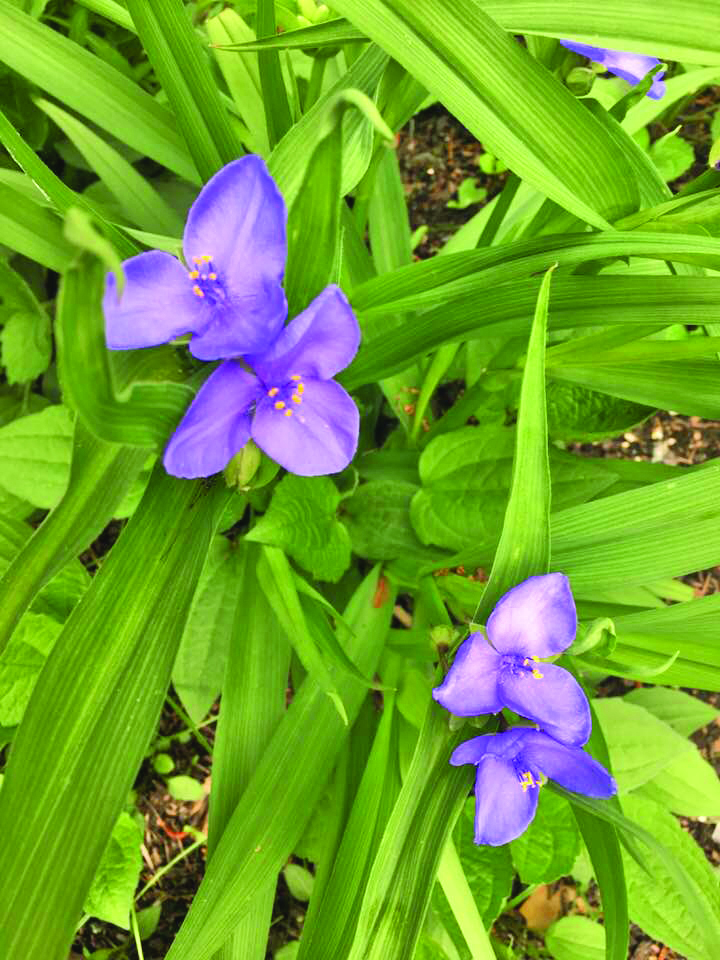
Spiderwort leaves can reach up to 2 feet in height. The dull green leaves taper to a point, arising from a clump of tough roots, and reaching a height of 1 to 3 feet and a spread of 1 to 1½ feet. The delicate, three-petaled flowers bloom from April to mid-summer, wilting after one day. The flowers bloom in a tight cluster above a pair of leaf-like bracts. Flower petals are shades of violet-blue, lavender, white, and occasionally rose pink. Stamens are bright yellow.

In July, the foliage droops and becomes unattractive. If cut back, the plant will rejuvenate and produce some new flowers into the fall when the leaves die. The roots will overwinter, and new leaves will appear in spring. Spiderwort leaves contain minute crystals that can cause skin irritation.
See the Virginia Native Plant Society website and NCSU Extension Master Gardener Plant Toolbox for more information on spiderwort. T. virginiana is the Virginia Native Plant Society Wildflower of the Year for 2023.

Box Turtles on the Road!

Gloucester Extension Master Gardener and Middle Peninsula Master Naturalist Carolyn Evans asked me to remind everyone to be on the lookout at this time of year for Eastern box turtles (Terrapene carolina carolina). A box turtle may travel up to 5 miles in its home range searching for favorite foods or a mate.

Box turtle habitat decreases every year with new construction of buildings and highways. Watch for box turtles when driving, because Carolyn reminds us that a box turtle on the roadway can look like a pine cone. If it is safe to do so, you can stop and move a turtle along, to the side of the road it was heading toward. Please do not keep box turtles as pets. They play a valuable role in our ecosystem and should be left in the wild.