
A recent Facebook post from the Virginia Cooperative Extension Master Gardeners Program page clarified a viral post claiming that wolf spiders hunt and eat black widow and brown recluse spiders. Wolf spiders eat other spiders, but they don’t deliberately select those species for prey.
We don’t always see them, but over 100 species of spiders live in our homes on any given day. Some enter through unsealed cracks in door or window frames; others enter on clothing or shoes or on a pet’s coat. Spiders also live in our garages, sheds, and gardens where their diet consists primarily of insects, making them beneficial helpers to humans rather than the deadly predators of Hollywood films.
As comforting as this information is, what kinds of spiders live in our homes? The good news is that most spiders are harmless, although all species of spiders produce venom to disable or kill their prey. Most will bite only when disturbed or handled. Spider venom has minimal effects on most people, except for young children, the elderly, and the immunocompromised. If you believe you have been bitten by a spider, elevate the body part, apply ice to the site, and seek medical attention. If you have the spider, take it with you to the doctor for identification.
Carolina or giant wolf spiders (Hogna carolinensis) are ground-dwelling spiders that frequently make their way into houses for warmth in winter. Easily recognizable by their size—females range from 7/8 to 13/8 inches across and cause considerable shock when discovered on the wall or behind a curtain. Wolf spiders are fast, agile ambush predators with excellent eyesight. Most of the time, they live in the garden, hunting insects for dinner. They are harmless and docile.
American house spiders (Parasteatoda tepidariorum) build messy, tangled webs in secluded spots in houses or other structures. Their dull, mottled brown color provides them with camouflage. They can reach one inch across in size with their legs extended. American house spiders are not aggressive; they tolerate humans and live for up to a year, if they can escape predatory spiders, assassin bugs, cats, and humans wielding brooms.
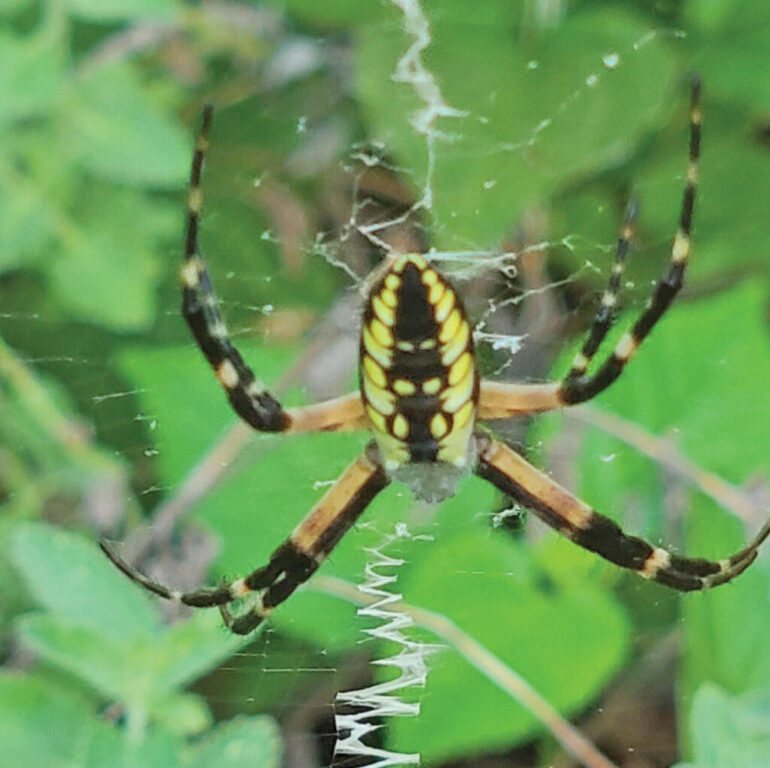
In the garden, the beautiful and elegant female yellow garden spider or “writer spider” (Argiope aurantia) is a welcome visitor in the fall. A. aurantia is an orb weaver; she spins a large, roughly circular web with four or five anchor points and a zigzag line of silk down the center. She is mildly venomous, but will bite only if she is disturbed. At ¾ to 1 inch in size, the yellow garden spider is a perfect model for fall nature photographs.
Two spiders that are native to Virginia are classified as “spiders of medical concern,” the black widow and the brown recluse, or fiddleback, although, as mentioned earlier, any spider bite can cause pain or other symptoms in sensitive individuals.
Two black widow species, the northern (Latrodectus variolus) and the southern (L. mactans) are found in Virginia. Both have shiny black bodies with red markings on the abdomen. L. mactans has a complete hourglass, and L. variolus may have unconnected red bars on both sides of the abdomen. Black widows bite when threatened. Symptoms may include redness, swelling, pain, followed by nausea and abdominal cramps. Black widow bites are rarely fatal.
Brown recluse or fiddleback spiders, so named for the dark-brown violin shape on their heads, are less than ½ inch long and commonly live in secluded areas like basements and garages. The bite may be painless, but systemic symptoms like fever, joint pain, and nausea may develop in 24 to 36 hours. The bite site can become necrotic and take weeks to months to heal.
Virginia Cooperative Extension Publications 3104-1586 (ENTO-212NP) “Wolf Spiders and Nursery Web Spiders”; and ENTO-73NP “Spiders of Medical Concern in Virginia”; provide information on several species of harmless and venomous spiders, as well as information on spider-proofing your home. The N.C. State Extension article “Spiders in and Around Homes” offers similar information.