
The Gloucester County School Board and Board of Supervisors held a joint meeting Tuesday night in the T.C. Walker Education Center auditorium to discuss the school board’s budget of more than $87 million, which the school board adopted at last Thursday’s budget work session.
The school division’s budget includes a local contribution increase of $1.5 million. The county’s current draft budget is set to provide level funding for the schools, which is a $30.4 million contribution.
Dr. Anthony Vladu, superintendent of schools, presented the district’s budget with priorities focusing on competitive compensation, safety, instruction, communication (which ties in with safety), transportation, maintenance and capital improvements.
As part of its adopted budget, the division is set to provide a scale and step salary increase of 3 percent to all division employees at $1.65 million. Health insurance costs are estimated to increase by 21 percent, of which employees will incur some of the cost. However, Vladu said that Gloucester County Public Schools is not requiring its employees to take on as much of the health insurance increases as neighboring divisions are requiring of their employees.
Another piece of the budget is taking care of transportation needs, which includes handling the rising costs of fuel and parts. Facilities is also in need of funding to keep up with preventative maintenance, necessary repairs, and testing and inspections.
Many supervisors expressed their appreciation for Vladu creating a very needs-based and bare-bones budget. Potential additional county contribution to the schools will depend on the state adopting its budget, making many of these conversations premature.
“It’s a very long, frustrating wait and see,” said County Administrator Carol Steele.
Unspent appropriations
At the joint meeting, the boards discussed the possibility of a resolution that would allow the school division to keep any unspent appropriations in a reserved fund balance to use for any non-recurring essential or critical needs.
Supervisors Ashley Chriscoe, Robert “JJ” Orth and Phillip Bazzani expressed opposition to the resolution, citing that the school board can come back to request those funds if needed and is almost never denied those unspent funds if asked.
Supervisors Kevin Smith and Ken Gibson said that the school board should be able to use the unspent funds in whatever way it deems appropriate and this resolution would be good for the two boards’ working relationship.
Orth said he would like to keep the funds available in the county’s general fund in case of emergency. Chriscoe stated the job of the supervisors is to appropriate funds. Bazzani said that the supervisors are accountable to the taxpayer, while Gibson added that the school board is also accountable to the constituents of the county.
No vote was taken on this topic.
Grant applications
The board of supervisors unanimously voted to authorize county staff to submit two grant applications for the Virginia Opioid Abatement Authority’s Regional and Individual Grant Programs. The grants would allow the county to further support the new prevention and treatment specialist position at Gloucester High School.
Tour
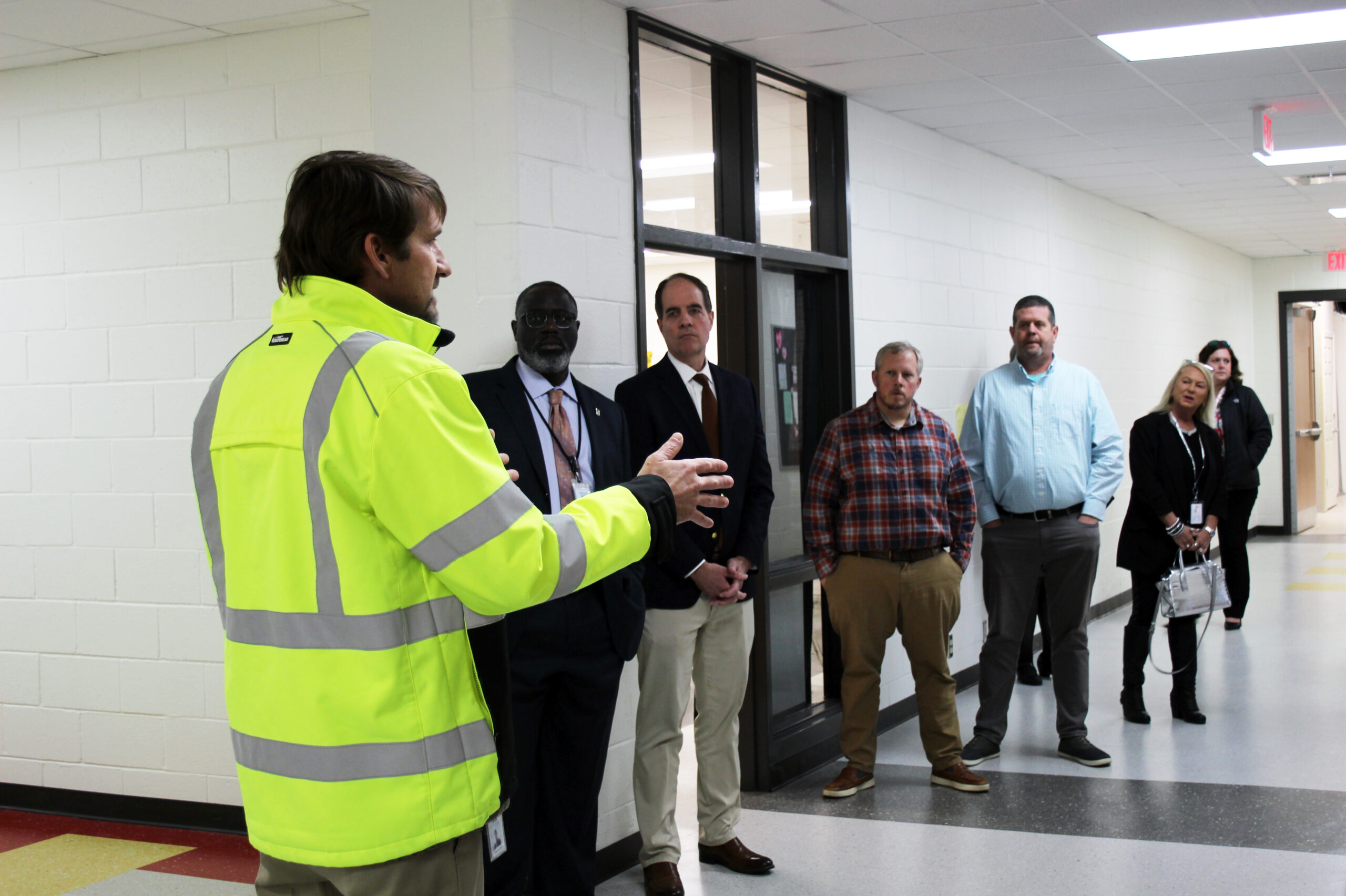
Prior to the joint meeting at T.C. Walker, the two boards convened to take a tour of the ongoing GHS renovation project, led by Charles Records, construction/project coordinator for the division.
Board members viewed the new front entrance, which includes a security vestibule, administration and counseling services; the new ‘A’ hall with wider hallways, spacious classrooms and new inclusive restrooms; and ongoing ‘C’ hall renovations.
Security
During the school board’s work session last Thursday, potential increased security measures at the school buildings were discussed.
The division has approximately $325,000 in a security grant that the board can use as it sees fit. Conversations from last Thursday centered around metal detectors and weapons detection systems.
“Metal detectors are really good at doing what they’re named to do and that’s detecting metal,” said Bryan Hartley, director of operations. “They’re not terribly efficient about getting a massive amount of people in buildings very quickly.
“Weapon detection devices are much more effective at doing that, but they have a different sensitivity and they are designed to find very specific things based on shape and density and things like that,” continued Hartley.
Another difference in these two systems is price. Walk-through metal detectors are about $5,000 apiece. Hartley said the weapons detection systems are that much more expensive, but the technology associated comes with a high price tag, making each device about $100,000. Putting two in each building would cost approximately $1.6 million, based on last year’s prices.
Metal detectors are frequently used at sporting events and school board meetings, but there is currently no system in place for students, staff or visitors entering the school building on a daily basis.
“The loss of one child is too expensive,” said school board member Carlton Drew.
On the metal detector side, school board member Kari Scruggs calculated that the division would need to buy 12 more to have two at each school with a cost of approximately $60,000. Since the division is operating on a budget of 4,800 average daily membership, the costs of the additional metal detectors would come out to $12.50 per student.
“I would pay that very easily for my two children,” said Scruggs. “I think if it’s broken down in those terms, it’s a much attainable number.”
The board can use the $325,000 left in the security grant for security items. The board would need to make a decision on which direction it would like to go with metal detectors and/or weapons detection systems.
“I want to assure our public as we’re talking about enhancements to security, that this is our number one priority,” said Vladu.

