
The omicron variant of COVID-19 is in Virginia in large numbers, and it’s spreading rapidly.
Since it was first identified in the U.S. on Dec. 1, omicron has become the dominant strain of COVID-19 in the U.S., said Dr. Richard Williams, medical director of the Three Rivers Health District. It’s the cause of 73 percent of the new cases arising nationwide, he said, and it’s proving to be as contagious as the measles, which “is more infectious than anything we’ve ever seen.”
Williams said he and his staff are quickly gearing up to handle the impact the virus could have on local residents in the coming weeks.
“It’s moving so fast, it’s ahead of everyone,” he said. “It’s doubling every two to three days … It’s really shocking how fast this thing has exerted its dominance.”
Reports that the omicron variant is not as virulent as other forms of COVID-19 are premature, said Williams, because South Africa, where the variant was first identified in November, is a very different place than the U.S. The population in South Africa is generally much younger than in the U.S., and milder cases are expected in that population. In addition, he said, vaccination rates are low in South Africa, so many people there have already contracted the virus from other variants.
Williams pointed out that infections always precede hospitalizations and deaths by 10 days to two weeks, so it will take at least that long to know how virulent the omicron variant might prove to be in the U.S. population.
“It may be milder than delta,” he said, “but it may be the same … It’s safest to assume it’s very dangerous.”
Even if the disease is milder, Williams said, an increase in hospitalizations can be expected because the reinfection rate with omicron is high, so it can infect people who’ve already had Covid, and the breakthrough rate in fully vaccinated people is high, as well, so even people who have had their booster shots are being infected. He said he’s also concerned about “our highly stressed hospitals,” and said that protecting them is critically important.
“The good news,” he said, “is that vaccinated people should be well protected against serious illness and death. Vaccination is by far our most powerful weapon in the fight against all COVID-19 variants.”
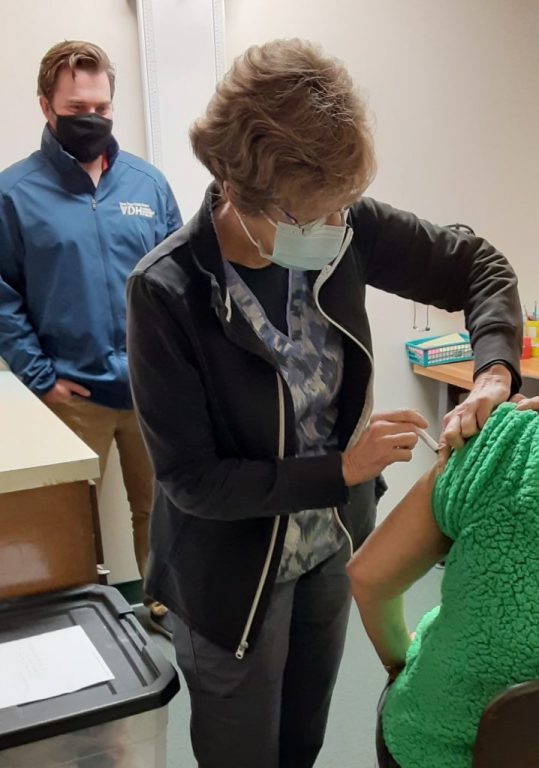
Williams urged everyone to get vaccinated, and urged those who have been vaccinated to get booster shots. He said his greatest worry is people who haven’t been vaccinated and who haven’t had Covid before. With the vaccine rollout, people became more relaxed about protecting themselves, he said, but self-protection is “even more imperative than before” because micron is so much easier to catch.
“Vaccination is the most powerful tool we have against Covid,” said Williams, “and the evidence is irrefutable that it works.”
Areas across the U.S. that have low vaccination rates have much higher rates of cases, hospitalizations, and deaths than those areas where most of the people are vaccinated, he said.
The U.S. isn’t likely to go back to lockdowns the way a number of European nations have, said Williams, but to help curb the spread of the disease, everyone should abide by the CDC guidelines for wearing masks in indoor public spaces, regardless of vaccination status; maintaining social distance from people; and avoiding crowds.
“The best thing is to protect yourself as much as possible,” he said.
In addition, anyone who expects to be around a person who might be vulnerable to the virus should get tested before getting together, he said.
“This is so much easier to catch than any previous variant,” said Williams, “so less exposure is needed to catch it.”
He had one hopeful forecast. He said that, based on the way the virus has been behaving, it looks like it could rise very sharply, then drop sharply, as well.
“That’s what everyone’s hoping it will do,” Williams said, “but it’s a huge unknown. Right now, it’s here, and you don’t want to get it.”

