
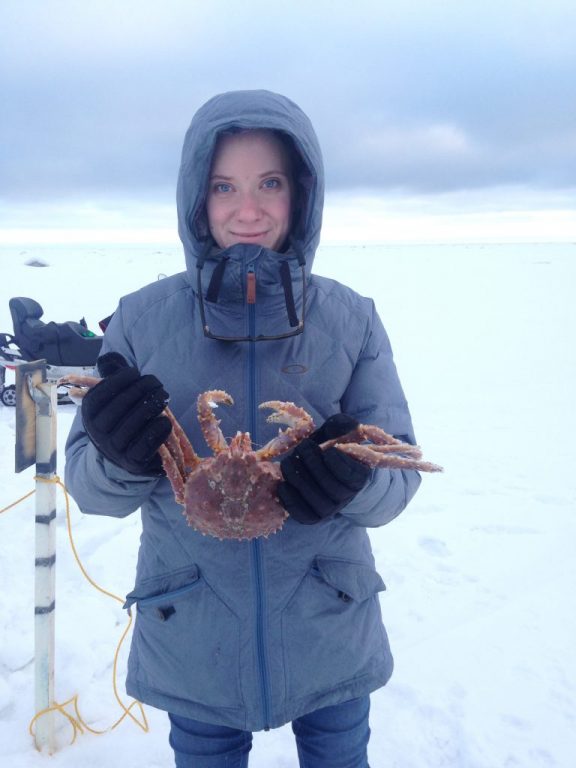
Jennie Diggs has an adventurous streak.
The 24-year-old Mathews native went off to Honduras on a short-term mission trip not long after graduating from high school, and it touched something within her that just felt right.
So when she finished college, Diggs didn’t even think about a job close to home. Instead, she trained to become a United Methodist Church Global Mission Fellow and headed off to Nome, Alaska, to work with children.
Now, two years later, that mission is completed, but Diggs isn’t returning to Mathews. Instead, she has chosen to remain in Nome, beginning over the past few weeks to settle into a job that’s quite different from her previous one.
She’s working at a nonprofit, non-residential independent living facility, Arctic Access, where she’s helping disabled people and the elderly with various aspects of everyday living, such as dealing with Social Security or paying bills.
“There are unique challenges in Nome,” said Diggs. “So many things are computerized, and the people here didn’t grow up with computers.”
Diggs also has a second job through the local hospital, as a direct care attendant helping disabled people with their daily living.
A life in Alaska might seem like a complete turnabout for a person who grew up in the moderate climes of Virginia, but Diggs said the weather and the notoriously short days are things people get used to. During the shortest days of the winter, there are only four hours of sunlight, she said, but “you take your Vitamin D and you know summer’s going to come.”
“There was a time in the winter when I started noticing the dark, and it was like ‘wow,’” said Diggs. “But the sun always comes back.”
In the summer, she said, it never gets really dark in Alaska. Instead, the nights are like dusk, with the sun just below the horizon. She said she has to use black-out curtains in order to sleep, but on the positive side, “it’s fun to be able to do things all day in the summer.”
When she was working as a missionary, Diggs worked at Nome’s youth center under the auspices of the United Methodist Church. Her work was largely with children aged 7-18 who were Alaska natives, the Yupik and Inupiak peoples. She said she couldn’t discuss the specifics of their lives, but that some of them had dealt with difficult, traumatic challenges. Most of them were not affluent. It was a good place for her to be when she was still growing up herself, she said. She was able to relate to the children, and they were able to relate to her. She said when she sees them around town, “We’re always excited to see each other.”
“Children understand a lot more than people give them credit for,” said Diggs. “They’re so resilient. You can be honest with them. If you’ve had a bad day, you can just acknowledge that and go on. Children notice adults who keep showing up, and they have respect for that.”
Working with an older population has been good for her, as well, she said. She was close to her grandmother growing up, doing a lot of things with her.
“She called me her helper,” said Diggs, “and that’s what I do now. It feels natural to me.”
Although she has changed jobs, Diggs still lives in the same apartment the church rented for her when she was a missionary, except that now she pays the rent herself. She said she maintains friendships with a former co-worker and friends she’s made outside of work, and at 4,000 residents, Nome is a small town anyway, so her life hasn’t changed that much.
“I never thought I’d want to live in a place smaller than Mathews,” she said, “but it doesn’t feel smaller.”
Part of that is because the population of Nome is compact, so more people live close together, and part of it is because there’s always a large influx of miners during the summer months.
Diggs leads a fairly quiet life. Although there’s “a big bar scene” in Nome, she’s not a part of that. She spends her time outside work writing and developing her cooking skills, and of course making use of modern technology on the internet.
In the summer, Diggs enjoys outdoor activities, especially going berry-picking in areas where blueberries and salmon berries grow wild. She also enjoys visiting the rustic villages near Nome, which are nothing like she had imagined.
She said that in general the Alaska she knows isn’t much like the reality shows people see on television.
“People think there are, like, 10 moose in my backyard,” she said with wry humor. “I’ve seen three moose in three years. That’s disappointing.”
As to whether she misses her family and friends in Mathews, Diggs said she occasionally gets homesick, but living in the digital age helps, since she can FaceTime with people she cares about. Besides that, she said, “At the age I am, it’s pretty natural to go off and do your own thing.”
Asked if she has any idea whether she’ll remain in Nome or go on to other things, Diggs said she has no desire to leave anytime soon.
“Right now, I feel content, and I’m happy, so I’ll stay,” she said. “Everybody has a place where it feels right, and this just feels like the right place for me to be right now.”
In her online blog, “The Mountains I Can’t Climb,” Diggs expresses her feelings eloquently.
“I will never be able to fully describe what it’s like to travel to an Alaska native village in January and hear stories of polar bears and whales from an elder, and to see the moon over the tundra and know that everywhere in the world people are seeing that same moon,” she said. “All I know is that as I stood there fascinated by the moon, I remembered the children who experienced unspeakable traumas and were still able to experience pure excitement upon seeing a rainbow. How wonderful it is to realize that even when we have experienced hurt that seems insurmountable, we have been given the capacity to fight through it and experience wonder again…”
Diggs’s blog about her experiences in Nome can be read at http://jdigg033.blogspot.com/.

