
Press "Enter" to skip to content

Mathews BZA rules in favor of Hole in the Wall restaurant

By a 4-1 margin last week, the Mathews Board of Zoning Appeals decided a case in favor of the Hole in the Wall Waterfront Grill. The restaurant had appealed an administrative decision alleging the Gwynn’s Island restaurant had violated the county zoning ordinance regarding an addition on the east side of the existing building and expansion of a previously permitted deck.

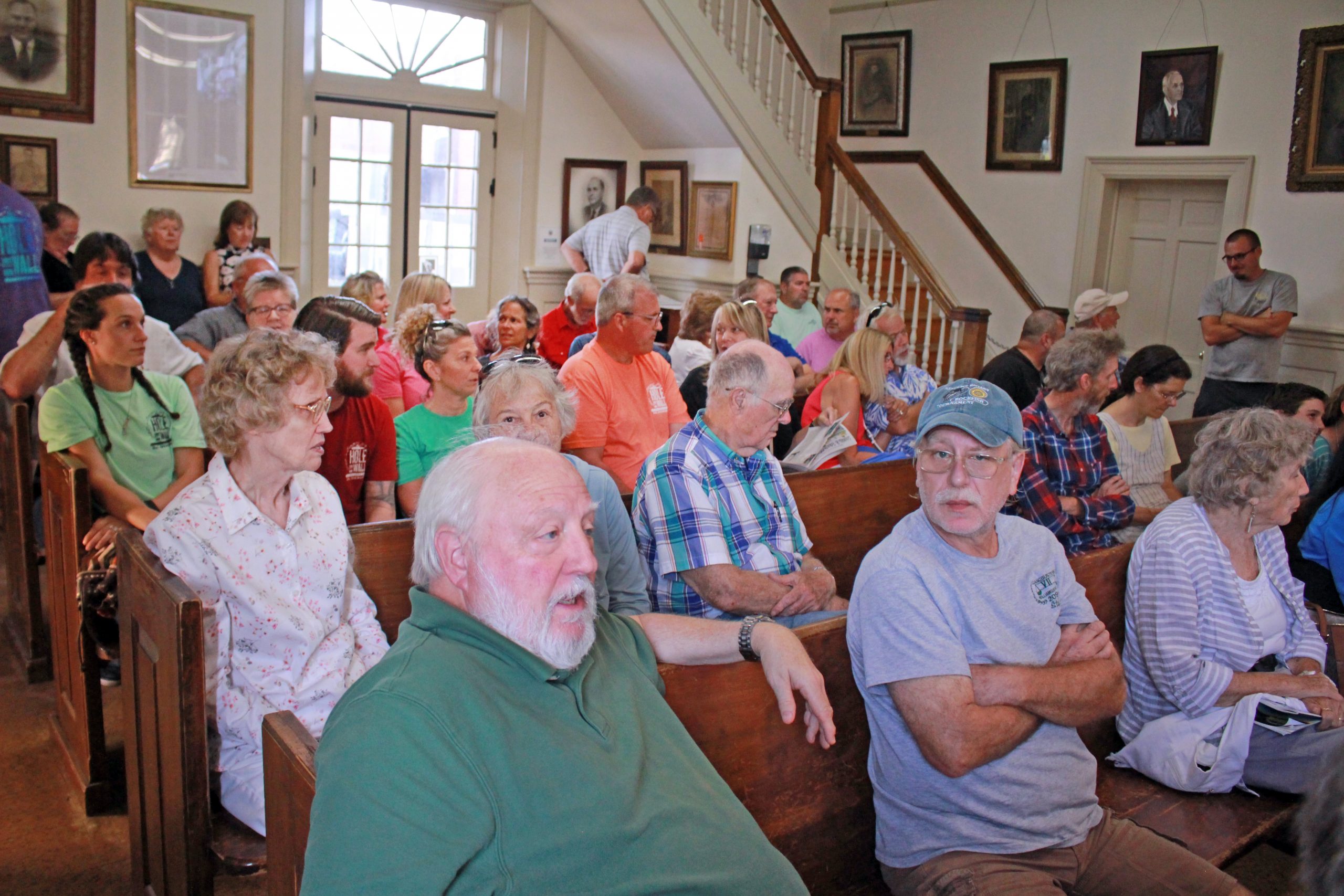
Meeting on Wednesday, July 12 in the colonial courthouse, the decision in favor of Hole in the Wall came after roughly three hours of testimony from Director of Planning and Zoning James Knighton, attorneys representing the county and appellant Mac Casale, as well as the appellant himself, a public comment period and deliberation of BZA members.

Soon after the start, board members went into closed meeting lasting about a half hour to review with Ann Neil Cosby, land use and zoning attorney with Wire Gill in Richmond, “statutory duties when hearing an appeal,” vice chairman Pete Clendenin said in making the motion.

Attorney Cortland Putbrese, partner in the firm of Dunlap, Bennett & Ludwig PLCC, had been retained by the county specifically with respect to this case. Thomas K. Norment Jr. of Williamsburg, of the firm Kaufman & Canoles, P.C., spoke on behalf of Casale.

At issue were two expansions/alterations for which, Knighton said, required zoning permits were not obtained—a 4’ x 15’ addition that Knighton alleged would be considered a “habitable” space which violates the side and rear yard setback, and construction of a 20’ x 44’ deck when the permit limited this deck to 18’ x 41’.

Chairman Susan Thomas made it clear at the start that the matter before the BZA that night was limited to the alleged zoning violations; issues related to the lease between Casale and the county (which owns the property) or the restaurant’s septic system (which has been a point of contention involving a costly pump-and-haul operation) would not be heard.

Knighton detailed the steps he took in notifying Casale of the zoning violations and pointing out that, according to state code, his determination “shall be presumed to be correct” and the burden of proof is placed on the appellant to demonstrate that it isn’t.

“We complied with everything the county asked us to do all along in the process,” said Casale. “We went through all the inspections and received a C.O. [Certificate of Occupancy] in 2018. If the county had not approved this extension of the deck, then I suspect they would have addressed their concerns during one of the many inspections … and they never did.” He claimed the county had asked Casale to increase the size of the deck to make it more favorable to handicapped people entering the building. “I had no reason to question their motive, (so) we just complied,” he said.

As for the small addition, a storage unit between one of the utility platform areas, Casale said that he had requested approval of a storage shed because the restaurant building is small and the shed was needed as storage space for dry goods. “It is not a ‘habitable space,’ we do not allow customers to use it, there is no seating.”

Norment introduced a pair of signed affidavits from former building official Jamie Wilks and former county administrator Mindy Conner. Both asserted that, to the best of their knowledge, the restaurant property was in compliance with all relevant ordinances during their time with the county.

Norment said that Knighton had based much of his argument on how these matters would be handled today, not during the time it was happening when Knighton was not yet employed by the county. “That’s what is relevant,” Norment said, referring to the way it was handled historically.

“I certainly have respect for Mr. Knighton,” BZA member Tom Robinson said, “and I will go along with his assumptions that the preponderance of evidence is on the side of the county in this day of 2023. But going back to when all of these egregious things occurred or things were not done according to Hoyle or today’s standards … They were done under people that were no longer here.”

Approving alterations to plans without a verifiable paper trail would have been “very sloppy bookkeeping,” Robinson said. “However, there are instances where that occurred.”

“I hate to penalize the applicant when records have been missing and we have affidavits from the official building person at that time that things were taken care of,” Robinson said. “It’s hard for me to dispute it.”

BZA member Tim Doss made the motion to rule in favor of the appellant on both violations based on the certificate of occupancy the county issued in 2018, with Robinson providing the second.

“Whoever did the inspections worked for this county,” Doss said. “Whatever decisions they made, they represented this county. And this county is on the hook for that unfortunately.”

“I think Mr. Knighton did a pretty good job about showing some of the discrepancies about (the affidavits),” Doss said. “But I look at the mess. This is a complete mess and nobody suffers other than the citizens of this county. That’s it, period.”

Doss, Robinson, Thomas and Clendenin all voted in favor of Hole in the Wall. Thomas cast her vote, she said, “with the hopes that the county and the appellant can work something out and there are things that have not been fully implemented on the permits such as the mitigation and a few other things and I think that you need to have a discussion on this.”

Norment replied to Thomas, pledging that Casale will “remediate, mitigate” those issues. Cosby indicated earlier in the meeting that, if the board had found in favor of the appellant, the alleged zoning violations would be considered “legally non-conforming.”

BZA member Sonny Fauver cast the only vote against the restaurant. “The question before this board is: Was Mr. Knighton correct in his ruling,” he asked. “That hadn’t happened. We haven’t received that information,” Fauver continued. “In fact, a lot of the documentation that we have received contradicts what they would say the truth is.”

Following a brief intermission after that case, the BZA returned and approved a request from applicant Mark Hill of Susan to reduce the Resource Protection Area buffer on his property from 100 feet to 81 feet to allow for the installation of a pervious paver patio.

The board also heard from Clendenin, who gave a report on the BZA’s nominating committee. The recommendation of naming Fauver chairman, along with Clendenin remaining as vice chair and Doss remaining as secretary, was unanimously approved.